The unemployment rate in Arkansas fell three-tenths of one percent in April to 6.6%, the lowest unemployment rate since December 2008. The relatively sharp decline corresponds to a 0.4% drop in the national unemployment rate in April. For both the state and the nation, however, the news of a sharp declines in unemployment rates is not unambiguously positive: the declines took place in the context of sharp drops in the size of the labor force. For Arkansas, specifically, the number of unemployed declined by over 5,000 but there was no corresponding increase in household employment. In fact, the number of employed declined by 3,200. Although the report represents only one month of data, the concern is that the drop in unemployment was caused by discouraged workers leaving the labor force (or the state).
Over a slightly longer term perspective, April represents a set-back relative to the positive trends that have prevailed for the past several months. Since August 2013, the number of employed is still up by more than 12,800 and the number of unemployed is down by 15, 280. But these changes imply that the labor force has declined, on net, by over 2,400.
Source: Bureau of Labor Statistics, Local Area Unemployment Statistics (LAUS)
Payroll Employment Data from the payroll survey concurred with the household survey’s lack of employment growth: Nonfarm payroll employment declined slightly in April (-500, seasonally adjusted). Declines were spread across several service-providing sectors, including a drop of 1,300 in Leisure & Hospitality services. On the other hand, goods-producing sectors added jobs in April. Manufacturing and Construction showed gains for the month, and employment in both sectors remain higher than levels of a year ago.
Source: Bureau of Labor Statistics, Current Employment Statistics (CES)
The unemployment rate in Arkansas dropped 2-tenths of 1 percent in March, falling to 6.9%. Today’s reports from the Bureau of Labor Statistics and the Department of Workforce Services represented the seventh consecutive month in which the number of the state’s unemployed declined and the number employed increased. Since August of last year, the number of unemployed has fallen by over 10,000 and the number of employed has increased by 16,000. With the unemployment rate below 7% for the first time since January 2009, the unemployment rate is now only 2-tenths of a percent higher than the nationwide average.
Source: Bureau of Labor Statistics
Payroll Employment February payroll employment totals were revised downward by 2,200, but the March figures were up 1,200 from the revised level. Since August 2013, payroll employment has increased by 17,000. As shown in the table below, employment increased in every non-government service sector in March. In the not-seasonally adjusted data reported by the Department of Workforce services, construction and manufacturing were also up for the month, but those gains were attributable to typical spring rebound effects.
Source: Bureau of Labor Statistics
Compared to a year ago, payroll employment is up 12,900, with increases in nearly every sector. Total employment remains 17,800 below pre-recession levels.
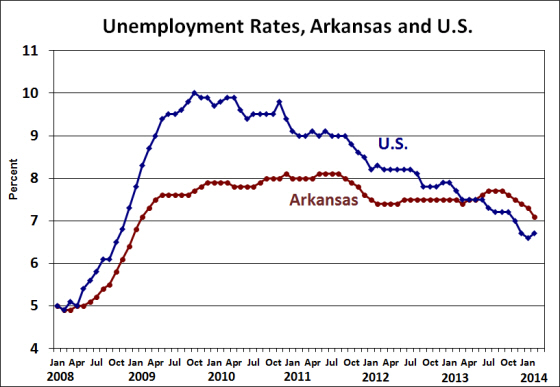
The February labor market reports from the Bureau of Labor Statistics revealed another month of positive employment growth for the state. The headline statistic was a decline in the unemployment rate from 7.3% to 7.1%. The national unemployment rate ticked upward by 0.1% in February, so the drop in Arkansas’ rate brought the gap between the state and national unemployment rates down to 0.4%. The Arkansas unemployment rate has now fallen 0.6% in the past 6 months, and it is 0.4% lower than a year ago.
Source: Bureau of Labor Statistics
The underlying data from the household survey showed a continuation–and acceleration–of recent positive trends. The number of unemployed declined by nearly 2,900, bringing the cumulative 6-month decline to more than 7,900. The number of employed rose by more than 5,300, raising the 6-month increase to over 13,700.
Source: Bureau of Labor Statistics, Local Area Unemployment Statistics (LAUS)
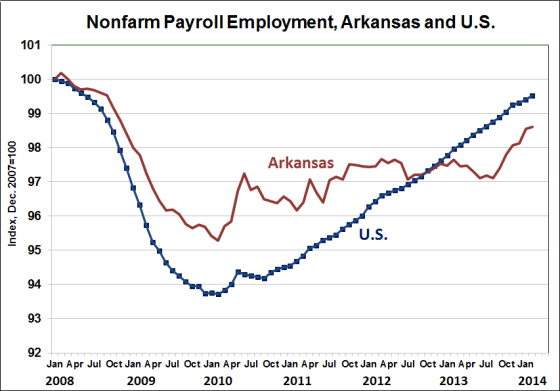
Payroll Survey The report on nonfarm payroll employment was similarly upbeat. The number of jobs increased by 800 in February (seasonally adjusted), following an upward revision to the data from January. After two years of stagnant job reports, payroll employment has increased by 18,000 over the past 6 months.
Source: Bureau of Labor Statistics
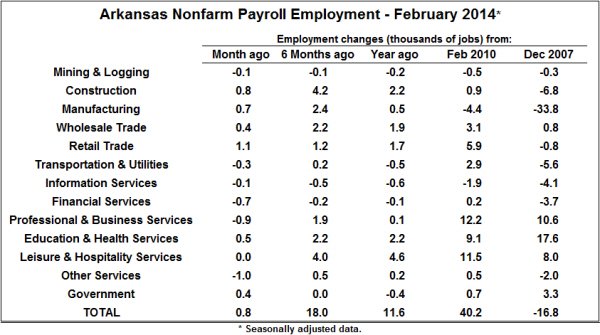
The table below breaks down the recent employment gains by sector. The data show another strong month for goods-producing sectors, with Construction up by 800 and Manufacturing up by 700. In the past 6 months we’ve seen a total increase of 6,600 in these two sectors alone. Employment changes in service-providing sectors were mixed in February, with increases in Retail Trade and Education & Health Services offset by losses on Professional & Business Services, Financial Services, and Other Services. Since the employment trough of February 2010 Arkansas has seen a cumulative increase of 40,200 jobs, but we remain 16,800 jobs below the employment levels that prevailed before the recession of 2008-09.
The first employment report of the new year came out this morning, and the latest data suggest some positive developments. The headline from this morning’s release from the Department of Workforce Services was that the unemployment rate declined from 7.4% to 7.3%.
As we have noted recently, the annual exercise of data revisions has revealed notable weakness in Arkansas labor markets during 2012 and 2013. The unemployment rate has been persistently hovering around 7.5% as the national rate declined, and revisions to payroll employment were expected to show that fewer jobs were created last year than initial reports had suggested. Nevertheless, the newly-revised data also indicate that trends in both household employment and payroll employment have been improving in recent months.
Household Employment The unemployment statistics are based on a survey of households, with statistical models used to estimate changes in total employment and unemployment. As we recently reported, the revised data indicate that employment was lower and unemployment higher than initially reported during much of 2012 and 2013. But the new data also show an improving trend since August 2013. As shown in the figures below, January was the fifth consecutive month in which employment increased and unemployment declined. As a result of these improving trends, the unemployment rate dropped from 7.7% in July and August of last year to 7.3% in January 2014.
Source: Bureau of Labor Statistics
While Arkansas’ unemployment rate remained stubbornly high at around 7.5% during 2012 and 2013, the national unemployment rate has been falling. As a result, the national rate fell below Arkansas’ rate last summer. We expect the downward trend to continue, for both Arkansas and the U.S., but with Arkansas now lagging somewhat behind.
Source: Bureau of Labor Statistics
Payroll Employment The payroll employment statistics that came out this morning reflected new benchmark revisions for the period April 2012 through December 2013. As expected, the level of employment in mid-2013 was revised sharply downward — by approximately 11,000 jobs as of October 2013. Nevertheless, the routine monthly revision of the December statistics and a relatively strong gain in January employment (+4,500, seasonally adjusted) combined to suggest a significant improvement in recent employment trends. Consistent with the household data, the newly-revised payroll data show five consecutive months of employment gains, with a cumulative increase of 16,800 jobs since August 2013.
Sources: Bureau of Labor Statistics, Institute for Economic Advancement
The table below shows the breakdown of payroll employment by sector. The pattern of employment gains in January was somewhat atypical of the post-recession pattern: Some of the service-providing sectors which have been showing the largest gains since the end of the recession suffered declines in January, while goods-producing sectors showed some unexpected gains. Particularly noteworthy was the increase in construction employment — up 2,300 on a seasonally adjusted basis. Overall, nonfarm payroll employment was 12,400 higher in January 2014 than in January 2013. That represents a cumulative increase of 39,000 jobs since the post-recession trough of February 2010. Compared to pre-recession employment levels, however, we are still down by 18,000 jobs.
Source: Bureau of Labor Statistics
The revisions to both the household and payroll data show that labor market conditions in Arkansas were worse than we thought during much of 2012 and 2013, but both surveys indicate significantly improving conditions over the past five months. In the long, slow process of recovery from the recession of 2008-09, we are still lagging behind pre-recession labor market conditions — but recent data indicate emerging favorable trends.
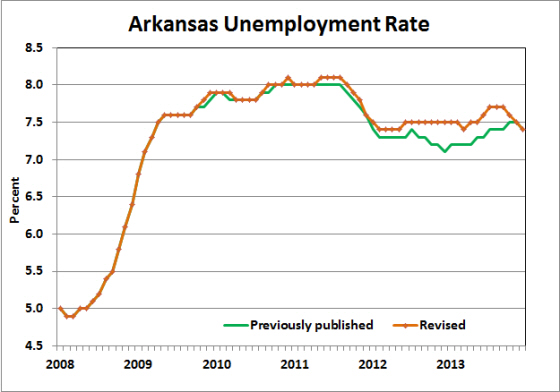
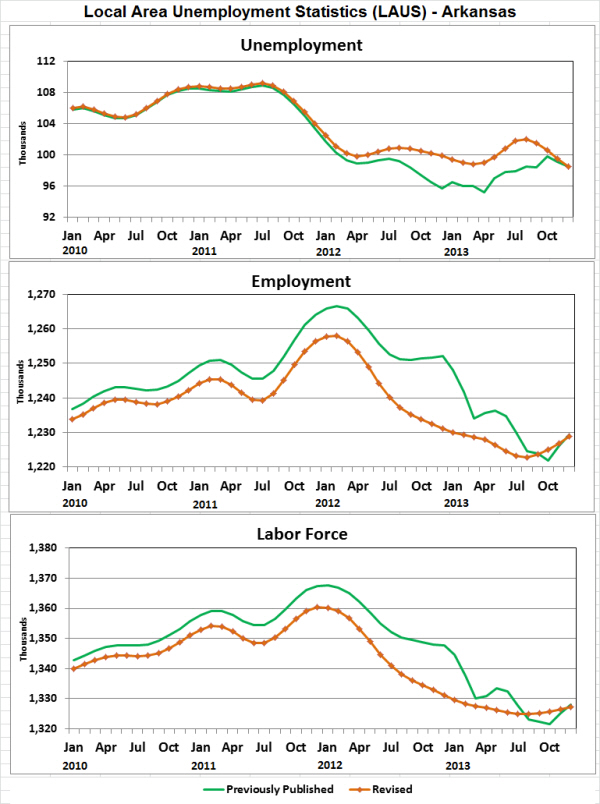
The Bureau of Labor Statistics has completed its annual review of state unemployment statistics, with revisions that incorporate new population data and model re-estimation. For Arkansas, the revised data show that the unemployment rate remained persistently high during 2012 and 2013. Previously-published data had suggested that the unemployment rate declined to as low as 7.1% at the end of 2012. The updated data indicate that Arkansas unemployment rate remained stuck at 7.5% through 2012 and into 2013. The new data also show the unemployment rate rising to 7.7% during the summer months of 2013, before declining to 7.4% in December 2013.
Source: Bureau of Labor Statistics
The figures below show the revisions to the underlying components of the unemployment rate. In late 2012 and early 2013, reports had suggested that the number of Arkansans unemployed dropped below 96,000. The revised data indicate that the true number hovered closer to 100,000, before rising to 102,000 in August. Meanwhile, the number of employed had been persistently overestimated: The downward revision to household employment averaged more than 9,000 during 2012 and 2013, reaching a peak of nearly 21,000 in December 2012. The net effect of these revisions was that the size of the Arkansas labor force had been also been persistently overestimated.
Source: Bureau of Labor Statistics
The downward revision to the level of household employment had the effect of reducing the magnitude of the measured change in 2013. Nevertheless, the BLS news release notes that Arkansas had the dubious distinction of having the second-largest decline in the employment-population ratio among the 50 states plus D.C. (-1.0 percentage point).
Household vs. Payroll Employment The revisions to the household employment data help to explain the puzzling divergence of the BLS’s two independent measures of state employment. Before the revisions, household employment was showing a contraction of over 36,000 jobs from January 2012 through December 2013. The revised data suggest that employment never rose as high as previously estimated, so the decline during 2012 and 2013 amounted to only 29,000 employed workers. This drop-off is still inconsistent with the data from the payroll survey, which shows an employment increase of 16,500 over the two-year period.
We are only days away from the release of revised estimates for payroll employment (March 17). The new payroll figures are likely to further narrow the gap between household and payroll employment (unfortunately). Our latest — and final — projection for the downward revision is for a downward shift of 11,400 payroll jobs as of December 2013.* If accurate, this would indicate that payroll employment expanded by only 5,000 jobs from January 2012 to December 2013. This still leaves a puzzling gap between the employment estimates from the household and payroll surveys, but the unexplained discrepancy is narrowing as more accurate estimates emerge.
Source: Bureau of Labor Statistics, Expected Revision Forecast by Institute for Economic Advancement
The latest revisions to the household employment data and the expected revision to the payroll employment data might not fully reconcile the discrepancies between the two series, but they do share a common theme: As weak as the Arkansas employment situation has appeared in recent months, emerging data suggest that it is even worse than we thought.
The unemployment rate in Arkansas fell by 0.1% in December to 7.4%. Although the decline was smaller than the 0.3% decline in the national unemployment rate in December, it represented movement in the right direction. Over the past two years, the national unemployment rate has fallen by about 1.5 percentage points, while the Arkansas rate has been stuck in the range of 7% to 7.5%. During the recession of 2008-09 and for much of the subsequent recovery, Arkansas’ unemployment rate was significantly lower than the U.S. average. However, recent data show that the rest of the nation has overtaken Arkansas in terms of progress toward lower unemployment.
Source: Bureau of Labor Statistics
Today’s report showed that the number of employed Arkansans increased by approximately 3,200 in December, and that the number of unemployed declined by 600. This represents the second consecutive month that the household survey has shown higher employment and lower unemployment. As shown in the set of charts below, these changes represent a welcome change from trends in recent months.
Source: Bureau of Labor Statistics
Payroll Survey The payroll survey showed a net decline of approximately 900 jobs in Dececember. Construction employment was down for the month, although it remained 1,400 higher than in December 2012. Manufacturing employment showed no net change for the month. More surprising was the weakness in service-providing sectors: Some of the sectors that have been strong performers in recent months showed net employment declines in December, including Professional and Business Services (-1,100), Education and Health Services (-100) and Leisure and Hospitality Services (-300). On the other hand, increases were reported for both the Wholesale and Retail Trade sectors.
Source: Bureau of Labor Statistics
Overall, the payroll data show a net employent increase of 12,600 jobs since December 2012. But over the same period, the household survey has shown a net decline in employment of over 22,000. This was the final report for 2013, but the data are subject to subsequent revision. In late February the BLS will release updated estimates of household employment and unemployment, then in mid-March, the annual “benchmark revisions” for nonfarm payroll employment will be released. As noted in previous posts, the payroll data are likely to be revised downward, but it appears unlikely that the downward revision to payroll employment estimates will be enough to bring the two surveys back into alignment. At this point, it remains an open question as to which survey is providing more accurate readings on the state of Arkansas labor markets. Given current data, however, neither survey is suggesting a particularly strong performance.
Source: Bureau of Labor Statistics, Institute for Economic Advancement
Data on metro area unemployment rates that came out earlier this week indicated that Arkansas metro areas are generally not following the improving trend seen in the nationwide data. The news release from the Bureau of Labor Statistics noted that November unemployment rates were lower than a year earlier in 293 of the nation’s 372 metropolitan areas. In Arkansas, only Fort Smith was included in this count. As shown in the table below, year-over-year unemployment rate increases ranged from +0.1% in Fayetteville and Jonesboro to +1.1% in Pine Bluff. The rate was down 0.4% in Fort Smith.
Source: Bureau of Labor Statistics, Local Area Unemployment Statistics (LAUS)
Smoothed seasonally adjusted estimates for unemployment showed monthly increases in Hot Springs, Little Rock, Memphis, and Texarkana. The unemployment rate in Fort Smith was down 0.1% from the previous month. For the remaining metro areas (and the statewide average), unemployment was unchanged from October to November.
Source: Bureau of Labor Statistics, Smoothed Seasonally Adjusted Metropolitan Area Estimates
Payroll employment data for Arkansas metro areas were mixed. Although statewide employment increased by 3,000 (+0.3%) in November, three of the state’s metro areas showed monthly declines (Fort Smith, Jonesboro, and Texarkana) and employment in Pine Bluff was unchanged. The four remaining metro areas saw increases ranging from 0.2% in Little Rock to 0.8% in Hot Springs. Compared to a year ago, payroll employment is down Hot Springs, Pine Bluff and Texarkana, but has increased in the remaining metro areas.
Source: Bureau of Labor Statistics, Current Employment Statistics (CES)
Since the employment trough of February 2010, most of the state’s metro areas have shown net employment increases. However, employment in Texarkana seen a recent decline that erased earlier gains and employment in Pine Bluff has continued a downward trend that began well before the 2008-09 recession. Compared to the pre-recession peak, only three metro areas have shown net increases: Jonesboro, Fayetteville, and Little Rock.
The latest employment report from the U.S. Bureau of Labor Statistics and the Arkansas Department of Workforce Services might appear disappointing on the surface, but there were some positive developments. Despite an unemployment rate that was unchanged at 7.5% in November, the underlying data from the household survey moved in the right direction: the number of employed was up by nearly 4,400 and the number of unemployed was down by almost 700. The net change in the labor force was an increase of approximately 3,700. As shown in the set of figures below, these monthly changes represent a welcome departure from the overall trends we’ve been observing since the beginning of 2012.
Source: Bureau of Labor Statistics, Local Area Unemployment Statistics (LAUS)
To some extent, it was disappointing that we did not see a drop in the unemployment rate. The statistics for October had been distorted by the federal government shutdown. On the national level, the unemployment rate ticked up one-tenth of a percent in October, then dropped by three-tenths of a percent in November. In Arkansas, we saw the October increase but remained stuck at 7.5% in November.
Source: Bureau of Labor Statistics
Payroll Survey: The report on nonfarm payroll employment was also somewhat encouraging this month: employment was up 3,000 in November (seasonally adjusted) and the figures for October were revised upward by 1,500. As shown in the table below, employment increased in several sectors, including Professional & Business services, Leisure & Hospitality, Education & Health, and Construction. Over the past 12 months, the payroll survey is showing a net increase of 13,500 jobs.
Source: Bureau of Labor Statistics, Current Employment Statistics (CES)
Contrasting Trends and Data Revisions: As previously noted, the household and payroll surveys have been showing dramatically different trends over the past two years. Since January 2012, the household survey has shown a net decline of nearly 40,000 employed, while the payroll survey has registered an increase of 18,200. There can often be a discrepancy between two reports over short periods of time, but a divergence of this magnitude and duration is unusual. The monthly data for November showed the two series moving in the same direction, but the cumulative deviation remains substantial.
Some new data from the Quarterly Census of Employment and Wages (QCEW) released this week might help reconcile the conflicting trends — but not by much and not in an encouraging way. The data from the QCEW are used to periodically revise the payroll statistics. This “benchmark revision” takes place once per year, with the revised data released in March. Previously released data from the QCEW had suggested that revisions to the payroll statistics for 2013 would be minimal. However, the latest release showed a downward revision for the first quarter of 2013, along with a stagnant second quarter. As a result, it now appears likely that the 2013 payroll statistics will be revised sharply downward.
The figure below illustrates the diverging trends of the household and payroll statistics, along with a projection of how revised payroll data are likely to affect the comparison. The revision is expected to lower the level of measured payroll employment by over 15,000 (as of June 2013). As a result, the cumulative change in payroll employment from January 2012 through November 2013 is likely to be approximately +2,500 (down from the +18,200 change in the currently-reported data). This would partly close the gap between the household and payroll employment numbers, but a discrepancy of over 42,000 jobs would remain.
Sources: Bureau of Labor Statistics (LAUS, CES, QCEW), with calculations by the Institute for Economic Advancement
This morning’s reports from the U.S. Bureau of Labor Statistics and the Arkansas Department of Workforce Services were mixed, with contradictory signals from the household and payroll reports continuing to confound clear interpretation of the data. Due to the federal government shutdown in October, release of the September data was postp0ned to coincide with the October release, so we have two months of statistics to consider.
Household report: The headline statistic was an uptick in the Arkansas unemployment rate in October– to 7.5%. September’s unemployment rate was unchanged from the previous month at 7.4%. The October increase coincided with a rise in the national unemployment rate from 7.2% to 7.3%, and can be at least partly attributed to the government shutdown. Although the BLS has described some ambiguity in the survey results for October, most government workers who were furloughed over the first part of the month appear to have been correctly classified as being temporarily unemployed.
Recent trends in Arkansas employment, unemployment and labor force participation continued over during September and October. The number of employed declined by more than 2,800 over the two-month period, while the number of unemployed increased by over 1,200. Accordingly, the Arkansas labor force contracted by approximately 1,600 workers. As shown in the set of charts below, these trends are alarming. The household survey data are showing that the number of employed has dropped by over 44,000 since January of 2012, along with a labor force decline of 46,000 over the same period. The number of unemployed — which had been in decline in 2012 and early 2013 — has increased by 4,500 since April.
Source: Bureau of Labor Statistics, Local Area Unemployment Statistics (LAUS)
Payroll Report: In contrast to the household data, the survey of employers showed positive employment growth in both September (+900) and October (+5000). Compared to October 2012, the latest payroll employment figure shows a net increase of 10,000 jobs. This is in sharp contrast to the nearly 30,000 employment decline over the same period in the household survey.
Source: Bureau of Labor Statistics, Current Employment Statistics (CES)
Payroll employment gains were distributed across several service-providing sectors, along with a two-month net increase in manufacturing employment. Growth in transportation and utilities was particularly robust, accounting for 2,600 jobs. Employment in retail trade also experienced a strong gain (+1,600). Overall, payroll employment in October was up more than 40,000 since the employment trough of February 2010, but still approximately 17,000 below pre-recession levels.
Source: Bureau of Labor Statistics, Current Employment Statistics (CES)
The contrast between the trends in the payroll and household surveys is something of a puzzle. Both are based on survey data, and are subject to both sampling and non-sampling error. But additional information from the Quarterly Census of Employment and Wages (QCEW) appears to more consistent with the payroll data than the household data. So although it is possible that the payroll employment figures will eventually be revised downward, it appears unlikely that they will be revised to show anywhere near the job losses that the household data are showing.
Yesterday was the scheduled release date for metro area employment and unemployment data from the Bureau of Labor Statistics, but no report was published due to the Federal government shutdown. Nevertheless, data on payroll employment for metro areas had already been posted on the BLS website, so we do have some new figures to report.
As previously reported, statewide payroll employment declined by 1,200 jobs in August — approximately 0.1%. The table below shows that employment declines were spread across several of the state’s metro areas. Job losses were particularly sharp in Jonesboro (-0.6%), Hot Springs (-0.5%), and Texarkana (-0.5%). Employment in Northwest Arkansas was unchanged from the previous month, and both Little Rock and Pine Bluff saw small employment increases.
Source: Bureau of Labor Statistics, Current Employment Statistics (CES)
Over the past year, employment growth has been positive for most of the state’s metro areas, with the prominent exceptions of Hot Springs and Pine Bluff. Since the national and state employment trough of February 2010, all metro areas except Pine Bluff have seen net increases. Compared to pre-recession employment levels, however, only Fayetteville, Jonesboro, and Little Rock have experienced net positive job growth.