Arkansas’ unemployment rate declined from 4.1% in June to 4.0% in July, remaining 0.1 percentage points lower than the U.S. average (a difference that is not statistically significant). The state and national unemployment rates are tracking closely together.
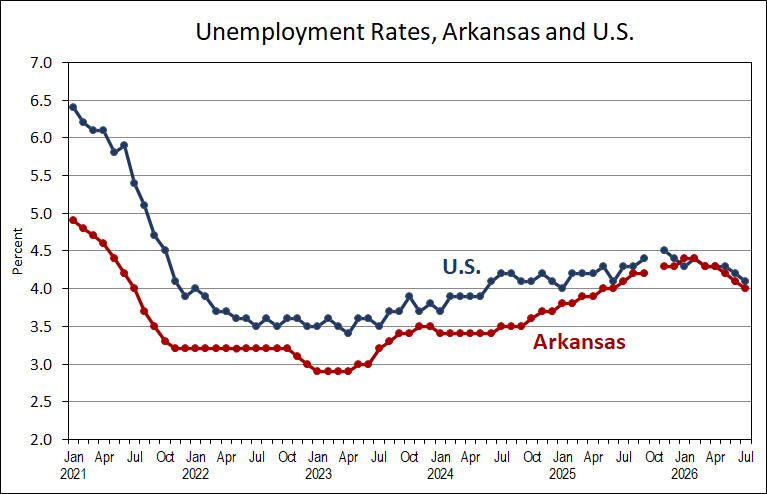
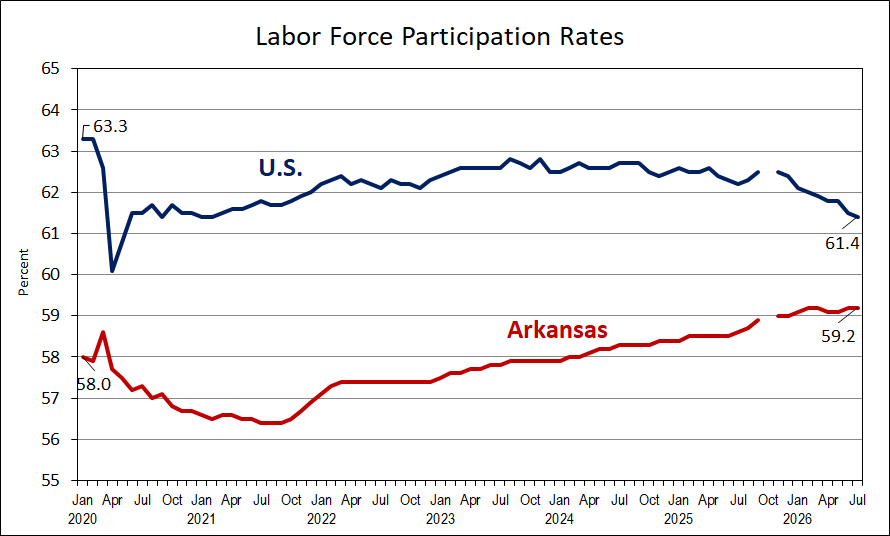
The declining unemployment rate since January has reflected six consecutive months of declines in the number of unemployed workers. That number was down 972 in July, and down a cumulative total of nearly 5,000 (-4,939) since January. Meanwhile, the number of employed workers in the household survey increased by 1,135 in July, up a cumulative total of 11,466 since January. The net increase in the total labor force was +163 in July.
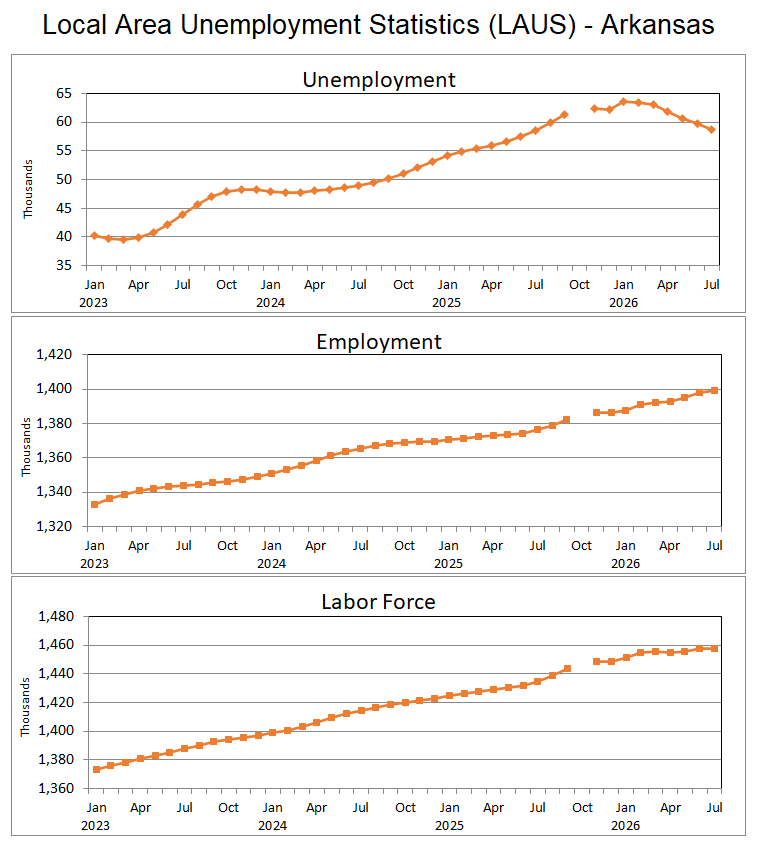
The steady gains in the size of the labor force have outpaced estimated population growth, resulting in a rising labor force participation rate. Over the past twelve months, the Arkansas participation rate has increased by 0.6 percentage points. Over the same period, the U.S. labor force participation rate has declined by by 0.8 percentage points.
Payroll Employment
Nonfarm payroll employment declined by 1,500 jobs in July (seasonally adjusted). The data released by the Arkansas Division of Workforce Services, which is not seasonally adjusted, showed a steeper decline of 16,500 jobs. The major seasonal component accounting for the difference is the typical mid-summer decline in employment at schools and universities.
The seasonally adjusted data show declines in a number of sectors, with the largest monthly declines in Professional & Business Services and Leisure and Hospitality Services. Transportation & Utilities and Construction both showed notable increases for the month.
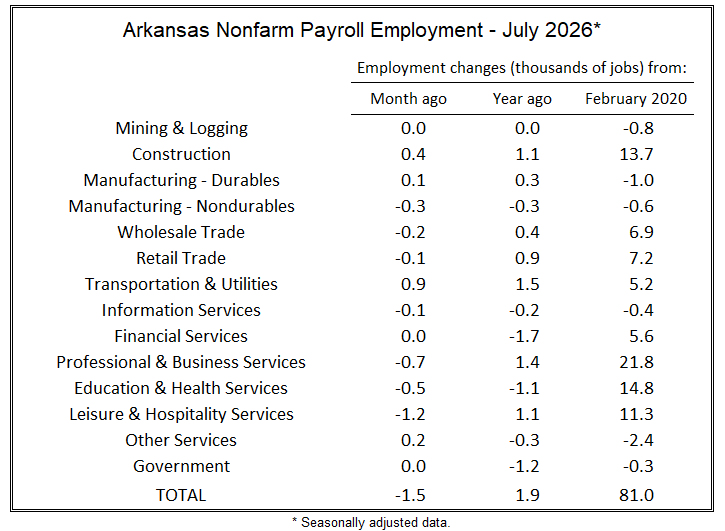
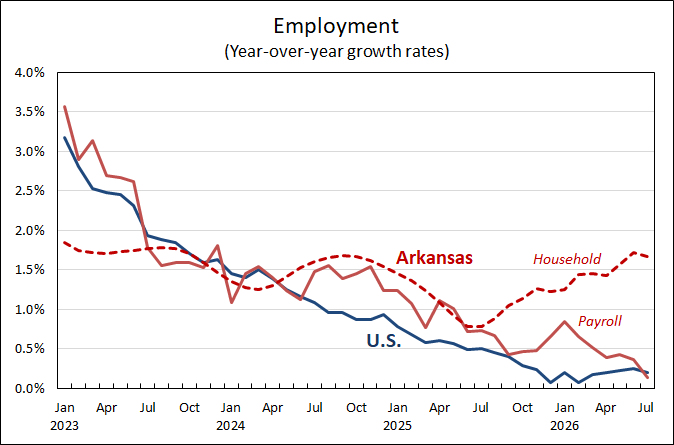
Over the past year, Arkansas nonfarm payrolls have only increased by 1,900 jobs, a percentage increase of a little over 0.1%. The slowdown in payroll employment growth generally tracks along with the national average. Over the past 12 months, U.S. payrolls have expanded by 0.2%.
Measures of household and payroll employment for Arkansas have diverged significantly over the past year, with the household data showing an increase of 1.7%. It’s not unusual for the two measures to diverge somewhat, but persistent differences like those observed over the past year indicate a likelihood that future revisions to the data will reconcile the two. In the meantime, the payroll data is generally considered to be the more accurate indicator.
# # #
Seasonally adjusted data for Arkansas nonfarm payroll employment, reported in a format consistent with the monthly news release from the Arkansas Division of Workforce Services, can be found here: Table-Seasonally Adjusted NFPE.