Skip to content

Metro Area Employment and Unemployment – June 2026

Unemployment rates in Arkansas’ metropolitan areas generally declined in June. Unemployment held steady in Fort Smith and Texarkana, but declined by 0.1 percentage points in all of the other metro areas that cover parts of Arkansas. The declines contribute to a trend of falling unemployment rates since the beginning of the year. From January through June, rates declined by 0.2 to 0.4 percentage points, with the exceptions of Memphis (unchanged) and Texarkana (-0.1).
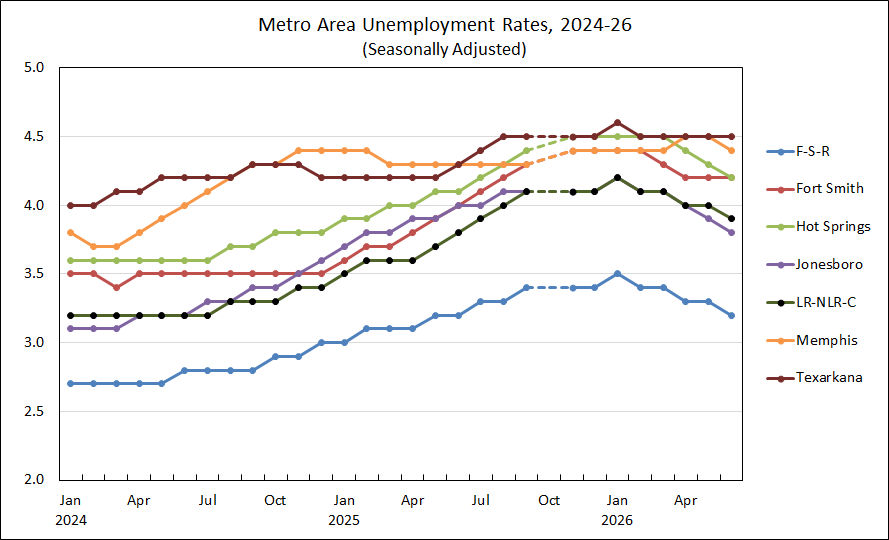
Source: Bureau of Labor Statistics, Smoothed Seasonally Adjusted Metropolitan Area Estimates

The unemployment rates reported for June show that Northwest Arkansas, Central Arkansas, and Jonesboro all have unemployment below the statewide and national averages. The remaining metro areas have rates equal to or slightly above the state and national levels.
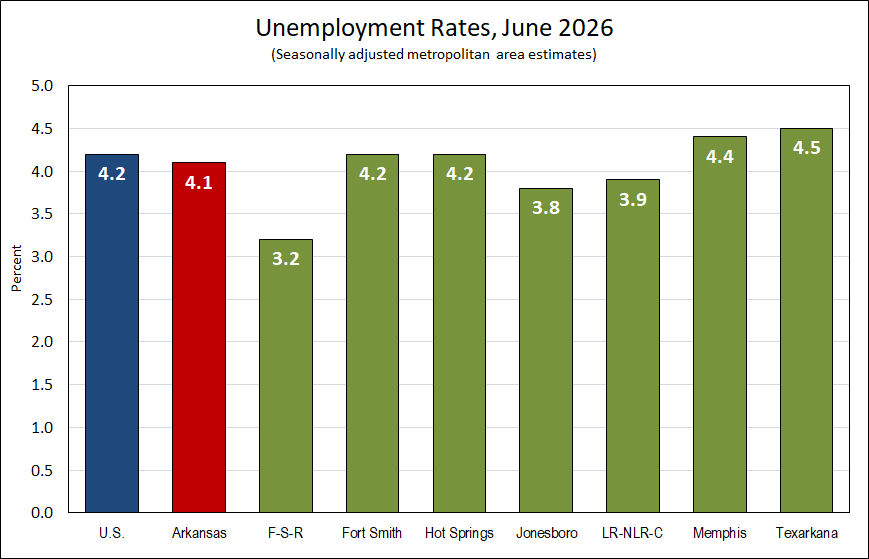
Source: Bureau of Labor Statistics, Smoothed Seasonally Adjusted Metropolitan Area Estimates

Payroll Employment
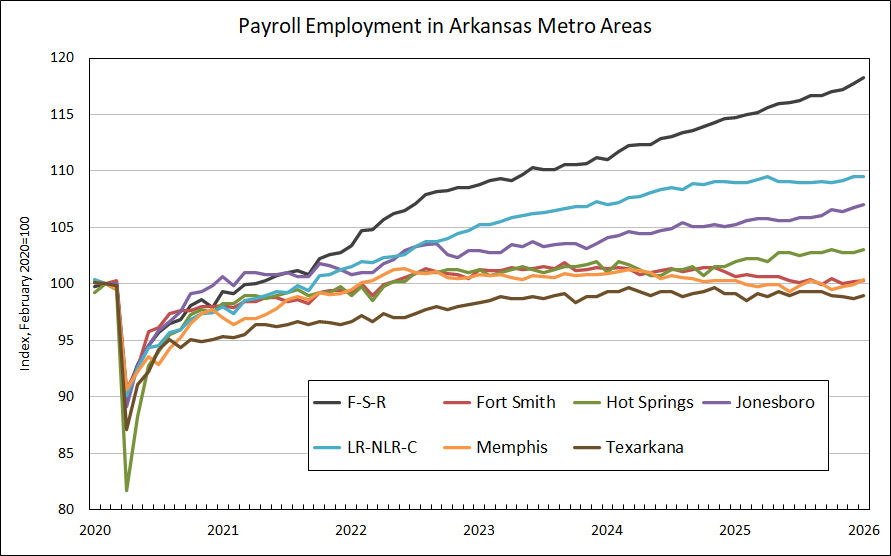
Nonfarm payroll employment declined in all of Arkansas’ metro areas except for Northwest Arkansas in June. The job losses continue a trend of weakening employment growth over the past several months. Three-month changes are negative in six metro areas, and the year-over-year changes are negative in three.
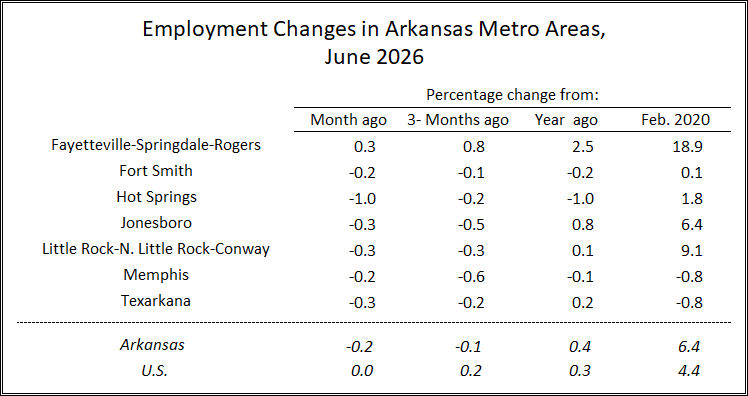
Source: Bureau of Labor Statistics, Current Employment Statistics (CES)

Over the longer-term, employment growth remains concentrated in a limited number of metro areas—particularly Northwest Arkansas, Central Arkansas, and Jonesboro.
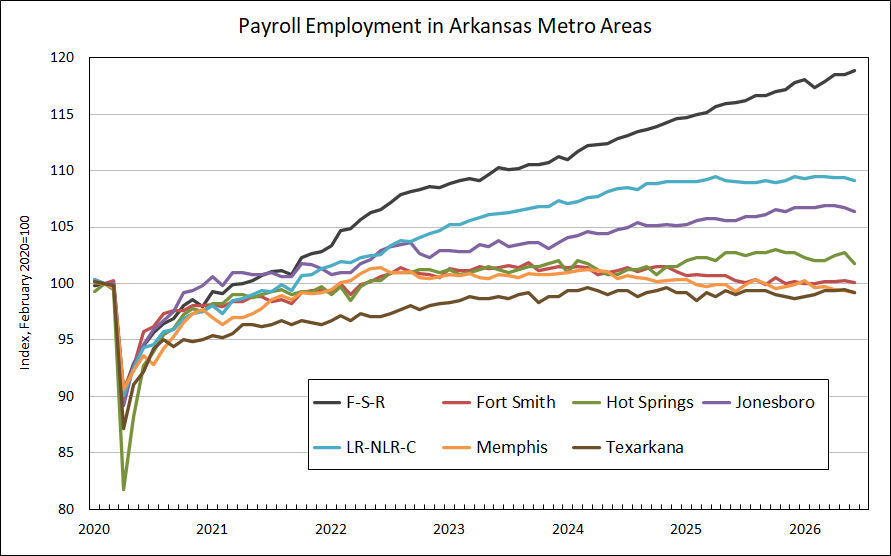
Source: Bureau of Labor Statistics, Current Employment Statistics (CES)

Metro Area Employment and Unemployment – March 2026

Annual revisions of the employment data for metropolitan areas is nearly complete. However, the Smoothed Seasonally Adjusted measures of employment and unemployment have yet to be updated.

Looking at the available data for March 2026, the not-seasonally adjusted unemployment data show a range of unemployment rates across the state’s metro areas. Northwest Arkansas continues to show the lowest unemployment rate in the state, while Hot Springs presently has the highest rate. Compared to March 2025, unemployment rates have risen in all metro areas except Memphis. (For reference, the not-seasonally adjusted unemployment rate for the state of Arkansas in March 2026 was 4.2%, up from 3.8% in March 2025.)

Source: Bureau of Labor Statistics, Local Area Unemployment Statistics (LAUS)

Payroll Employment
From February to March, nonfarm payroll employment increased in Northwest Arkansas, Jonesboro, Memphis, and Texarkana. Employment was down slightly in Little Rock, and unchanged in Fort Smith and Hot Springs. Over the past 12 months, employment has increased by 2.2% in Northwest Arkansas and by 1.1% in Central Arkansas. Other areas have shown smaller increases. Fort Smith is down by 0.7% and Hot Springs is 0.2% lower than in March 2025.

Bureau of Labor Statistics, Current Employment Statistics (CES)

Over the past six years, employment gains in Northwest, Central Arkansas, and Jonesboro have been significant. Hot Springs is up by 2.0% over the 6 year period, while Memphis and Texarkana have experienced job losses over that time span.

Bureau of Labor Statistics, Current Employment Statistics (CES)

Metro Area Payroll Employment – Revisions & New Data for January

As discussed last week with regard to state payroll employment, this year’s annual benchmark revisions were unusually extensive for Arkansas. Typically, the published monthly data reported in Current Economic Statistics (CES) are revised by aligning the series with the more accurate benchmark data from the Quarterly Census of Employment and Wages (QCEW). The QCEW is based on state unemployment insurance records, so it is often referred to as “covered employment.”

This year, there was also a refinement of the methodology for estimating non-covered employment. The impact of that modification was then back-cast all the way to the beginning of the data series, 1990. For observations over the past several years, this revision had the effect of lowering the entire path of the data, but presumably leaves the short-run growth rates and fluctuations intact. In that sense, the shift in series levels had no significant economic effect.

For Arkansas metro areas, the level-shift portion of the revision affected Fayetteville-Springdale-Rogers, Fort Smith, and Little Rock-North Little Rock-Conway. There was no evident longer-term revisions for Hot Springs, Jonesboro, Memphis, or Texarkana (although seasonal factors were re-estimated for all series).

In order to identify the revisions due to the literal re-benching of the series to QCEW data, we can express the pre-revision and post-revision series as indexes, where the two series are aligned as of a certain date. As we have done in past analysis, we will use February 2020 as the reference point. The figures below illustrate the nature of the benchmark revisions that affected recent growth rates and trends.

Source: Bureau of Labor Statistics

The impacts of these revisions on recent growth trends are summarized in the table below. Among the one-year growth rates, all metro areas except for Jonesboro and Hot Springs showed downward revisions. Over the longer span—since February 2020—only Hot Springs and Little Rock were revised higher. For Memphis and Texarkana, the revisions changed positive growth figures into negatives—over both time horizons.

Source: Bureau of Labor Statistics

Latest Data
The newest data released last week covered January 2026. With the revised history now incorporated into the data, the chart and table below summarize the most recent growth rates and trends.

Source: Bureau of Labor Statistics

Metro Area Employment and Unemployment – July 2025

The latest employment report showed mixed results for Arkansas’ metro areas. Unemployment rates were mostly unchanged, ticking up 0.1 percentage points in Little Rock and Memphis. Over the past 12 months, unemployment rates have generally drifted higher, with the exception of Texarkana, where the rate is down by 0.2 percentage points since July 2024.

Source: Bureau of Labor Statistics, Smoothed Seasonally Adjusted Metropolitan Area Estimates

Payroll Employment
Nonfarm payroll employment increased in most metro areas across the state. Memphis payrolls declined slightly and Fort Smith showed zero net gain for the month. However, increases were recorded in Arkansas’ other metros, with particularly notable gains in Hot Springs and Little Rock. Over the past 12 months, employment in Memphis, Hot Springs, and Fort Smith has held fairly steady, while payrolls in Jonesboro, Little Rock and Texarkana have increased by magnitudes greater than one percent. In Northwest Arkansas, the increase in employment since July 2024 has been 2.7%.

Source: Bureau of Labor Statistics, Current Employment Statistics (CES)

Metro Area Employment and Unemployment – June 2025

Labor market indicators for Arkansas’ metropolitan areas in June were mixed. Unemployment rates ranged from 2.9% in Northwest Arkansas to 4.3% in the Memphis metro area. Unemployment rates in Fort Smith and Jonesboro edged slightly higher from the May estimates, while Memphis and Texarkana declined by 0.1 percentage points.

Source: Bureau of Labor Statistics, Smoothed seasonally adjusted metropolitan area estimates.

Compared to six months ago, unemployment rates are generally up slightly, but with small declines in Memphis and Texarkana. Rates are higher than a year ago in all metro areas except Texarkana.

Payroll Employment
Nonfarm payroll employment changes were also mixed. Employment was lower in the four metro areas that have been showing the strongest growth in recent months: Northwest Arkansas, Central Arkansas, Jonesboro, and Texarkana. Employment was up slightly in Fort Smith, and unchanged in Hot Springs and Memphis.

Source: Bureau of Labor Statistics, Current Employment Statistics (CES)

Compared to a year ago, employment has increased in all metro areas except Memphis, albeit to varying degrees. Over the longer term, Fayetteville, Little Rock and Jonesboro have had the highest growth trends, but employment in all of the metro areas is higher than the pre-covid peak in February 2020.

Metro Area Employment and Unemployment – May 2025

Revisions to the metro area unemployment data—including the revised seasonally adjusted figures—are finally complete. The most significant revisions involve redefinitions of the metropolitan areas themselves, as well as updated population controls for labor force numbers. Pine Bluff is no longer considered a metropolitan area so new data will not be available for that urban center. Changes to the unemployment rate readings across the other metro areas were subject to only minor revisions.

Source: Bureau of Labor Statistics, Smoothed Metropolitan Area Estimates

Generally, the state’s metro areas have seen unemployment rates trending higher over the second half of 2024 and the first half of 2025 (with the exception of Fort Smith, which has seen no change since the beginning of 2024).

In the most recent monthly data for May, unemployment rates in all seven metro areas were unchanged from April. Northwest Arkansas continues to show the lowest unemployment rate in the state at 2.9%. Memphis and Texarkana have rates above 4%, while all other metro areas remain near 3.5% (slightly higher in Hot Springs).

Source: Bureau of Labor Statistics, Smoothed Metropolitan Area Estimates

Payroll Employment
Data for nonfarm payroll employment was revised in March. As with the unemployment rate data, the revisions were primarily associated with changes in population controls and the metro area definitions. The pattern of employment growth rates around the state was largely unaffected.

Recent trends are summarized in the table and figure below. From April to May, employment increased in all metro areas except Jonesboro. Over the past 12 months, growth rates have ranged from near zero in Hot Springs and Memphis to 3.2% in Northwest Arkansas.

Source: Bureau of Labor Statistics, Current Employment Estimates (CES)

All metro areas have shown net employment growth over the past five years. Employment growth in NWA has been nearly double that of Central Arkansas, with Jonesboro showing only slightly slower growth than Little Rock. Fort Smith, Hot Springs and Texarkana have all expanded by approximately 2% over the course of 5 years, while employment growth in Memphis has been near zero.

Source: Bureau of Labor Statistics, Current Employment Estimates (CES)

Metro Area Employment and Unemployment – December 2024

The final, but unrevised, report for 2024 metropolitan area employment and unemployment came out this week.

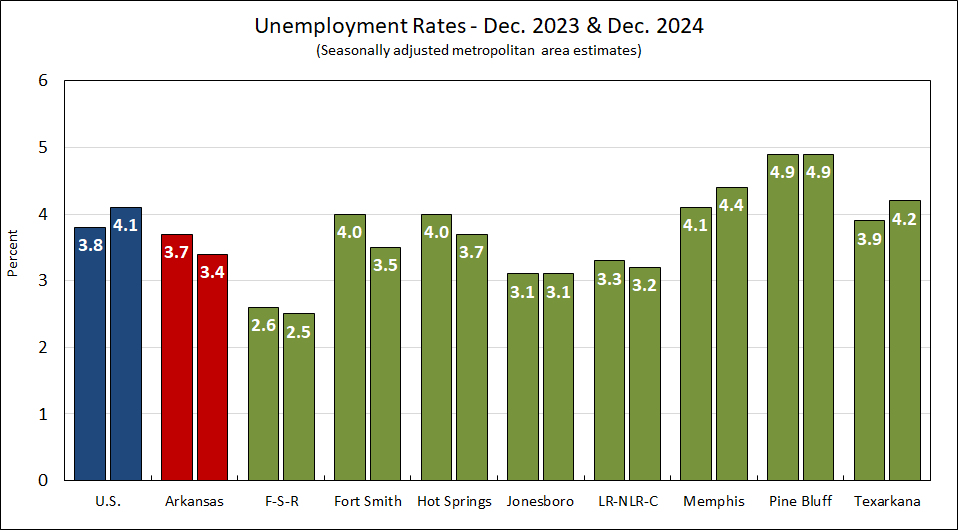
Unemployment rates tended to edge higher from November to December. Mirroring the 0.1 percentage point increase recorded for the state, unemployment rates edged up in Hot Springs, Jonesboro, Little Rock and Pine Bluff. Compared to a year earlier, unemployment rates were unchanged or down slightly, with the exception of Memphis and Texarkana which ended the year with higher rates than in December 2023. Northwest Arkansas had the state’s lowest unemployment rate, which was down to 2.5% by December. Pine Bluff remained the metro area with the highest unemployment rate, unchanged at 4.9%.

Source: Bureau of Labor Statistics

Payroll Employment
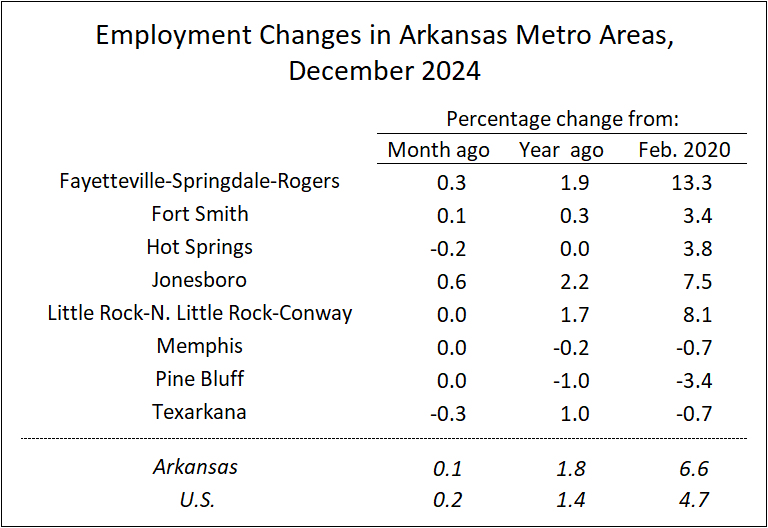
Nonfarm payroll employment rose sharply for Jonesboro in December, with mixed changes among other metro areas. The end-of-year surge in Jonesboro boosted year-over-year growth to 2.2%—the highest growth rate in the state for 2024. Northwest Arkansas and Central Arkansas both saw strong growth over the year as well. Memphis and Pine Bluff were the only metro areas to experience employment declines for the year.

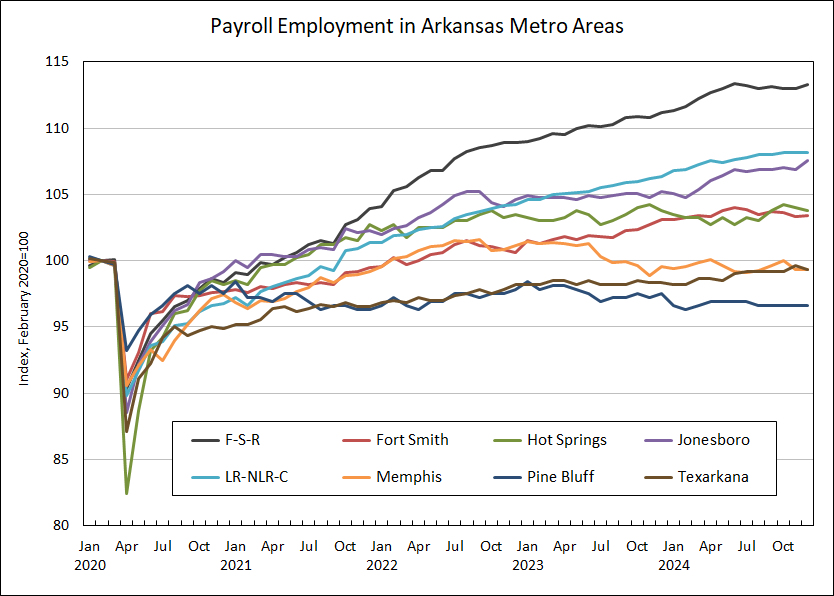
Over the longer-run, Northwest Arkansas continues to lead the state in employment growth, followed by Central Arkansas and Jonesboro. Fort Smith and Hot Springs have shown positive growth over the last five years, while employment Memphis, Texarkana and Pine Bluff remain lower than pre-pandemic levels.

The next report on metro area employment and unemployment will incorporate annual revisions for nonfarm payroll employment and will partly include annual revisions to the unemployment data as well. We will report on the revisions when they are released in March and April.

Metro Area Employment and Unemployment – July 2024

Updates to the data on employment and unemployment for metropolitan areas were released earlier this week. For Arkansas’ MSAs, there was little to take note of—except for the fact that softening labor market conditions in the rest of the nation does not seem to be taking hold here in Arkansas.

For example, the U.S. unemployment rate rose by 0.2 percent in July to 4.3% and Arkansas’ rate was unchanged at 3.3%. As shown in the table below, unemployment rates were unchanged in most of Arkansas’ metro areas, with the exception of small upticks in Memphis and Pine Bluff.

Source: Bureau of Labor Statistics, Smoothed seasonally adjusted metropolitan area estimates.

After rising through the second half of 2023, unemployment rates in most of Arkansas metro areas have been coming back down over the first half of 2024. As a result, unemployment rates across the state are little changed compared to a year ago, while the national unemployment rate has risen 0.8 percent. The exception to the general pattern has been Texarkana, which has followed the contrary pattern of lower unemployment in the second half of 2023 and a return to higher rates in 2024.

Source: Bureau of Labor Statistics, Smoothed seasonally adjusted metropolitan area estimates.

Payroll Employment
Nonfarm payroll employment showed mixed changes, with monthly declines in Jonesboro and Texarkana and relatively large increases in Pine Bluff and Hot Springs. Other metro areas were unchanged or up slightly.

Source: Bureau of Labor Statistics, Current Employment Statistics (CES)

Relative to a year earlier, payroll employment has increased in all metro areas except Memphis. Compared to February 2020, before the disruption of the Covid contraction, employment remains lower in Memphis, Pine Bluff and Texarkana. All other metro areas have shown positive growth, particularly in Northwest Arkansas, but also with solid increases in Jonesboro and Central Arkansas.

Source: Bureau of Labor Statistics, Current Employment Statistics (CES)

Metro Area Employment and Unemployment – May 2024

The latest information on metro area employment and unemployment showed stability in labor markets across the state. Unemployment rates were unchanged in all of Arkansas’ metro areas except for Texarkana, where the rate ticked up by 0.1 percentage points.

Source: Bureau of Labor Statistics, Smoothed Seasonally Adjusted Metropolitan Area Estimates.

Meanwhile, changes in nonfarm payroll employment were mixed. Employment increased n Northwest Arkansas, Fort Smith, Hot Springs, and Jonesboro. Declines were registered for Central Arkansas, Memphis, and Pine Bluff. Texarkana–the only metro area to see a change in the unemployment rate–had payroll employment that was essentially unchanged from the previous month.

Source: Bureau of Labor Statistics, Current Employment Statistics (CES)

Over the longer run, employment growth trends have diverged considerably. Over the past year Fayetteville continues to be the most rapidly growing metro area in the state, followed by Little Rock and Fort Smith. Growth in Jonesboro slowed in 2022 and 2023, but has picked up thus far in 2024. Hot Springs is down slightly over the past 12 months, and has seen little growth since mid 2022. Memphis, Pine Bluff, and Texarkana remain in the doldrums, with employment levels lower than at the onset of the Covid Contraction.

Source: Bureau of Labor Statistics, Current Employment Statistics (CES).

With little other information of interest to consider regarding metropolitan areas, this is an opportune time to look at a snapshot of county-level unemployment rates around the state. On the map below, the metro areas with the lowest unemployment rates (Northeast, Northwest, and Central) stand out, with Benton and Washington counties having the lowest rates of all (2.4% and 2.3%, respectively). Counties with unemployment rates above 5% are clustered in the southeastern part of the state, with the highest unemployment rates in Chicot and Desha counties (both at 5.7%).

Metro Area Employment and Unemployment – April 2024

The latest estimates for employment and unemployment in metro areas were released by the BLS this week. Unemployment rates in most of Arkansas’ metro areas were unchanged, with small declines (-0.1%) registered for Northwest Arkansas and the Fort Smith MSA. It had been previously reported that the national unemployment rate ticked up by one-tenth of a percent in April, and that Arkansas’ unemployment rate ticked down by the same amount. Unemployment rates remain lower than the national average in Northwest Arkansas, Jonesboro, and Central Arkansas. In other metro areas, unemployment rates are at or above the national average.

Source: Bureau of Labor Statistics, Smoothed Seasonally Adjusted Metropolitan Area Estimates

Payroll Employment
Nonfarm payroll employment increased in most of the state’s metro areas in April, with the notable exception of Hot Springs. The largest percentage increases were in Northwest Arkansas and Jonesboro. Compared to a year ago, Northwest Arkansas has achieved the highest growth rate, followed by Central Arkansas. Employment in Fort Smith and Jonesboro have also increased, while other metro areas show zero or negative job growth.

Source: Bureau of Labor Statistics, Current Employment Statistics (CES)

Since the pre-pandemic month of February 2020, payroll employment growth rates have varied widely. Northwest Arkansas, Central Arkansas and Fort Smith have shown steady growth, albeit at different paces. Hot Springs and Jonesboro showed employment rebounds in 2022, but growth in those metro areas has slowed. In Pine Bluff, Texarkana and Memphis employment us unchanged or lower relative to levels in February 2020.

Source: Bureau of Labor Statistics, Current Employment Statistics (CES)