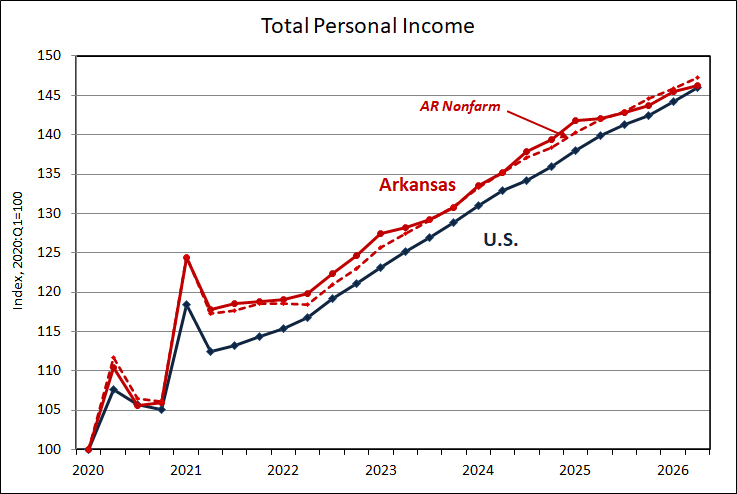
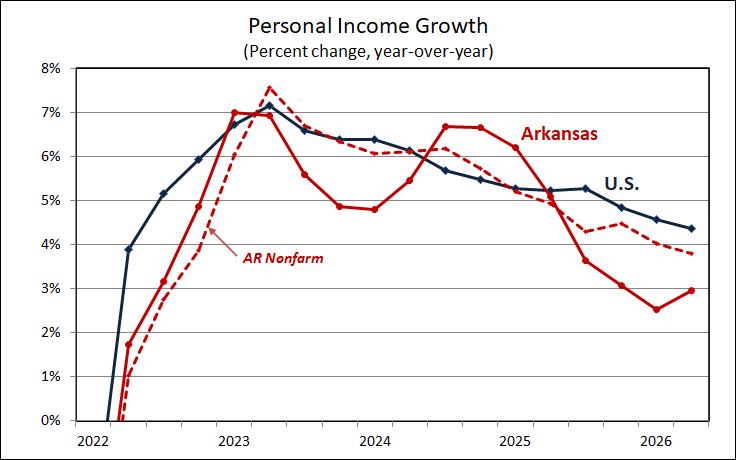
The latest data from the Bureau of Economic analysis shows that Arkansas personal income increased at an annual rate of 3.7% in the first quarter of 2026. The growth rate of U.S. GDP for the same period was 3.4%.
In addition to the growth reported for the first quarter, the data for 2025 were also revised higher for Arkansas. Previous estimates showed fourth-quarter growth rate of only 0.7%. The revised data now indicate a growth rate of 3.0%. For the period from 2024:Q4 through 2025:Q4, the revisions raised the growth rate from 3.1% to 3.8%.
Source: Bureau of Economic Analysis
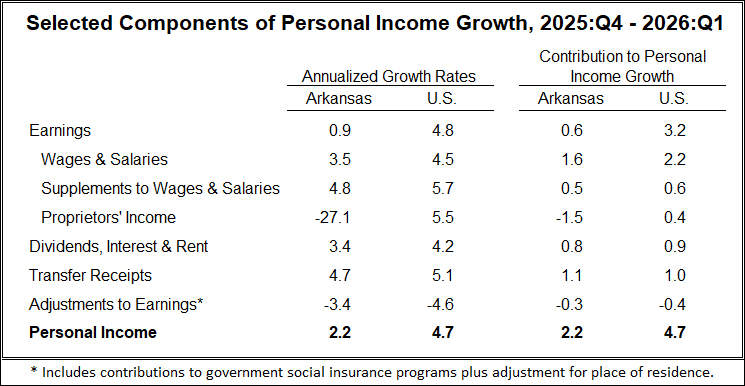
A breakdown of the components of personal income growth shows shows growth in all categories of earnings, with particularly strong growth in Proprietors’ Income. At an annualized growth rate of 13.6%, Proprietors’ Income contributed 0.7 percentage points to total Personal Income Growth.
Source: Bureau of Economic Analysis
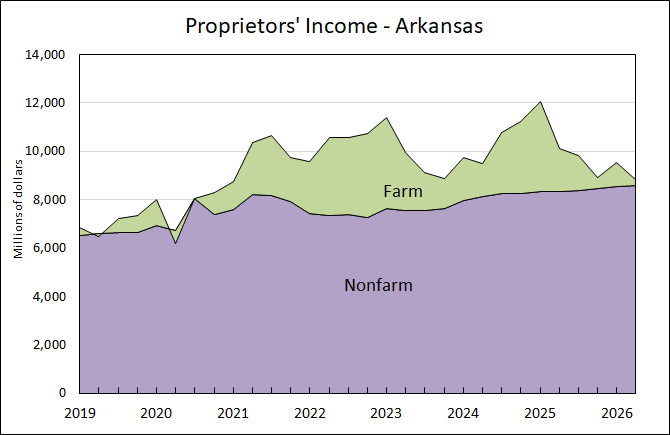
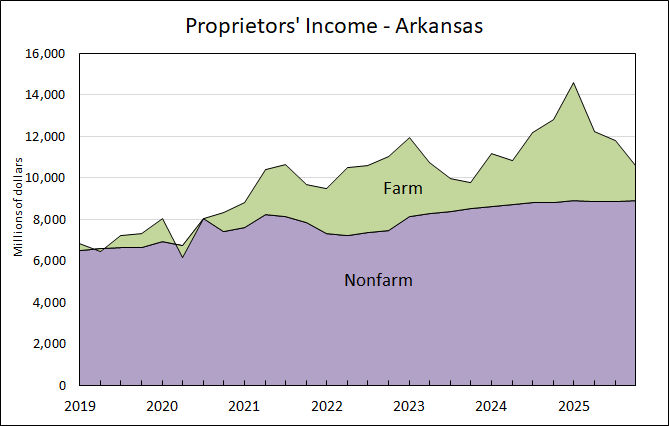
The increase in Proprietors’ Income was entirely attributable to Farm Income. Nonfarm Proprietors’ income declined slightly in the first quarter (-0.3% at an annual rate). Farm income increased at a rate of 91.4%. Nevertheless, the recent swings in that category of income left it down 57.2% from its peak four quarters earlier.
Source: Bureau of Economic Analysis
On a year-over year basis, Arkansas Personal Income was up by 2.4%, while the U.S. total was 3.6% higher. Much of the relatively slow growth is attributable to the peak in Farm Proprietors’ Income in the first quarter of 2025. If we remove Farm Income component, Arkansas Personal Income would be 4.2% higher than a year ago.
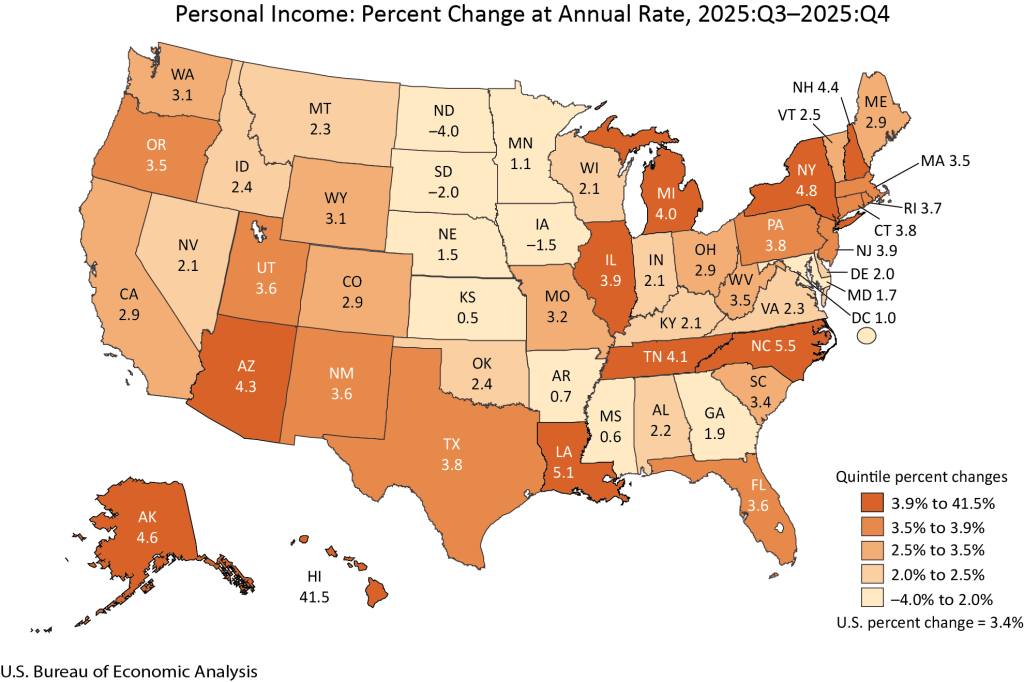
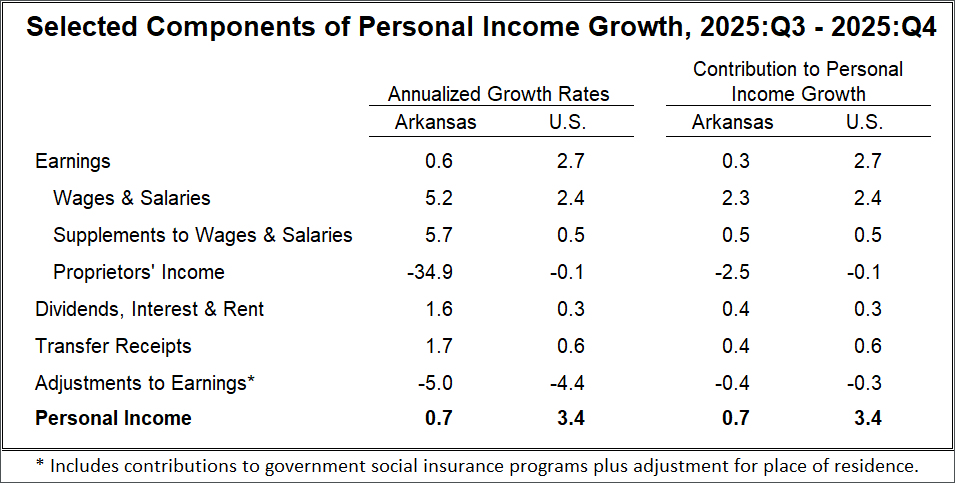
Personal income data for the fourth quarter of 2025 report another relatively weak quarter of growth for Arkansas. On an annualized basis, Arkansas personal income expanded at a 0.7% rate, compared to 3.4% for the U.S. average.
Arkansas and the rest of the nation have seen slowing income growth in 2025. After a strong first quarter, Arkansas growth rate for the rest of the year averaged below 1%. The U.S. growth rate has slowed as well, although not so dramatically.
Source: Bureau of Economic Analysis
A breakdown of the components of personal income growth shows ongoing growth in Wages & Salaries; Dividends, Interest & Rent; and Transfer Receipts. The category most responsible for suppressing earnings growth was Proprietors’ Income.
Source: Bureau of Economic Analysis
Regular readers of the Arkansas Economist should be able to guess the underlying source of weakness in Proprietors’ Income in the fourth quarter: Farm Income. The farm component of proprietors income, while accounting for only a small fraction of personal income, has been exhibiting highly variable growth patterns in recent years. As illustrated in the figure below, Non-farm Proprietors’ Income has been expanding steadily (albeit at a decelerating rate), while Farm Proprietors’ income drive the major fluctuations overall.
Source: Bureau of Economic Analysis
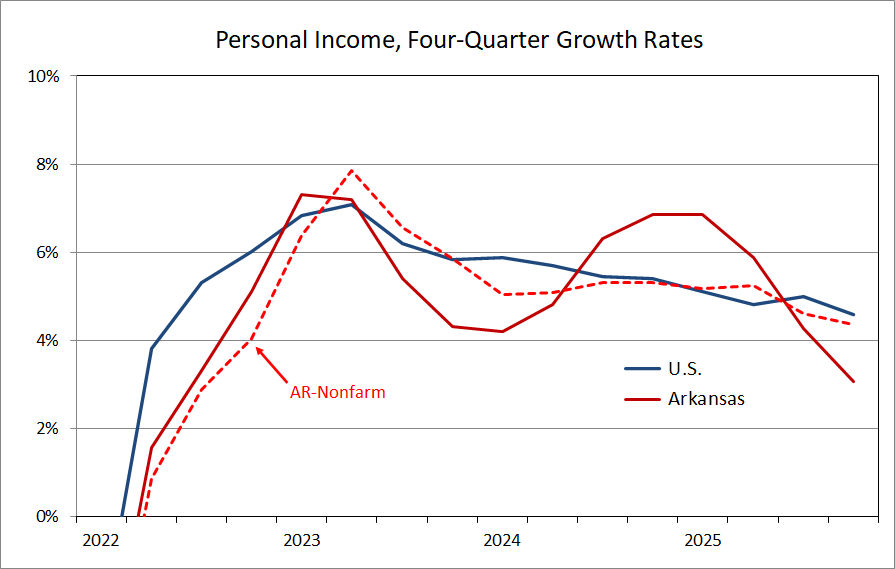
Some of the quarterly volatility in personal income growth can be smoothed by considering four-quarter moving-average growth rates. Adjusting total income growth to exclude farm income reveals an even steadier growth trend. Income growth has been slowing nationwide and the smoothed trend for Arkansas shows roughly similar pattern.
Source: Bureau of Economic Analysis
Over the longer-run, Personal Income growth since the beginning of 2020 has cumulatively totaled 41.2% for the U.S. and 43.2% in Arkansas.
Delayed by a month due to the federal government shutdown, state-level data are now available for Personal Income for the third quarter of 2025. Total Personal Income increased at an annual rate of 3.1%, slightly lower than the 3.3% U.S. average. Year-over-year growth rates were 4.9% for Arkansas and 4.7% for the U.S.
Source: Bureau of Economic Analysis
A breakdown of the components of income growth shows solid growth in Wages & Salaries and Transfer Receipts, accompanied by a sharp offsetting drop in Proprietors’ Income, which resulted in lowering total income growth by 0.8%.
Source: Bureau of Economic Analysis
As has frequently been the case in recent quarters, the drop in Proprietors’ Income was mostly in the Farm Component. Nonfarm Proprietors’ Income increased at a modest rate of 0.6%, while Farm Proprietors’ Income declined at a 38.1% rate.
Source: Bureau of Economic Analysis
To some extent, the recent swings in Farm Income have obscured the general underlying trends. As illustrated with four-quarter growth rates, Arkansas Personal Income growth has swung below and above the U.S. growth rate over the past two years, but after removing the Nonfarm Proprietors’ income component, income growth has been relatively steady at between 5% and 5-1/2%. In 2025:Q3, this adjusted Nonfarm Income measure increased by 5.1%.
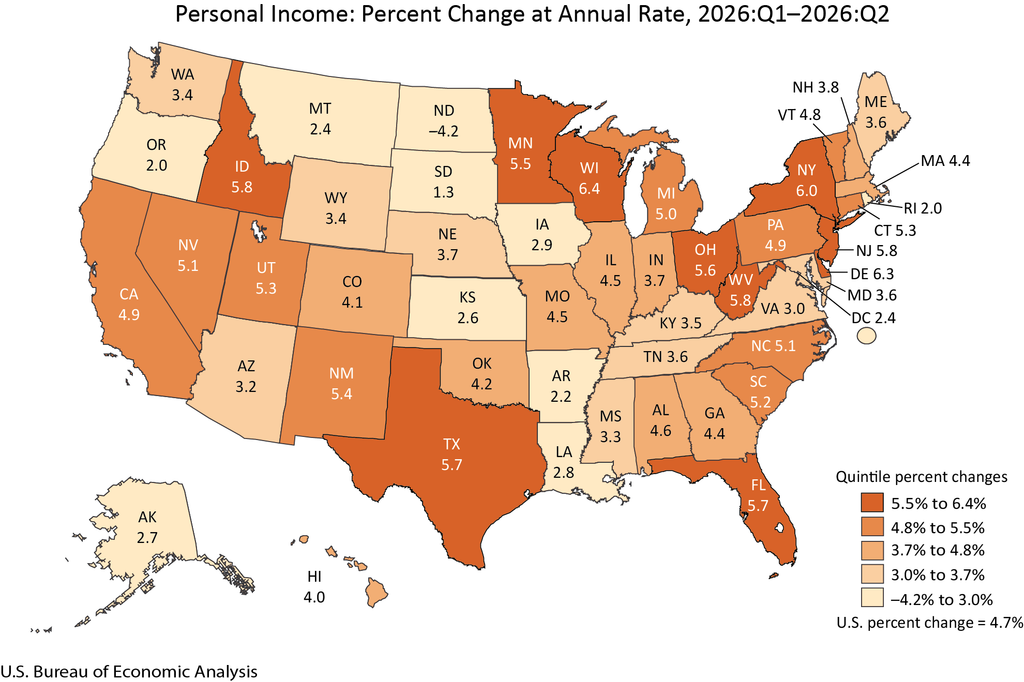
Arkansas personal income growth for the second quarter came in at a 0.9% annual rate, compared to 5.5% for the U.S. Arkansas had the slowest income growth of all 50 states. The second quarter growth rate is in sharp contrast to the (revised) first quarter growth rate of 9.2%.
The slowdown in growth was predictably associated with the volatile Farm Proprietor’s income component. Total Proprietors’ income declined at a 45% annualized rate, shaving 4.1 percentage points off of total income growth. In other words, total personal income would have increased at a rate of 5.0% if proprietors’ income had shown zero growth. Other components of personal income, including Wages & Salaries; Dividends, Interest & Rent; and Transfer Receipts showed growth rates higher than the U.S. total.
While proprietors’ income had been boosted in recent quarters by a recovery in farm incomes, the farm component once again suppressed growth in the second quarter.
Total personal income growth in Arkansas had been outpacing the nation as Farm Proprietors’ income was boosting growth through 2005. From 2024:Q1 through 2025:Q1, Arkansas personal income expanded by 6.7% while U.S. personal income grew by 5.1%. The reversal in relative growth rates in the first quarter narrowed the longer-term growth gap that had been opening up. Nevertheless, Arkansas remains above the national average when it comes to cumulative growth since the first quarter of 2020
Annual Data Revisions Annual revisions to personal income series overall had a relatively small impact on total income reported for 2025. The path of income was revised downward for 2022 and 2023, but somewhat higher estimates of growth during 2024 brought the revised growth path more closely in line with the previously published level. As of 2025:Q1, the revised estimate of total personal income was only 0.5% lower than the level that was initially reported. The Wage & Salary component was revised downward by only 0.1%.
Some components of personal income were revised more substantially. As of 2025:Q1, Proprietors’ Income was revised upward by 25%; Dividends, Interest, and Rent was revised down by 9.3%.
The latest report on state level GDP was accompanied by new data for state personal income for the first quarter of 2025. Arkansas personal income grew at an annual rate of 8.7%, significantly higher than the U.S. growth rate of 6.7%. Arkansas was in in the top ten of state income growth, ranking #6.
All major components of income growth in Arkansas outpaced the U.S. totals, with substantial contributions from capital income (Dividends, interest and rent) and from Transfer receipts. Proprietors’ income comprised the bulk of earnings growth in Arkansas, expanding at a 33.9% rate and contributing 1.8 percentage points to the personal income growth rate.
Source: Bureau of Economic Analysis
Not surprisingly, the growth in Proprietors’ income was concentrated in the farm component. Farm proprietors’ income increased at a 237% annual rate, while Nonfarm proprietors’ income was up at at 1.3% rate.
Source: Bureau of Economic Analysis
The recent data release included revisions to figures for 2024. The revisions included a slight upward revision to second quarter growth and a slight downward revision to third quarter growth (without altering Arkansas’ ranking as #1 for personal income growth in the Q3). The fourth quarter number was revised upward considerably, from 3.6% to 6.1% (annual rates).
Source: Bureau of Economic Analysis
Longer term trends continue to show that Arkansas is outpacing the nation for income growth. Over the past 5 years (from 2020:Q1-2025Q1), Arkansas income growth has cumulatively totaled 42.4% while total U.S. growth has been 35.6%.
Source: Bureau of Economic Analysis
After adjusting for inflation (using the Personal Consumption Expenditures Price Index), real income growth over the five year period totaled 18.4% for Arkansas and 12.7% for the U.S.
State-level personal income statistics for the fourth quarter came out today [LINK]. Arkansas’ annualized growth rate for the quarter was reported at 3.6%, one percentage point lower than the U.S. growth rate of 4.6%. Arkansas ranked in the lowest quintile of growth rates among states. However, the state’s growth rate for the third quarter was revised upward from 5.4% to 7.1%, retaining the status of being the highest-growth state in the third quarter (and making Arkansas the highest growth state for the third and fourth quarters combined).
The slower growth in Arkansas than the U.S. was attributable to net earnings. Transfer receipts generated approximately the same growth for personal income at the national and state level, while property income (Dividends, Interest, & Rent) contributed somewhat more to Arkansas’ growth rate than for the nation.
Source: Bureau of Economic Analysis
The slower growth rate of earnings in Arkansas was, in turn, driven by lower growth in wage & salary components. In contrast, Proprietors’ Income surged higher, growing at an annualized rate of over 30% and contributing 1.5 percentage points to the personal income growth rate for the quarter.
Source: Bureau of Economic Analysis
If you’ve been following the personal income statistics for a few quarters, the source of the surge in Proprietors’ Income should not be surprising: farm proprietors’ income accounted for the bulk of the increase. This component has been the source of volatility in Arkansas income growth statistics since 2020.
Source: Bureau of Economic Analysis
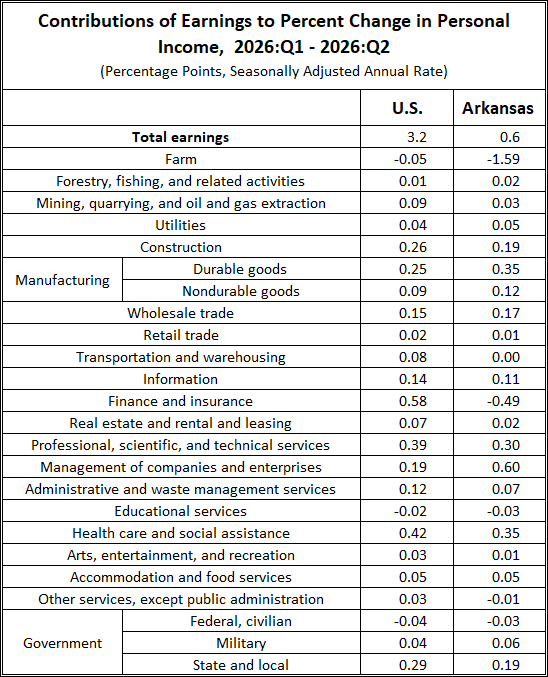
The contribution of the agriculture sector is also prominent in the breakdown of earnings by sector, with Arkansas Farm earnings accounting for nearly three-quarters of growth in total earnings.
Source: Bureau of Economic Analysis
Note that Management of Companies and Enterprises had a significant negative contribution to overall earnings growth in the fourth quarter; however, that decline merely offset a sharp positive spike in the third quarter (and therefore contributing to the strong third-quarter growth).
Source: Bureau of Economic Analysis
With the preliminary estimates for fourth-quarter income in hand, the preliminary annual figures for 2024 are now also available. Compared to the previous year, Arkansas growth was 4.2%, compared to 5.4% for the U.S.
Source: Bureau of Economic Analysis
One notable feature of the annual growth contributions is the relatively small contribution of Personal Current Transfer Receipts to earnings growth in 2024. The press release from the BEA noted that Arkansas had the lowest growth rate in the nation for transfer payments (only 1.7%).
Yesterday, the U.S. Bureau of Economic Analysis released third-quarter data for state-level personal income and GDP. For both series, Arkansas had the distinction of having the highest growth rates in the nation. Arkansas Personal Income increased at an annual rate of 5.4% and real GDP expanded at a 6.9% pace.
Arkansas’ rapid growth rate in the third quarter was attributable to the same factor that was responsible for relatively slow growth in the second quarter: the volatile Farm Income component. Excluding the sector of Agriculture, forestry, fishing and hunting, GDP growth in the third quarter was 4.0%. Excluding that component from second-quarter growth yields a growth rate of 3.4%, compared to total GDP growth of only 1.5%. Over the four quarters from 2023:Q3 – 2024:Q3, Arkansas GDP growth was 4.4%, compared to a growth rate of 2.7% for the United States. Excluding the farm income component, Arkansas’ four-quarter growth rate would be 3.5%.
Source: Bureau of Economic Analysis
A more detailed breakdown of contributions to GDP growth by sector highlights the contribution of agriculture, but also reveals positive contributions from a number of industries. Manufacturing added nearly a full percentage point to growth and retail trade added nearly 1.5 percentage points. The only sectors showing negative growth for the quarter were Construction and Accommodation and food services.
Source: Bureau of Economic Analysis
Personal Income Arkansas personal income expanded at a 5.4% rate, compared to 3.2% for the U.S. As broken down in the table below, the growth rate of earnings (by place of work) was 9.7%, led by a huge increase in Proprietors’ Incomes. Capital income (Dividends, interest, and rent) contracted both nationally and here in Arkansas.
Source: Bureau of Economic Analysis
The contribution of proprietors’ income to income growth was, not surprisingly, dominated by farm income. Nonfarm proprietors’ income increased at an annual rate of 1.3%, while farm proprietors’ income increased more than three-fold in a single quarter.
This week, the U.S. Bureau of Economic Analysis released new figures for real (inflation-adjusted) income and consumer spending by state for 2023. The data show how changes in prices over time and across geographic areas affect relative income and purchasing power.
At the heart of the real income and consumption data is the calculation of Regional Price Parities, which compare the cost of living across states. In 2023, for the second year in a row, the state with the lowest cost of living in the nation was Arkansas, with a RPP of 86.5. This figure implies that the overall cost of living in Arkansas is 13.5% lower than the U.S. average.
Arkansas moved from being a low cost-of-living state to the lowest cost-of-living state in 2022, with a decline in the state’s RPP coefficient that continued into 2023. This means that the relative cost of living in Arkansas was declining relative to the U.S., or more concretely, that consumer prices were rising more slowly in Arkansas than the rest of the nation.
As a matter of fact, we can use the RPP figures to derive distinctive patterns of inflation for the state compared to the nation. As shown in the figure below, Arkansas prices were rising faster than the U.S. average during the consumer-spending boom of 2020 and 2021, but the rate of price increase has been lower than the U.S. since then—particularly during the peak inflation year of 2022. From 2019 through 2023, the cumulative increase in Arkansas prices has been 14.8%, compared to 16.4% nationwide.
Source: Bureau of Economic Analysis
The differences in purchasing power that are identified in the RPP data also have implications for assessing the relative welfare of households. Without price adjustment, per capita income in Arkansas is only 82.6% of the national average and spending per capita is only 78.7% of the national average. After accounting for the relatively low cost of living, however, real incomes in Arkansas amount to 95.5 of the national average, while consumer spending is 91%. The price-adjusted standard of living in Arkansas is clearly higher than the nominal (dollar denominated) figures suggest.
The latest report on state-level personal income came out late last week. The significance of the most recent data is of interest, but its relevance for our current situation and outlook for the near future is eclipsed by data revisions that substantially altered some key components of recent income growth.
First, the most recent numbers: In the second quarter, Arkansas Personal Income expanded at an annualized rate of 4.3%, one percentage point lower than the national average of 5.3%. Growth rates ranged from a high of 6.9% in South Carolina to a low of 2.3% in North Dakota. Arkansas ranked #40 among the 50 states.
The composition of income growth in the fourth quarter shows that the Earnings component fully accounted for the fact that Arkansas’ growth rate was slower than the national average. Dividends, Interest, and Rent as well as Transfer Receipts each contributed about the same amount to income growth in Arkansas compared to the U.S.
Source: Bureau of Economic Analysis
As shown in the further breakdown below, the shortfall in earnings was entirely attributable to Proprietors’ Income. Not surprisingly, given its recent volatility, Farm Proprietors’ income accounted for most of that decline, falling at an annualized rate of 76%. Nonfarm Proprietors’ Income increased at a rate of 3.3%.
Source: Bureau of Economic Analysis
The figure below puts the most recent change into context relative to the (revised) trends. Expressed as index values normalized to 2020:Q1=100, the figure shows that Arkansas Personal Income has shown cumulative growth of 36.4% compared to 31.4% for the U.S. To adjust for the recent volatility of farm income, the figure also shows a measure of personal income excluding farm income. By that measure, the acceleration of income growth in 2022 and the slowdown in 2023 are smoothed out considerably.
Source: Bureau of Economic Analysis
Data Revisions The data revisions that underly the figure above are more significant than the most recent quarterly growth rate. The latest report incorporated the results of BEA’s annual updates, utilizing “new and revised source data that are more complete and more detailed than previously available.” For Arkansas, the revision showed significantly higher growth over the past five years than did the previously-published data. The newly-revised data show that Personal Income in Arkansas for the first quarter of 2024 was $12.2 billion higher than previously estimated—an upward revision of 7.2%.
Source: Bureau of Economic Analysis
A breakdown of the sources of revision shows that the gains were positive across all major components, and generally larger for Arkansas than for the U.S. data (with the exception of Transfer Receipts). Of particular significance are the revision so Proprietors’ Income and Dividends, Interest, and Rent.
Source: Bureau of Economic Analysis
The increase in estimates of Dividends, Interest, and Rent amounted to nearly $9 billion as of the first quarter of 2024, accounting for 73% of the full revision to Personal Income.
Source: Bureau of Economic Analysis
The upward revision to Proprietors’ Income amounted to nearly 1.5 billion—accounting for 18.4% of the total revision to first quarter personal income. Both farm and nonfarm were substantially revised upward, with farm income accounting for 8.3% of the first quarter revision, and nonfarm proprietors’ income accounting for 3.8%.
Source: Bureau of Economic Analysis
Although the second quarter statistics show somewhat disappointing income growth, the revisions show that the quarterly slowdown in personal income growth—such as it is—appears as a minor distraction from more positive long-term trends.
As is their relatively new practice, the U.S. Bureau of Economic Analysis issued a combined combined report on state-level GDP and Personal Income. [Link: Analysis of Arkansas GDP] The report showed that Arkansas Personal Income increased at a rate of 6.1% in the first quarter of 2024–somewhat slower than the 7.0% growth rate for the U.S. Arkansas’ quarterly growth rates have been erratic over the past two years, but this first observation for 2024 suggests a resumption of a trend paralleling the national average.
Source: Bureau of Economic Analysis
The contributions to overall growth from Net earnings and Dividends, interest & rent were nearly identical for the state and the nation. Arkansas growth rate lagged in the Transfer receipts component.
Source: Bureau of Economic Analysis
Nationwide, and for some of the higher-growth states, transfer payments accounted for a particularly large component of growth. The BEA report noted that “The increase in transfer receipts in the first quarter of 2024 reflected a 3.2 percent cost-of-living adjustment for social security recipients, along with increases in refundable tax credits and Medicaid benefits.” These adjustments had significant impacts on some states, but were proportionately smaller for Arkansas.
Source: Bureau of Economic Analysis
A breakdown of the major components of total earnings shows the key change in the turn-around in Arkansas’ growth in the first quarter: Proprietors’ income. After declining by 22.8% over the four quarters of 2023, Proprietors’ income rose by 4.4% in 2024:Q1 (an annualized growth rate of 18.8%). Dividends, interest & rent increased at an annualized rate of 5.3%, while Wages and salaries increased at a 4.7% pace.
Source: Bureau of Economic Analysis
As reported for the fourth quarter, Farm Proprietors’ Income has been the driving factor in the unusual swings in Arkansas’ growth patterns for Total Proprietors’ Income (and Total Personal Income) over the course of 2022 and 2023. In 2024:Q1, both farm and non-farm components increased.
Source: Bureau of Economic Analysis
A breaking down the components of earnings by industry highlights the importance of the Farm sector. Other important contributors to personal income growth were Construction, Health Care, and Administrative services.
Source: Bureau of Economic Analysis
The erratic nature of Farm income clearly complicates the analysis of underlying trends in personal income growth. The volatility in the time-series is likely related to changes in inventory valuations that accompany variability in commodity prices. In measuring farm income, the BEA factors in changes in agricultural commodity prices to revalue inventories, even though those changes may not actually impact farmers’ cash flows. To the extent that is true, the quarter-to-quarter fluctuations likely overstate the true volatility of farm income.
One final note: The personal income data are not adjusted for inflation. If we adjust the first quarter growth rates for a 3.4% rate of inflation (using the PCE price index) the rate of real personal income growth was 2.6% for Arkansas and 3.5% for U.S.