Skip to content

Arkansas Employment and Unemployment – January 2025

With annual data revisions now nearly complete, state-level data on employment and unemployment is now available with updates for January 2025.

The Arkansas unemployment rate was unchanged at 3.6% in January. The originally published data for December reported an unemployment rate for 3.4%, but recent revisions raised the December estimate to 3.6%. For more information on revisions to the LAUS data, see https://arkansaseconomist.com/laus-data-revisions/

The January figures indicated a fairly strong gain in household employment, +1,956. After the recent revisions, the data now show that household employment has not shown a month-to-month decline since April 2020. The number of unemployed edged slightly higher in January (+112). As a result, the labor force expanded by 2,068 for the month.

Payroll Employment
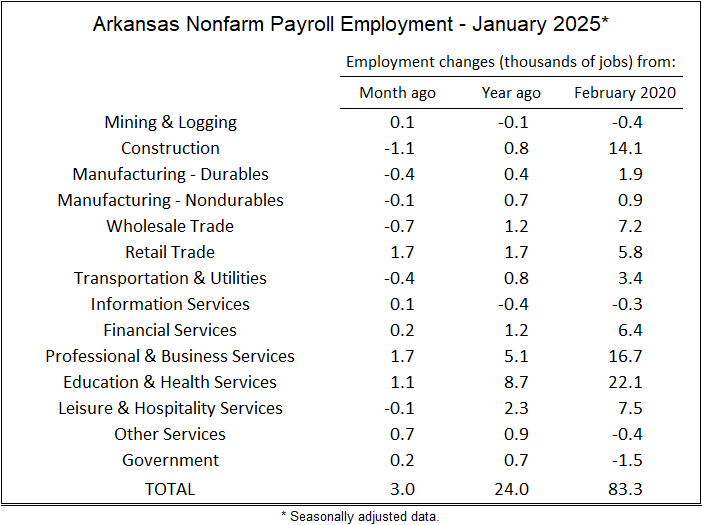
Without seasonal adjustment, nonfarm payroll employment contracted by 16,500 jobs in January. However, there is always a sharp drop in employment after the holidays and the start of a new year. After taking this predictable seasonal pattern into account, the data for seasonally adjusted payroll employment showed an increase of 3,000 jobs for the month.

The largest gains came from Retail Trade and Professional & Business Services, which were both up by 1,700 jobs. Sectors showing declines included Construction and Manufacturing, as well as Wholesale Trade. Compared to a year earlier, nearly all sectors showed increases, with total employment increasing by 24,000 jobs—approximately 1.8%.
Source: Bureau of Labor Statistics, Local Area Unemployment Statistics (LAUS)

Revisions to Payroll Data
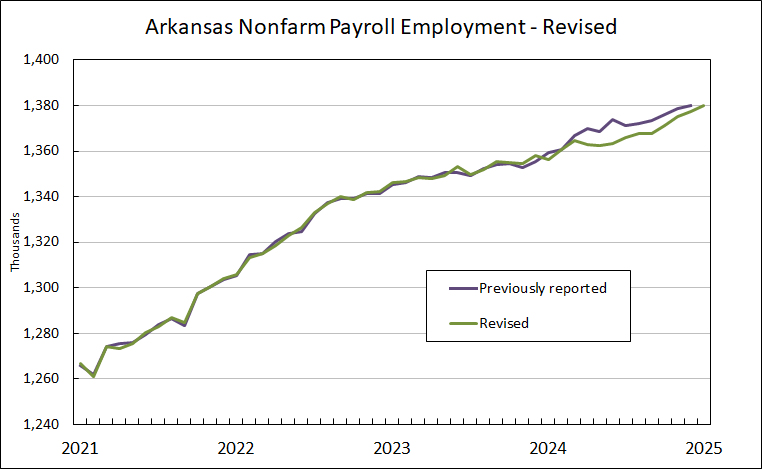
The annual benchmark revisions changed some of the month-to-month patterns of employment growth for specific sectors, but had little quantitative impact on the situation at the end of 2024. As shown in the figure below, the data revisions had the effect of lowering measured employment during mid-2024, but higher growth estimates toward the end of the year brought the revised data back to nearly in line with previously-reported information. The largest revision was for the month of June (-10,600 jobs). By December the gap was reduced to 2,600 jobs. Hence, January’s increase of 3,000 jobs means that employment for January was higher than at any other time in history (at least for the seasonally-adjusted data).
# # #

Seasonally adjusted data for Arkansas nonfarm payroll employment, reported in a format consistent with the monthly news release from the Arkansas Division of Workforce Services, can be found here: Table-Seasonally Adjusted NFPE.

LAUS Data Revisions

The full set of revisions to state employment and unemployment data, along with new information for January 2025, will be released next week. Meanwhile, the Bureau of Labor Statistics has issued revised data for the Local Area Unemployment Statistics (LAUS). This years LAUS revisions were more extensive than normal, with data revised back to the beginning of the series in 1976. In this article, we will focus on the more recent history revealed by the revised data.

The figures below compare the pre-revision time series to the newly revised data for total household employment and unemployment. As is typical, the revisions tend to smooth out some of the fluctuations in the originally published data.

The originally published data for the number of employed showed two brief periods of contraction, in 2022 and 2023. The revised data show positive monthly increases for the entire period from May 2020 through December 2024. The revised series ends up slightly lower than the original estimates, but by only 1,850 individuals (0.14%).

Source: Bureau of Labor Statistics, Local Area Unemployment Statistics (LAUS)

The number of unemployed individuals was revised lower for the second half of 2023, then somewhat higher during the second half of 2024. As a result, the new path of unemployment shows a slow, but relatively steady increase in the number of unemployed over the past two years. As of December 2024, the number of unemployed was revised higher by approximately 2,740 individuals.

Source: Bureau of Labor Statistics, Local Area Unemployment Statistics (LAUS)

The impact on the unemployment rate was a smoother profile path, attenuating some of the extreme changes. The record-low unemployment rate of 2.8% in early 2023 has been revised up to 2.9%; the transitory peak in late 2023 was lowered from 3.7% to 3.5%; and the new end-of year unemployment rate was revised up from 3.4% to 3.6%.

Source: Bureau of Labor Statistics, Local Area Unemployment Statistics (LAUS)

The revisions also affected the calculated estimates for the state’s labor force participation rate. The new data show a more sustained rate of increase over the past two years, culminating in a rate of 58.3% in December 2024—slightly higher than the $58.2% originally reported.

Source: Bureau of Labor Statistics, Local Area Unemployment Statistics (LAUS)

Metro Area Employment and Unemployment – December 2024

The final, but unrevised, report for 2024 metropolitan area employment and unemployment came out this week.

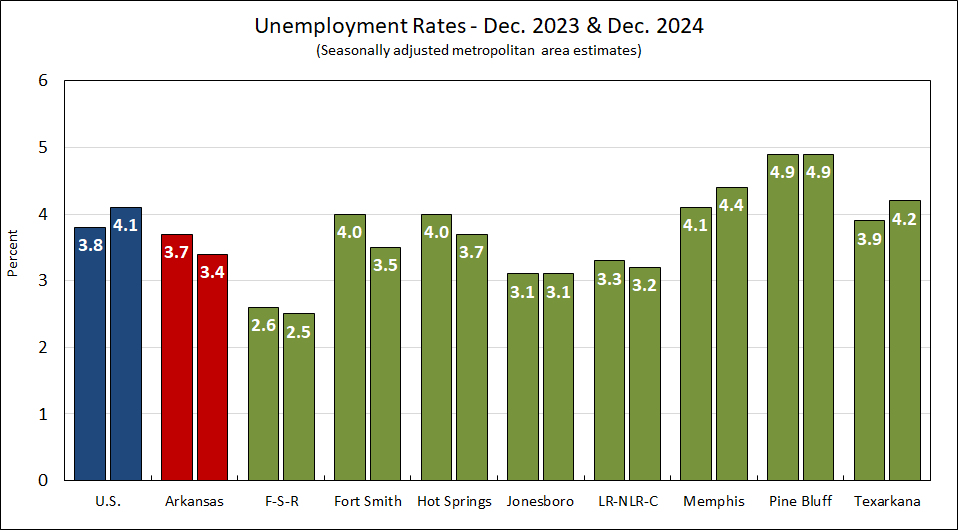
Unemployment rates tended to edge higher from November to December. Mirroring the 0.1 percentage point increase recorded for the state, unemployment rates edged up in Hot Springs, Jonesboro, Little Rock and Pine Bluff. Compared to a year earlier, unemployment rates were unchanged or down slightly, with the exception of Memphis and Texarkana which ended the year with higher rates than in December 2023. Northwest Arkansas had the state’s lowest unemployment rate, which was down to 2.5% by December. Pine Bluff remained the metro area with the highest unemployment rate, unchanged at 4.9%.

Source: Bureau of Labor Statistics

Payroll Employment
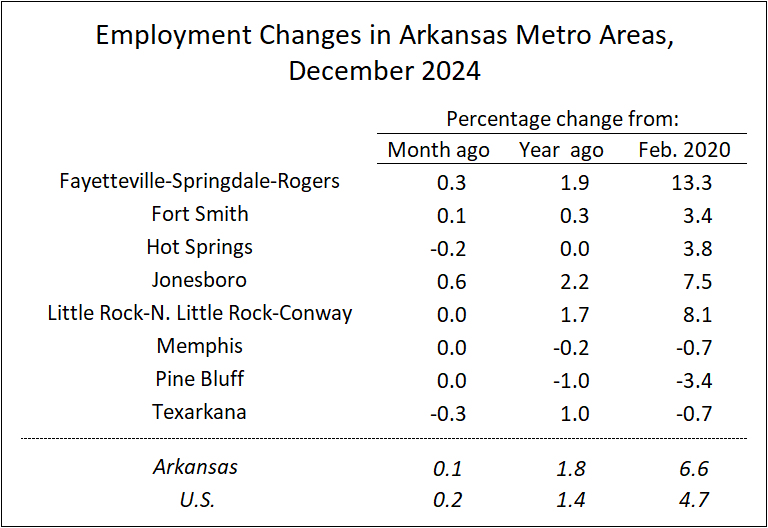
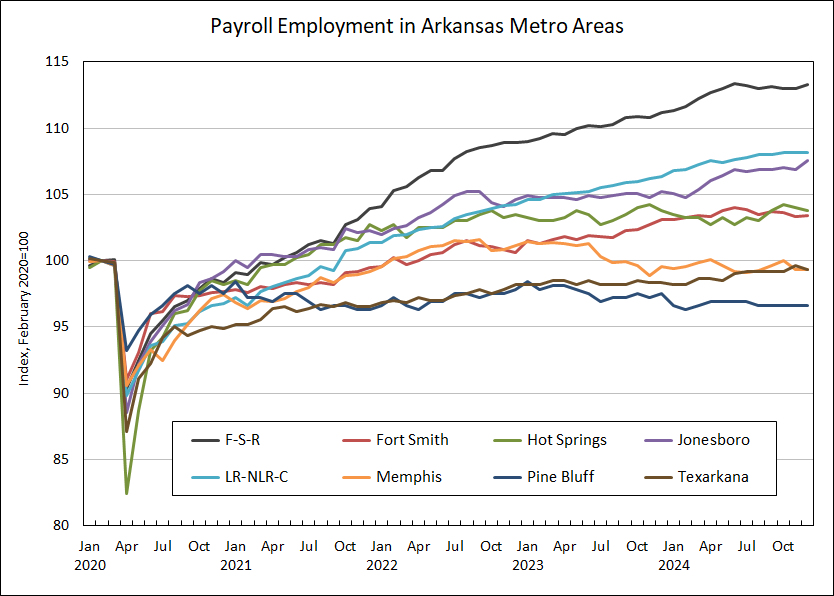
Nonfarm payroll employment rose sharply for Jonesboro in December, with mixed changes among other metro areas. The end-of-year surge in Jonesboro boosted year-over-year growth to 2.2%—the highest growth rate in the state for 2024. Northwest Arkansas and Central Arkansas both saw strong growth over the year as well. Memphis and Pine Bluff were the only metro areas to experience employment declines for the year.

Over the longer-run, Northwest Arkansas continues to lead the state in employment growth, followed by Central Arkansas and Jonesboro. Fort Smith and Hot Springs have shown positive growth over the last five years, while employment Memphis, Texarkana and Pine Bluff remain lower than pre-pandemic levels.

The next report on metro area employment and unemployment will incorporate annual revisions for nonfarm payroll employment and will partly include annual revisions to the unemployment data as well. We will report on the revisions when they are released in March and April.

Arkansas Employment and Unemployment – December 2024

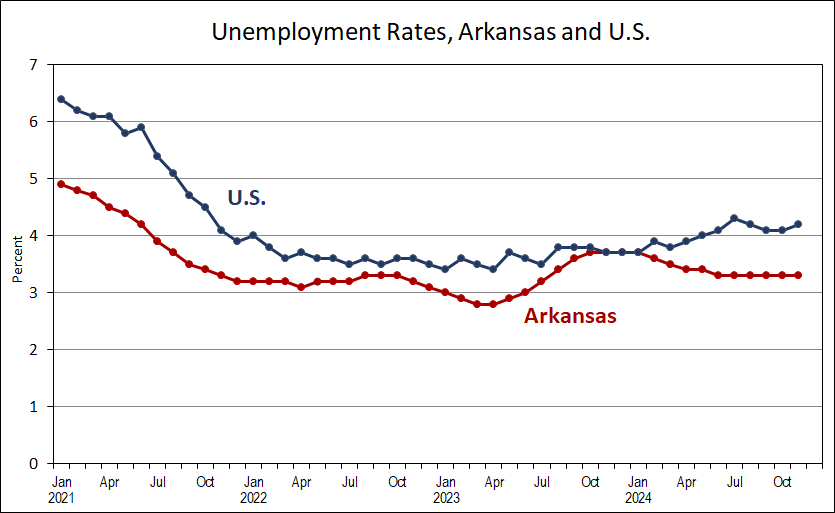
In the final month of 2024 the Arkansas unemployment rate crept slightly higher, from 3.3% to 3.4%, while both household and payroll employment continued to expand. The national unemployment rate edged lower in December to 4.1%, contributing to closing the gap between rates for Arkansas and the U.S. Nevertheless, Arkansas’ unemployment rate remains significantly lower than the national average.

Source: Bureau of Labor Statistics

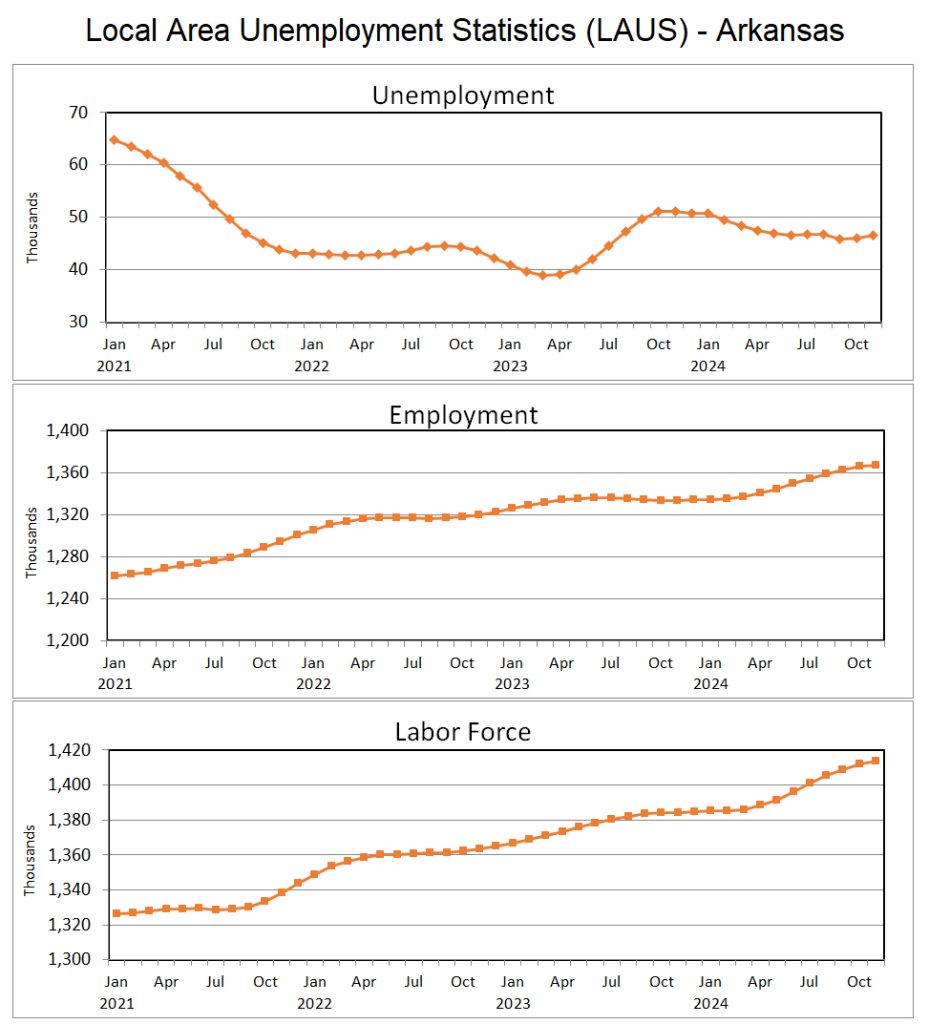
The number of unemployed increased by 1,057. This was the third monthly increase, with the cumulative increase totaling nearly 2,000 (+1,897). Although the monthly pace of employment gains has slowed somewhat in the past two months, total household employment was up by 1,487 with a three-month increase of 5.663. With increases in both employed and unemployed, the Arkansas labor force expanded by 2,554 in December and by 7,560 over the past three months. Compared to a year earlier, employment was up by 31,598 (2.6%) and the number unemployed down by 3,028.

Source: Bureau of Labor Statistics, Local Area Unemployment Statistics (LAUS)

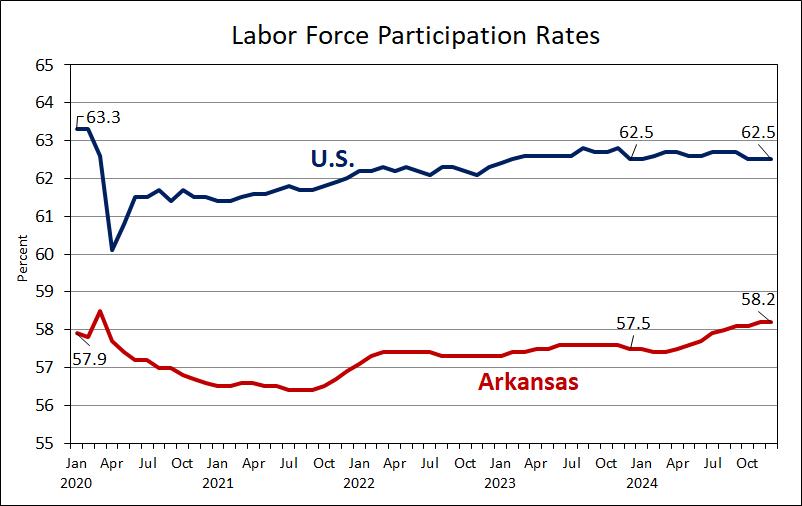
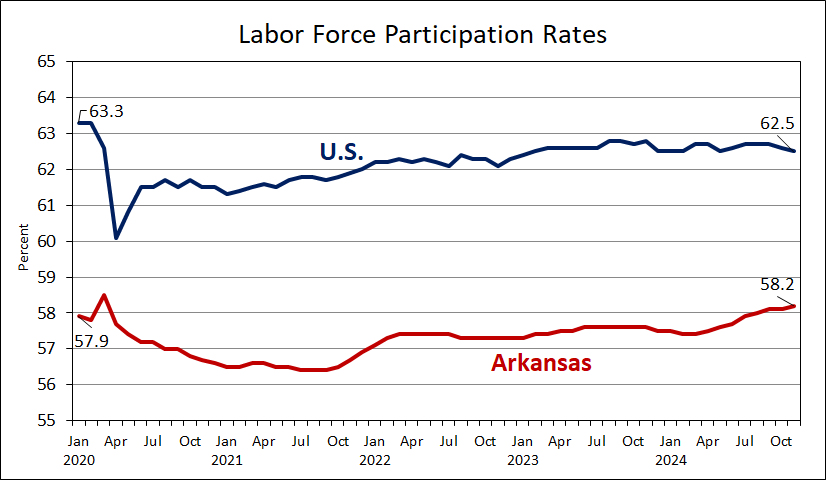
The expanding labor force pushed the labor force participation rate higher over the course of 2024. From December 2023 to December 2024, Arkansas’ participation rate increased from 57.5% to 58.2%—exceeding the pre-pandemic rate. Over the same period, the U.S. participation rate was unchanged at 62.5%.

Source: Bureau of Labor Statistics

Payroll Employment
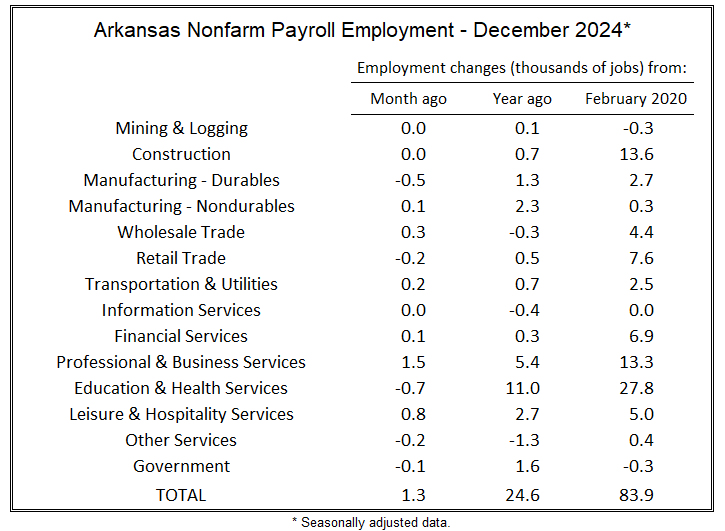
Nonfarm payroll employment expanded by 1.300 jobs in December and was up 24,600 from the previous year (seasonally adjusted data). The monthly increase was dominated by surge in employment in Professional & Business services. Most of that increase was in the category of Administrative & Support Services. Leisure & Hospitality Services also showed a strong gain, continuing to recover from a sharp decline over the summer months. Education and Health Services showed an unusual monthly decline, with both the private education and health care categories contracting.

Source: Bureau of Labor Statistics, Current Employment Statistics (CES)

Over the past 12 months, payrolls have expanded by 24,600—an increase of 1.8%. The most significant growth sector has been Education & Health Services, with strong gains in Professional & Business Services as well.

With the first-published data for 2024 now complete, the next state-level employment report will incorporate annual revisions. The annual averages for unemployment rate data will be released on March 5, 2025, and the fully revised household and payroll data will be released on March 17, 2025. Stay tuned!

# # #

Seasonally adjusted data for Arkansas nonfarm payroll employment, reported in a format consistent with the monthly news release from the Arkansas Division of Workforce Services, can be found here: Table-Seasonally Adjusted NFPE.

Arkansas Personal Income and GDP

Yesterday, the U.S. Bureau of Economic Analysis released third-quarter data for state-level personal income and GDP. For both series, Arkansas had the distinction of having the highest growth rates in the nation. Arkansas Personal Income increased at an annual rate of 5.4% and real GDP expanded at a 6.9% pace.

Arkansas’ rapid growth rate in the third quarter was attributable to the same factor that was responsible for relatively slow growth in the second quarter: the volatile Farm Income component. Excluding the sector of Agriculture, forestry, fishing and hunting, GDP growth in the third quarter was 4.0%. Excluding that component from second-quarter growth yields a growth rate of 3.4%, compared to total GDP growth of only 1.5%. Over the four quarters from 2023:Q3 – 2024:Q3, Arkansas GDP growth was 4.4%, compared to a growth rate of 2.7% for the United States. Excluding the farm income component, Arkansas’ four-quarter growth rate would be 3.5%.

Source: Bureau of Economic Analysis

A more detailed breakdown of contributions to GDP growth by sector highlights the contribution of agriculture, but also reveals positive contributions from a number of industries. Manufacturing added nearly a full percentage point to growth and retail trade added nearly 1.5 percentage points. The only sectors showing negative growth for the quarter were Construction and Accommodation and food services.

Source: Bureau of Economic Analysis

Personal Income
Arkansas personal income expanded at a 5.4% rate, compared to 3.2% for the U.S. As broken down in the table below, the growth rate of earnings (by place of work) was 9.7%, led by a huge increase in Proprietors’ Incomes. Capital income (Dividends, interest, and rent) contracted both nationally and here in Arkansas.

Source: Bureau of Economic Analysis

The contribution of proprietors’ income to income growth was, not surprisingly, dominated by farm income. Nonfarm proprietors’ income increased at an annual rate of 1.3%, while farm proprietors’ income increased more than three-fold in a single quarter.

Source: Bureau of Economic Analysis

Arkansas Employment and Unemployment – November 2023

The November employment report showed continued strength in Arkansas labor markets. Although the number unemployed edged higher (+669), the unemployment rate remained steady at 3.3%. The U.S. unemployment rate ticked up from 4.1% to 4.2% for the month.

Source: Bureau of Labor Statistics

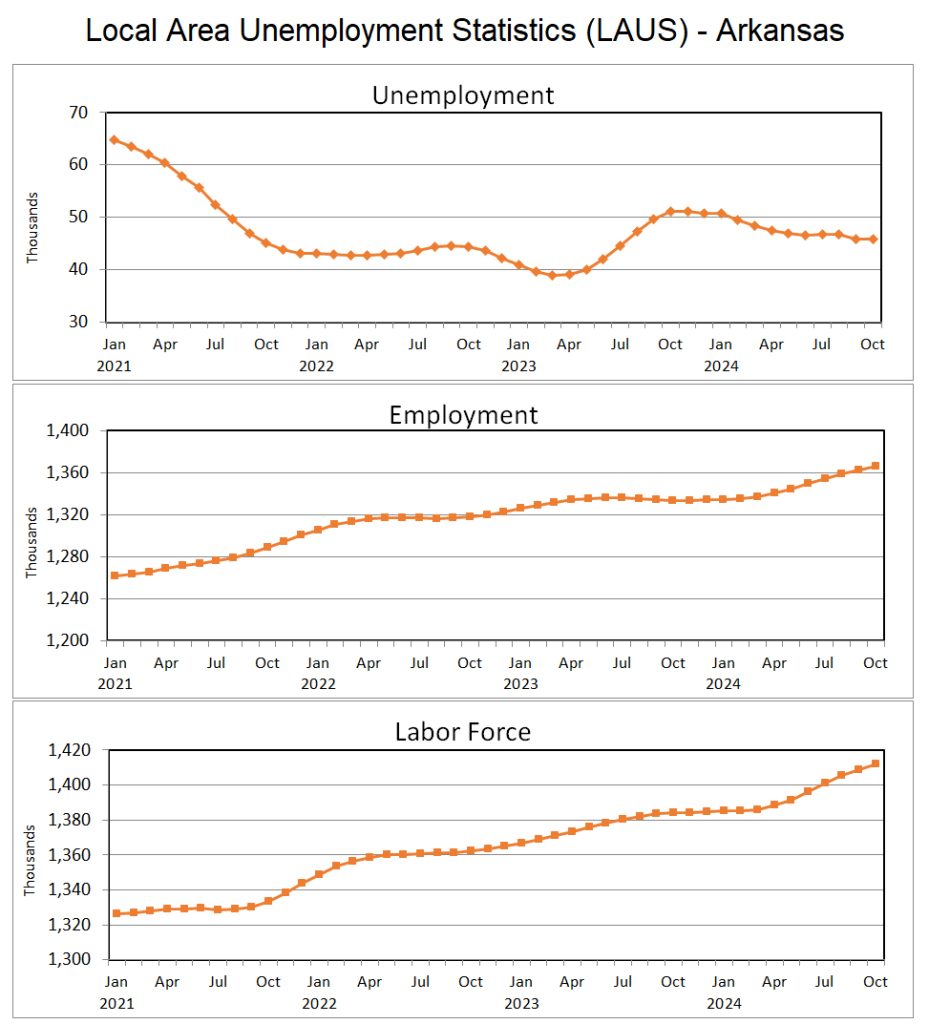
The number of unemployed rose for the second consecutive month in November, but the two-month increase amounts to only 817 and the number of unemployed remains lower than it was in July and August. The number of employed increased by 1,073 in November–a slightly slower pace than in recent months, but it continues a series of uninterrupted increases for over a year. The labor force expanded by 1,742.

Source: Bureau of Labor Statistics, Local Area Unemployment Statistics (LAUS)

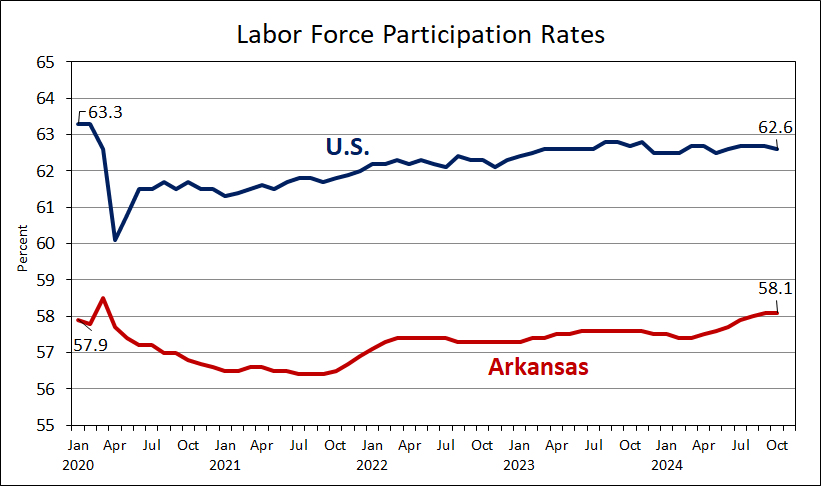
Recent labor force growth has driven an increase in Arkansas’ labor force participation rate, which ticked up to 58.2% in November. Since March, the participation rate has risen by 0.8 percentage points.

Source: Bureau of Labor Statistics

Payroll Employment
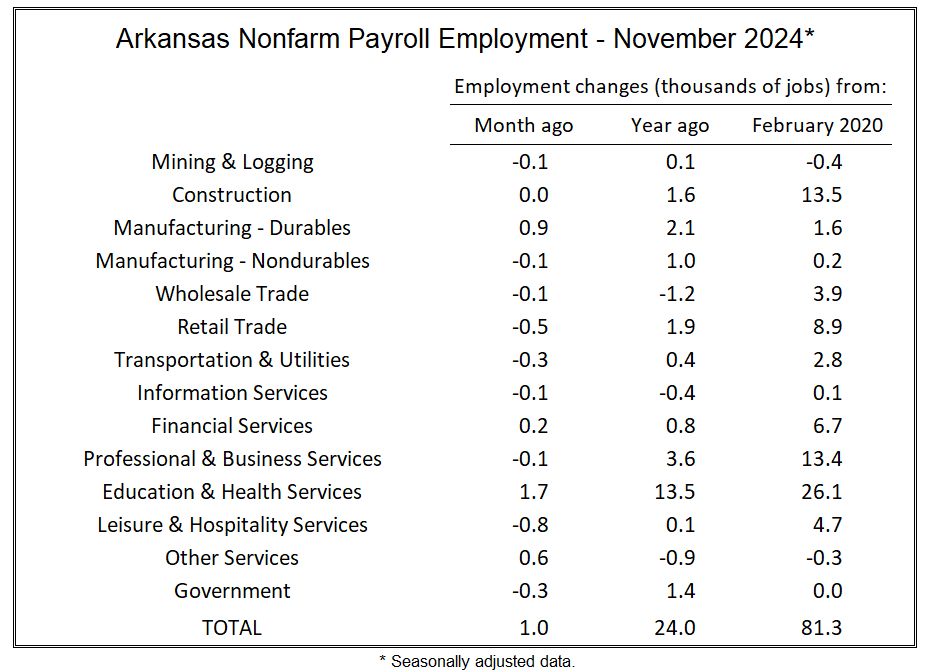
Nonfarm payroll employment expanded by 1,000 jobs in November (seasonally adjusted). The gains were entirely attributable to growth in Durable Goods Manufacturing and Health Services. Most other sectors, including Leisure & Hospitality and the Trade, Transportation and Utilities sectors saw employment declines for the month.

Source: Bureau of Labor Statistics, Current Employment Statistics (CES)

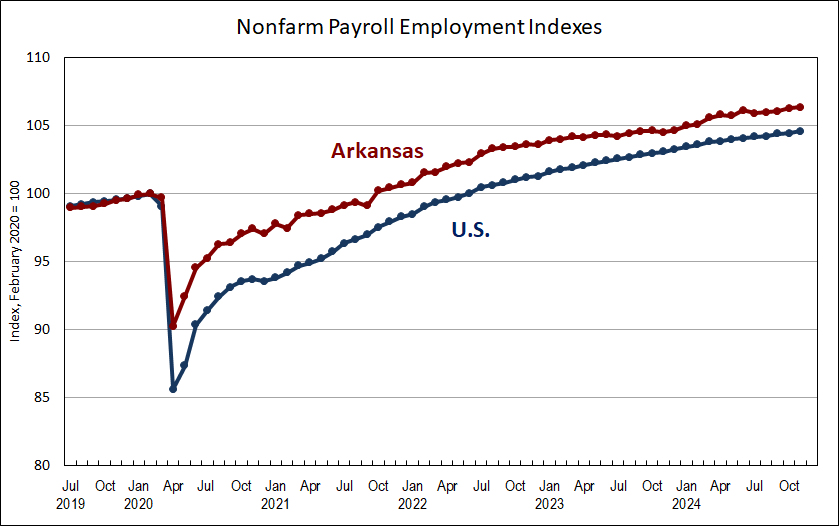
From November 2023, payroll employment has grown by 24,000 jobs—representing growth of 1.8%. Over the same period, U.S. employment growth has been 1.4%.

Source: Bureau of Labor Statistics, Current Employment Statistics (CES)

# # #

Seasonally adjusted data for Arkansas nonfarm payroll employment, reported in a format consistent with the monthly news release from the Arkansas Division of Workforce Services, can be found here: Table-Seasonally Adjusted NFPE.

Real Income and Consumer Spending – 2023

This week, the U.S. Bureau of Economic Analysis released new figures for real (inflation-adjusted) income and consumer spending by state for 2023. The data show how changes in prices over time and across geographic areas affect relative income and purchasing power.

At the heart of the real income and consumption data is the calculation of Regional Price Parities, which compare the cost of living across states. In 2023, for the second year in a row, the state with the lowest cost of living in the nation was Arkansas, with a RPP of 86.5. This figure implies that the overall cost of living in Arkansas is 13.5% lower than the U.S. average.

Arkansas moved from being a low cost-of-living state to the lowest cost-of-living state in 2022, with a decline in the state’s RPP coefficient that continued into 2023. This means that the relative cost of living in Arkansas was declining relative to the U.S., or more concretely, that consumer prices were rising more slowly in Arkansas than the rest of the nation.

As a matter of fact, we can use the RPP figures to derive distinctive patterns of inflation for the state compared to the nation. As shown in the figure below, Arkansas prices were rising faster than the U.S. average during the consumer-spending boom of 2020 and 2021, but the rate of price increase has been lower than the U.S. since then—particularly during the peak inflation year of 2022. From 2019 through 2023, the cumulative increase in Arkansas prices has been 14.8%, compared to 16.4% nationwide.

Source: Bureau of Economic Analysis

The differences in purchasing power that are identified in the RPP data also have implications for assessing the relative welfare of households. Without price adjustment, per capita income in Arkansas is only 82.6% of the national average and spending per capita is only 78.7% of the national average. After accounting for the relatively low cost of living, however, real incomes in Arkansas amount to 95.5 of the national average, while consumer spending is 91%. The price-adjusted standard of living in Arkansas is clearly higher than the nominal (dollar denominated) figures suggest.

Source: Bureau of Economic Analysis

Arkansas Employment and Unemployment – October 2024

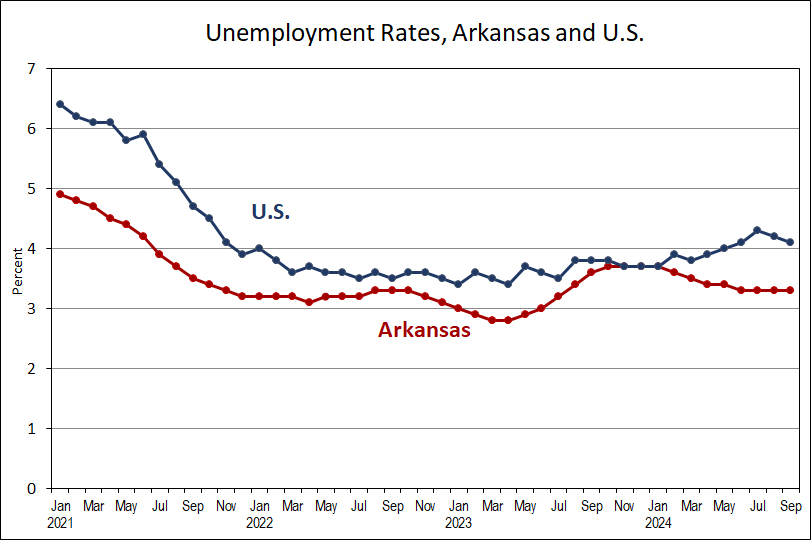
The state employment report for October continued to indicate a trend of better-than-expected employment growth and low unemployment. The unemployment rate remained at 3.3%, significantly lower than the national average of 4.1%. Employment growth continues to be impressive, whether measured in the household survey data or the establishment survey data. By any measure, total Arkansas employment was at record levels in October.

Source: Bureau of Labor Statistics

Household Survey Data
The unemployment rate was unchanged at 3.3%. The number of unemployed was essentially unchanged (+132), while both the number of employed and the total of labor force rose by over 3,000.

Source: Bureau of Labor Statistics, Local Area Unemployment Statistics (LAUS)

The Arkansas labor force participation rate was unchanged at 57.1%, having recovered to pre-pandemic levels in recent months. The U.S. participation rate remains slightly lower than in 2019, consistent with long-term trends associated with an aging population.

Source: Bureau of Labor Statistics

Payroll Survey Data
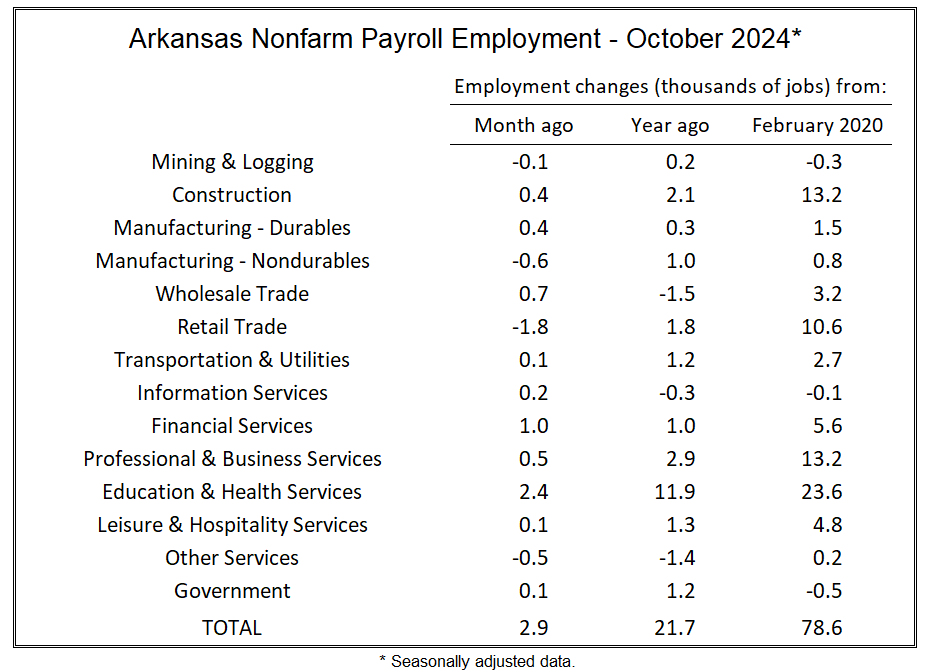
The information from the payroll survey was also generally positive. Total nonfarm payrolls were up by 2,900 jobs in October and job growth in September was revised upward by 700 jobs (seasonally adjusted). Employment in goods-producing industries was up slightly in October, with gains in Construction and Durable Goods Manufacturing offsetting losses in Nondurable Goods Manufacturing. In the service-providing sectors, Retail Trade was the only sector with notably negative employment growth. In the not-seasonally adjusted data, employment in Retail Trade was unchanged, so the decline in the seasonally adjusted statistics can be interpreted as indicating that employment in that sector has fallen short of the increase that typically happens at this time of year, relative to trend.

Source: Bureau of Labor Statistics, Current Economic Statistics (CES)

In the year-over-year statistics, total employment is up by 21.7 thousand jobs, with over half of those represented by the increase in Education & Health Services (primarily Health). Health Services represent the largest contributor to longer-run employment growth as well, with significant contributing sectors that include Construction, Retail Trade, and Professional & Business Services.

# # #

Seasonally adjusted data for Arkansas nonfarm payroll employment, reported in a format consistent with the monthly news release from the Arkansas Division of Workforce Services, can be found here: Table-Seasonally Adjusted NFPE.

Forecast Conference 2024

Thank you to all of the attendees at this mornings’ Arkansas Economic Forecast Conference. Special thanks to our guest speakers, Tara Sinclair and Bryan Day.

Copies of the national and state outlook presentations are available by clicking the following links:


Register now for the 2024 Arkansas Economic Forecast Conference, to be held on Thursday November 14th. The conference features updates on economic conditions and the outlook for the state and the nation.

When:
Thursday, November 14, 2024
7:30 – 9:30 AM

Where:
Wyndham Riverfront Little Rock
2 Riverfront Place, North Little Rock, AR 72114

The program includes:  

  • The National Economic Outlook, Tara Sinclair, Professor of Economics and International Affairs, George Washington University. Professor Sinclair is also the director of the GW Center for Economic Research, which focuses on economic forecasting. 
  • Arkansas Economic Outlook, Michael Pakko, Chief Economist and State Economic Forecaster, Arkansas Economic Development Institute.
  • Local Economic Developments, Bryan Day, Executive Director of the Port of Little Rock.
  • The program will include Q&A with all of the presenters.

The event is free, but register soon, because space is limited. The deadline for registration is November 8, 2024.

Questions? Please contact Dr. Ranjitsinh Mane at 501-916-5958.

Arkansas Employment and Unemployment – September 2024

The latest report on state-level employment and unemployment shows that Arkansas labor markets are continuing on a trend of low unemployment and job growth. The unemployment rate was unchanged at 3.3%, significantly lower than the 4.1% national unemployment rate.

Source: Bureau of Labor Statistics

The components of the unemployment rate all moved in a favorable direction in September: The number of unemployed was down by 944 and the number of employed was up 4,341. The net result was an increase in the labor force of 3,397. These changes were very close to driving the unemployment rate lower by one-tenth percent: If only 12 people were moved from the unemployed to the employed category, the unemployment rate would have been 3.2% after rounding.

Source: Bureau of Labor Statistics, Local Area Unemployment Statistics (LAUS)

Compared to a year earlier, the Arkansas unemployment rate is down 0.3%, with the number of employed up by 29,000 and the number unemployed down by 3,800.

Payroll Employment
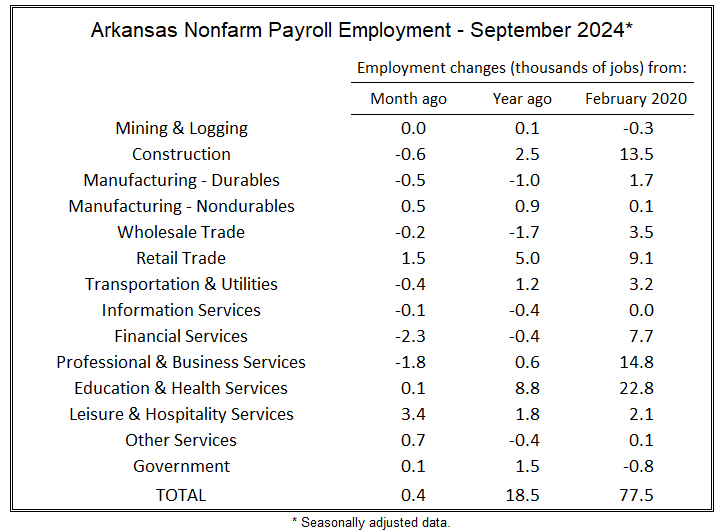
Arkansas Nonfarm payroll employment increased by 400 jobs in September, although the estimate for the previous month was revised downward by 1,800 jobs (seasonally adjusted data). As a result, total employment in September remained slightly below the all-time high reached in June, but is still 18,500 higher than in September 2023.

Changes in employment by industry showed considerable variability. Employment in Construction was down, continuing a downward trend since this spring. Employment in manufacturing in Durables was also lower for the month, while nondurables were higher. Among the service-providing sectors, both Financial Services and Professional Business Services were lower, while Leisure & Hospitality Services was sharply higher. The 3,400-job increase in Leisure & Hospitality employment followed a weak August that saw L&H jobs decline by 1,800.

Source: Bureau of Labor Statistics, Current Employment Statistics (CES)

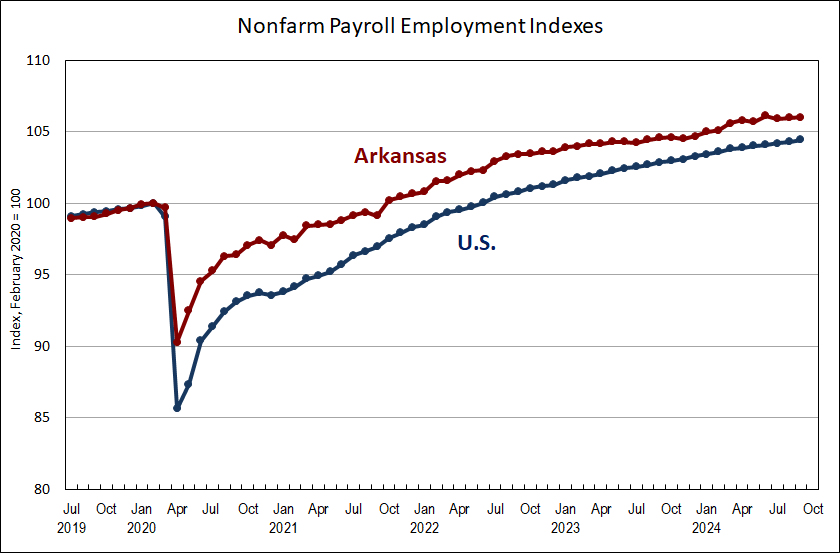
The year-over-year payroll employment growth of 18,500 jobs represents an increase of 1.4%. Over the same period, U.S. payroll employment has expanded at a rate of 1.6%. Compared to the pre-COVID-19 peak of February 2020, Arkansas employment has increased by 6.0%, while the comparable U.S. increase has been 4.5%.

Source: Bureau of Labor Statistics, Current Employment Statistics (CES)

# # #

Seasonally adjusted data for Arkansas nonfarm payroll employment, reported in a format consistent with the monthly news release from the Arkansas Division of Workforce Services, can be found here: Table-Seasonally Adjusted NFPE.