The final, but unrevised, report for 2024 metropolitan area employment and unemployment came out this week.
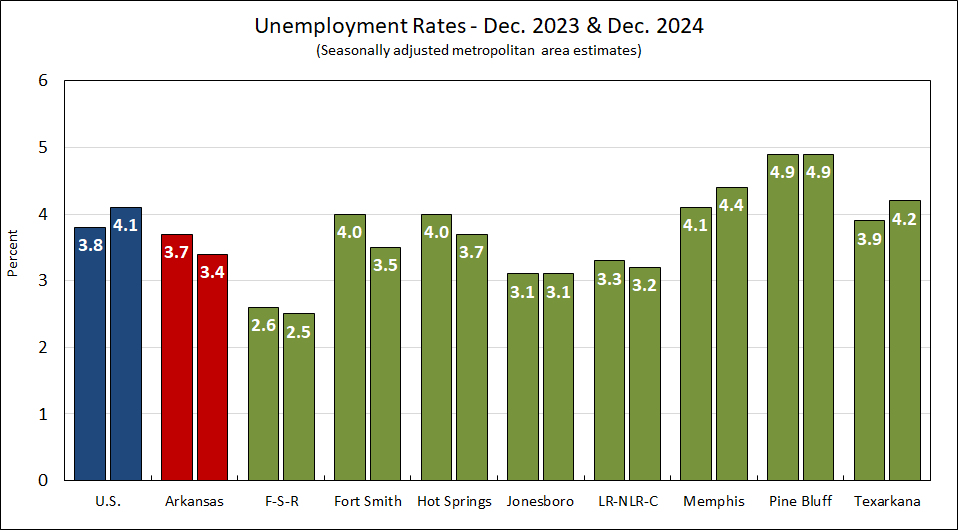
Unemployment rates tended to edge higher from November to December. Mirroring the 0.1 percentage point increase recorded for the state, unemployment rates edged up in Hot Springs, Jonesboro, Little Rock and Pine Bluff. Compared to a year earlier, unemployment rates were unchanged or down slightly, with the exception of Memphis and Texarkana which ended the year with higher rates than in December 2023. Northwest Arkansas had the state’s lowest unemployment rate, which was down to 2.5% by December. Pine Bluff remained the metro area with the highest unemployment rate, unchanged at 4.9%.
Payroll Employment
Nonfarm payroll employment rose sharply for Jonesboro in December, with mixed changes among other metro areas. The end-of-year surge in Jonesboro boosted year-over-year growth to 2.2%—the highest growth rate in the state for 2024. Northwest Arkansas and Central Arkansas both saw strong growth over the year as well. Memphis and Pine Bluff were the only metro areas to experience employment declines for the year.
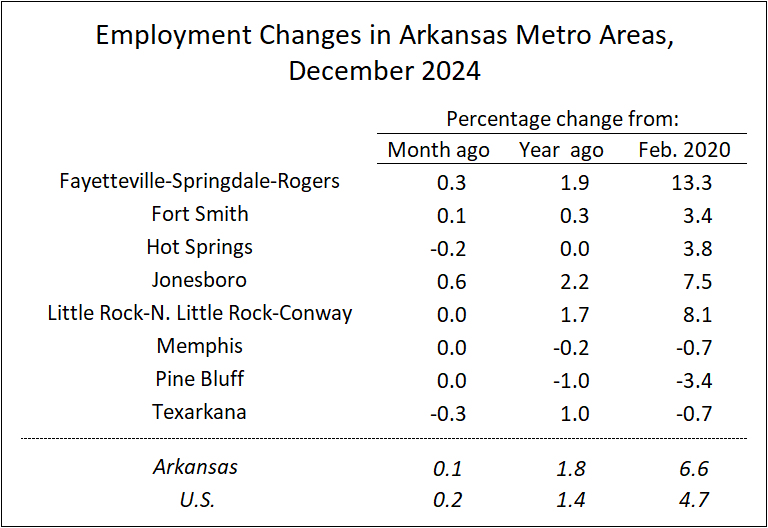
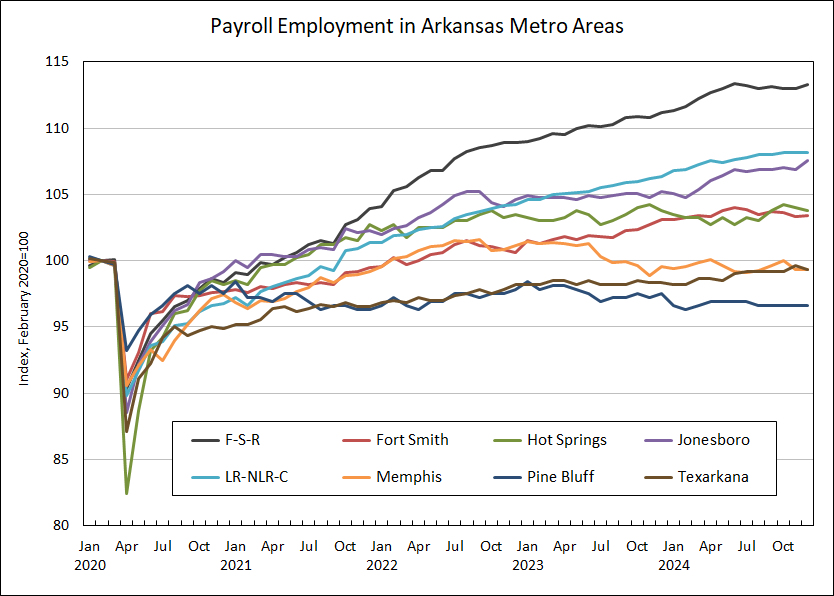
Over the longer-run, Northwest Arkansas continues to lead the state in employment growth, followed by Central Arkansas and Jonesboro. Fort Smith and Hot Springs have shown positive growth over the last five years, while employment Memphis, Texarkana and Pine Bluff remain lower than pre-pandemic levels.
The next report on metro area employment and unemployment will incorporate annual revisions for nonfarm payroll employment and will partly include annual revisions to the unemployment data as well. We will report on the revisions when they are released in March and April.