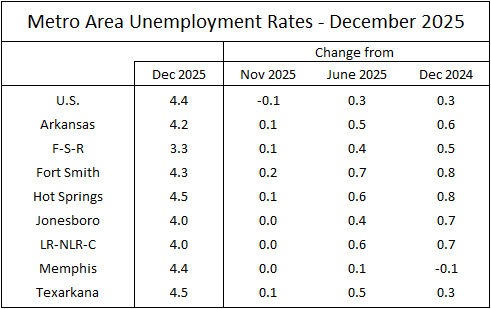
Arkansas metropolitan areas ended the year 2025 with rising unemployment rates, juxtaposed against a backdrop of employment growth that is slowing in some parts of the state but continuing to expand in other areas.
In December, unemployment rates were either unchanged or slightly higher than the previous month. Over the past several months, the rise in unemployment has been significant, with rates increasing by 0.4 to 0.7 percentage points in just the second half of the year (with the notable exception of Memphis, which has maintained a relatively steady unemployment rate).

Payroll Employment
Nonfarm payroll employment changes were mixed in December. Fort smith, Hot Springs, Memphis and Texarkana experienced declining employment for the month, while Northwest Arkansas, Central Arkansas, and Jonesboro registered employment gains.
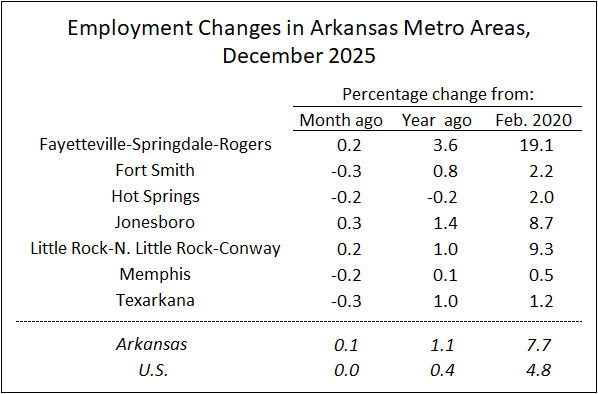
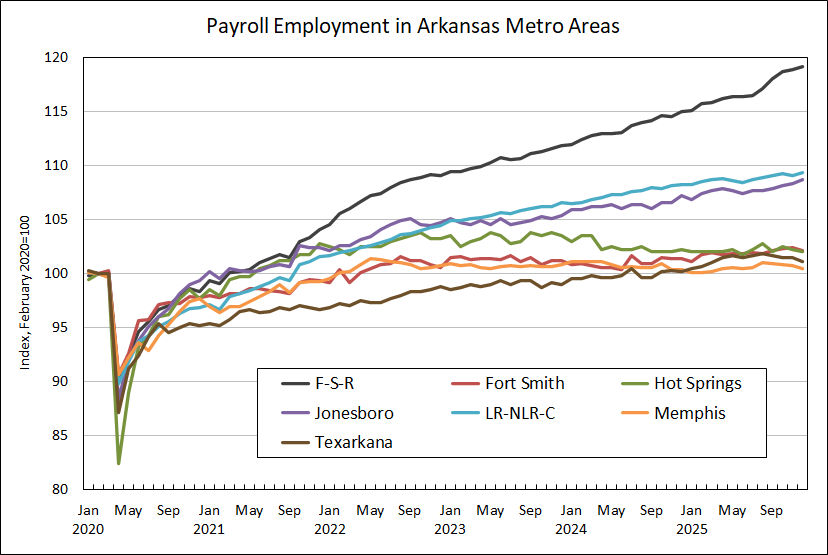
The pattern of relative growth rates is evident in longer term trends as well. Northwest Arkansas has consistently shown the strongest job growth in the state, with Central Arkansas and Jonesboro maintaining relatively strong growth rates as well. Over the most recent 12 months, Texarkana has also trended higher. Fort Smith, Hot Springs, and Texarkana have grown relatively slowly over the past five years, increasing by only one or two percent relative to February 2020.
County Unemployment Rates
An end-of-year snapshot of unemployment rates around the state shows a typical pattern. The areas of high unemployment are concentrated in the southeast, with some high-unemployment counties in north-central Arkansas as well. In and around the rapidly growing metropolitan areas, unemployment rates remain below 4%.