After longer-than-usual delays associated with federal government shutdowns last year, the Bureau of Labor Statistics finally released new state-level employment data for January 2026, along with the annual data revisions. In general, the revised and updated data paint a picture of weaker labor market conditions than were indicated by the unrevised data.
A case in point is Arkansas’ unemployment rate. As shown in the figure below, the pre-revision data was showing a gradual increase in unemployment during the second half of 2024 and through all of 2025. After revision, we see that the increase in unemployment took place more rapidly during 2025 than originally estimated. By the end of the year, the unrevised data a state unemployment rate of 4.2%, with a revised figure for December of 4.3%. Although this is a relatively small revision for December, the data for the summer months was revised to show unemployment rates as much as 0.4% higher than originally published.
The new information for January 2026 shows an unemployment rate of 4.4%, one-tenth of a percentage point higher than the U.S. average (although the difference is not statistically significant).

Payroll Employment
Nonfarm payroll employment was also subject to annual benchmark revisions (discussed below). For January, payroll employment increased by 1,800 jobs (seasonally adjusted, revised data). As shown in the table, most sectors saw employment gains, with the exception of Construction, Retail Trade, and Leisure & Hospitality Services.
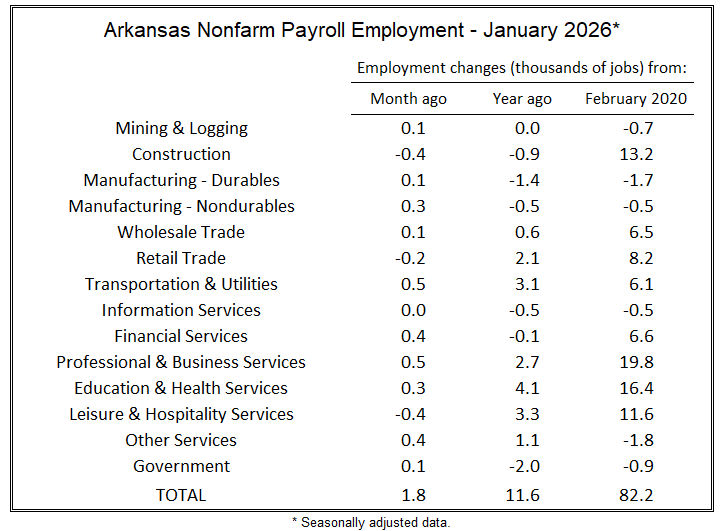
Over the past year, most sectors have experienced employment growth, with an overall increase of 11,600 jobs (approximately 0.9%). particularly notable are declining employment figures for Construction and Manufacturing. For manufacturing (both durable and nondurable goods), the newly revised data show that employment is lower now than it was prior to the onset of the COVID pandemic. This is a revelation that stems from the new data revisions.
Payroll Data Revisions
The annual benchmark revisions for nonfarm payroll employment were significantly larger than usual–at least for Arkansas. As of December 2025, the new total for payroll employment is 3.7% lower than previously reported. This was the largest revision among the 50 states plus District of Columbia.
A significant share of the downward revision was attributable to a rebasing of the entire employment series. Data as far back as 1990 was revised significantly lower, affecting the level of employment not just for recent years, but throughout the entire history of employment data for the state. An inquiry to the Arkansas Division of Workforce Services yielded an explanation that this source of revision had to do with the way non-covered employment was calculated (i.e., employment not subject to unemployment insurance). Because these revisions shifted the level of the entire structure of employment over 36 years, this source of revision is not economically significant. That is, the changes have little impact on recent employment growth trends.
On the other hand, the usual benchmarking process that uses updated source data over the past two years was also larger than usual. Of particular note were revisions to employment growth in manufacturing. As shown in the figures below, growth over the past 15-18 months has been considerably slower than previously reported. From October 2024 through December 2025, the originally-published data showed an increase of 1.9% for durable goods employment and 1.2% for nondurable goods employment. After revision the new series show a decline of 3.5% for durable goods, and zero net change in nondurable goods.

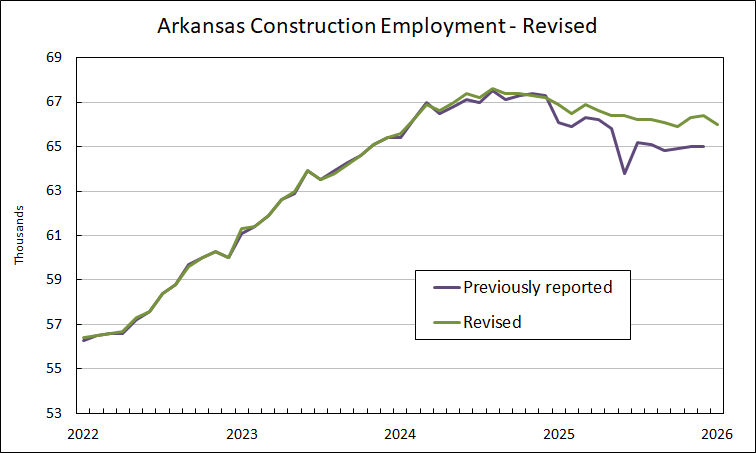
The other goods-producing sector that has shown declining employment over the past 12 months, construction, had a different revision pattern. Although construction employment has been declining for the past 18 months, the revised data show the decline to be attenuated relative to the originally-published figures.
In order to control for the long-term rebasing of the series back to 1990, we can examine the employment index that we usually use to compare growth trends in Arkansas with the U.S. By using index values using the pre-COVID month of February 2020 as a base period, it is possible to compare trends before and after revision with the total U.S. equivalent. As shown below, the newly revised data show a slower recovery of employment from mid-2020 through 2022, as well as a slower growth trend in 2024 and 2025. Overall, the revised data show employment in December 2025 was 6.3% higher than in February 2020, while the previously-published data had shown 7.7% growth over that period.

The Figure below shows year over year growth rates for 2023-2025. The new revisions have the effect of raising Arkansas employment growth in 2023 (from 1.2% to 1.8%), and lowering growth in 2024 and 2025. Notably, the revised Arkansas employment data show higher growth rates than the U.S. over all three years. In particular, even the 0.65% growth rate in 2025 outpaces the near-zero growth for the U.S. total.

# # #
Seasonally adjusted data for Arkansas nonfarm payroll employment, reported in a format consistent with the monthly news release from the Arkansas Division of Workforce Services, can be found here: Table-Seasonally Adjusted NFPE.