Skip to content

Arkansas Employment and Unemployment – November 2025

After delays associated with the federal government shutdown in October, the U.S. Bureau of Labor Statistics and the Arkansas Division of Workforce Services today released new employment and unemployment data for Arkansas. The household survey that is used to generate statistics on unemployment rates and participation rates was not conducted in October, so there will be a gap in those series. Today’s release included new data from the payroll survey for October and November, as well as revised data for September.

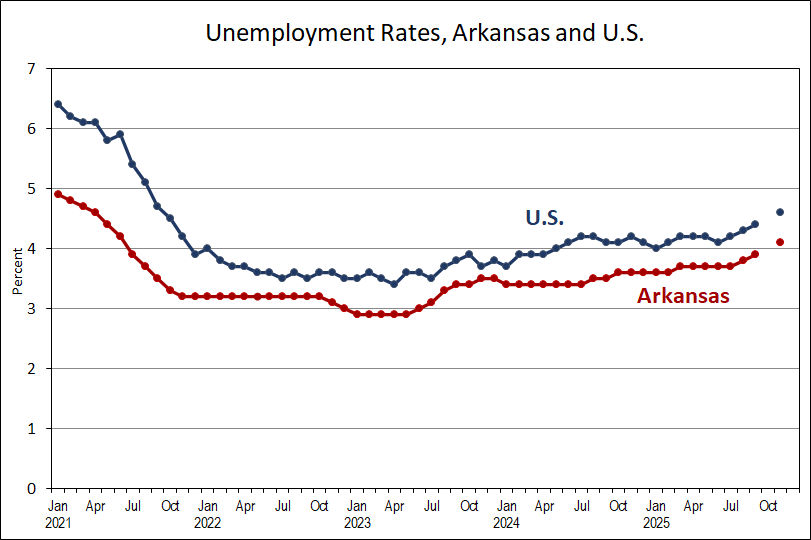
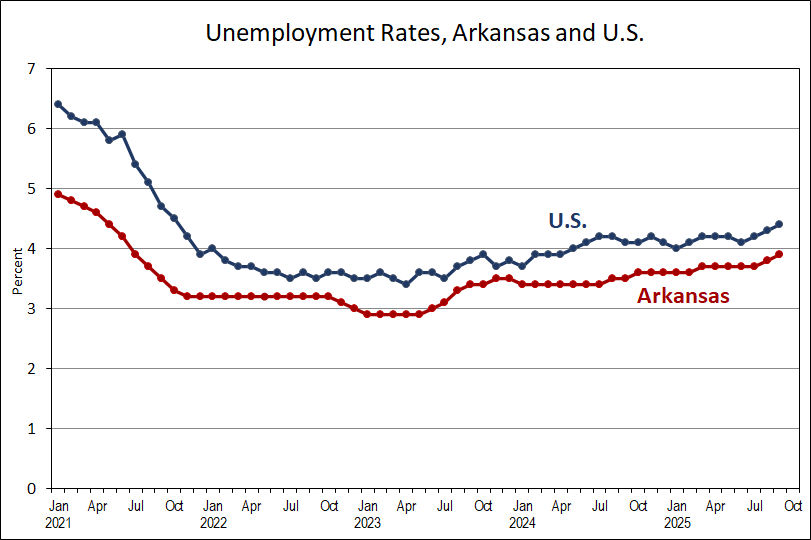
The headline news was an increase in the Arkansas unemployment rate from 3.9% in September to 4.1% in November. Over the same period, the U.S. unemployment rate rose from 4.4% to 4.6%.
Source: Bureau of Labor Statistics

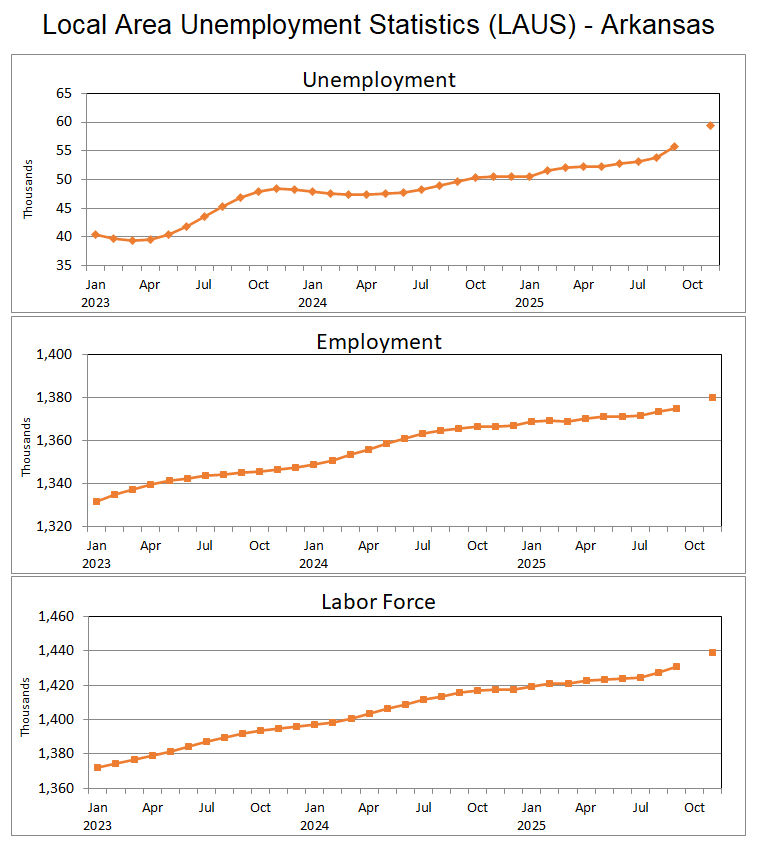
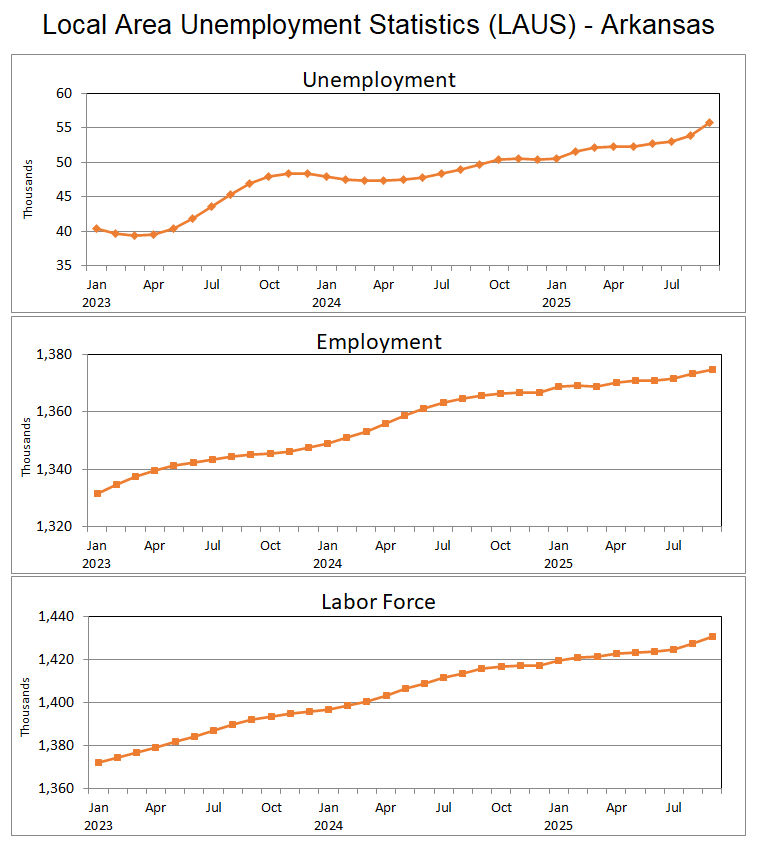
The increase in the Arkansas unemployment rate was driven by relatively large increases in the number of unemployed workers in the survey. The number of unemployed rose by 1,891 in September and by another 3,634 from September to November, for a total of 5,525 over the three-month period. While this surge in unemployment is notable, we also saw increases in household employment. Employment rose by 1,546 in September and then by another 4,999 from September to November. As a result of these increases, the labor force expanded by 12,070 over the three-month period.
Source: Bureau of Labor Statistics, Local Area Unemployment Statistics (LAUS)

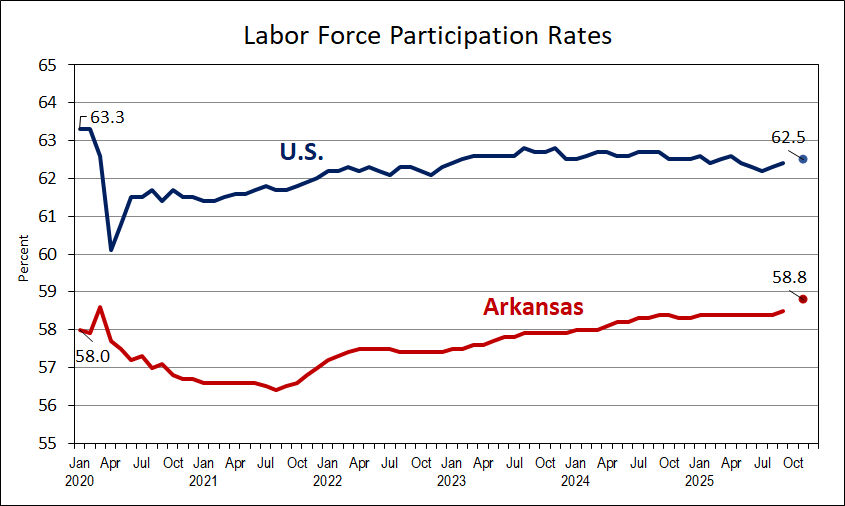
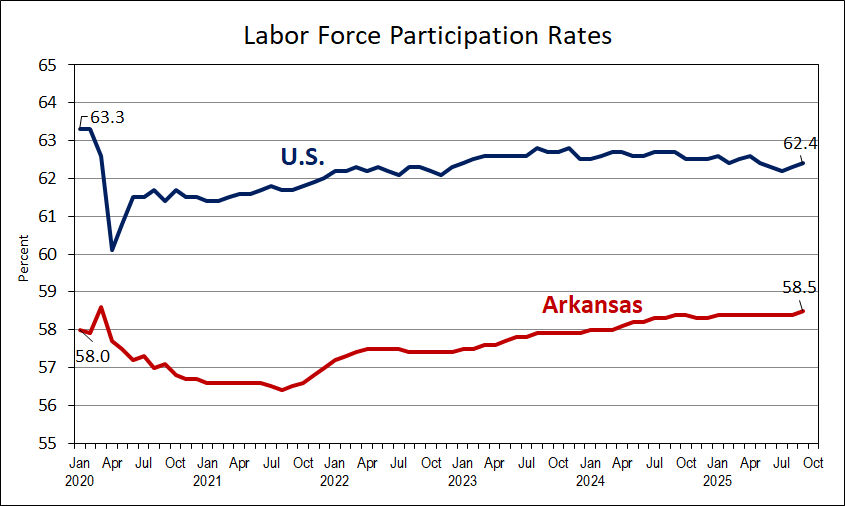
The expansion the labor force also resulted in a higher labor-force participation rate for the state, increasing from 58.5 in September to 58.8 in November.
Source: Bureau of Labor Statistics

Payroll Employment
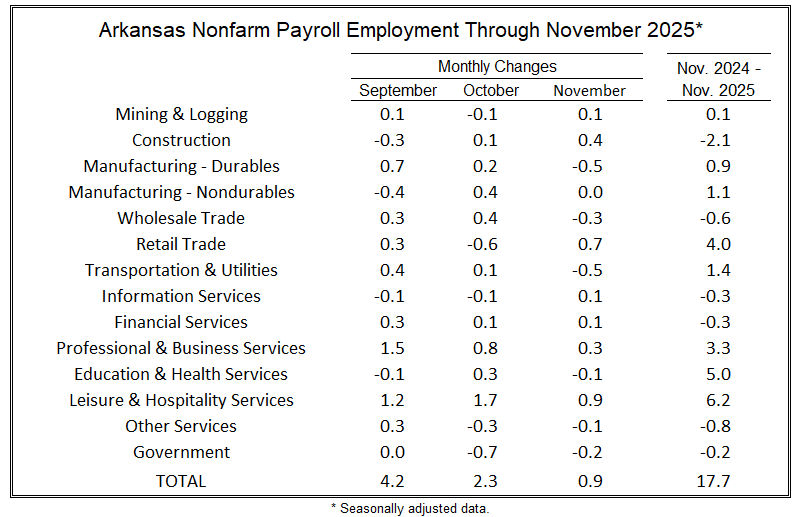
The establishment survey data also showed increases in employment, with nonfarm payrolls expanding by 4,200 in September, 2,300 in October, and 900 in November (seasonally adjusted data). Employment gains in that three month period amounted to an annualized growth rate of 2.2%.

Nearly every major sector expanded over the August-November period, with the exception of Information Services, Other Services, and Government. The largest gains were in Leisure & Hospitality Services and Professional & Business Services. Employment in Health Services was uncharacteristically weak, increasing by only 400 jobs over the three-month period (with employment in Private education services down 300).
Source: Bureau of Labor Statistics, Current Employment Statistics (CES)

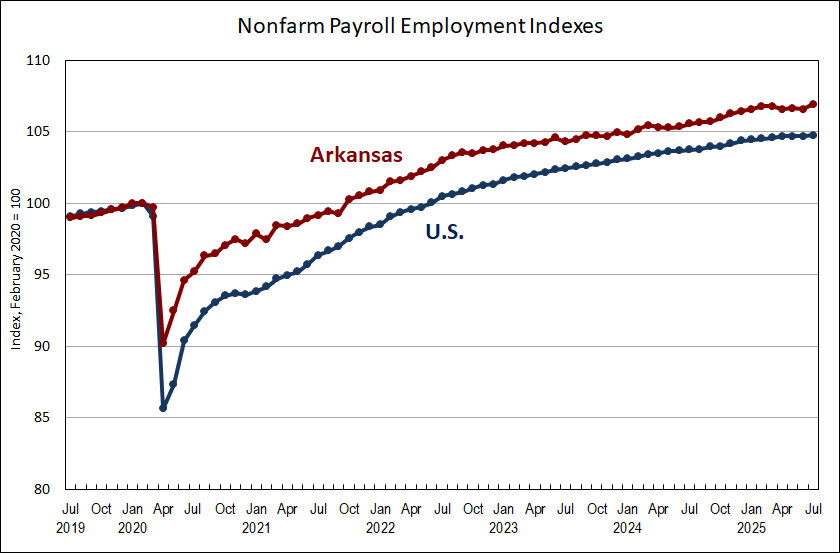
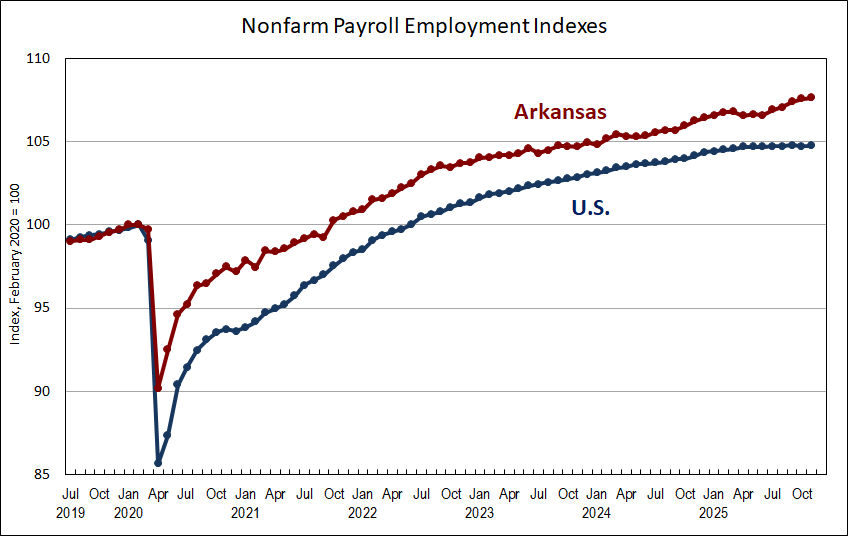
Over the most recent 12 months, total nonfarm payrolls expanded by 17,700—a percentage rate of 1.3%. Over the same period, U.S. payroll employment grew at a rate of 0.6%. Since the pre-pandemic peak of February 2020, Arkansas employment has increased by 7.6% and U.S. employment has increased by only 4.8%.
Source: Bureau of Labor Statistics, Current Employment Statistics (CES)

# # #

Seasonally adjusted data for Arkansas nonfarm payroll employment, reported in a format consistent with the monthly news release from the Arkansas Division of Workforce Services, can be found here: Table-Seasonally Adjusted NFPE.
Arkansas Unemployment – September 2025

The Arkansas Division of Workforce Services released new data on household employment and unemployment today, showing that the state’s unemployment rate rose 0.1 percentage point in September, rising to 3.9%. The U.S. unemployment rate had previously been reported as rising from 4.3% to 4.4% in September. The federal government shutdown has delayed many data releases, even cancelling some. The new data for September was collected prior to the government shutdown, but was delayed in publication until this week. The Bureau of Labor Statistics is not scheduled to announce state-level employment and unemployment data until Thursday (December 11).

Source: U.S. Bureau of Labor Statistics; Arkansas Division of Workforce Services

Underlying the increase in the unemployment rate was a surge in the number of unemployed, up by 1,891. This was the largest monthly increase since the spring of 2023, and adds to the increasing trend in unemployment that has generally prevailed since the spring of 2024. The number of employed Arkansans was also higher in September, increasing by 1,546. As a result, the labor force rose by 3.437.

Source: U.S. Bureau of Labor Statistics; Arkansas Division of Workforce Services

With the increase in the labor force, Arkansas’ labor force participation rate ticked higher, reaching 58.5% in September.

Source: U.S. Bureau of Labor Statistics; Arkansas Division of Workforce Services

Note: As is the usual practice, the data from the Arkansas Division of Workforce Services included only not-seasonally adjusted figures for nonfarm payroll employment. Many of the monthly changes for September were attributable to seasonal factors, with schools starting back up in the fall (increasing Education and Government employment) and the end of the summer travel season (decreasing Leisure & Hospitality employment). We will report on the seasonally adjusted data when they are released by the BLS later this week.

Arkansas Economic Forecast Luncheon

The date is rapidly approaching. Register now!  

Join the Little Rock Branch of the Federal Reserve Bank of St. Louis and the Arkansas Economic Development Institute at UA-Little Rock for the 2025 Arkansas Economic Forecast luncheon.

Date:
Thursday, Nov. 6, 2025

Time:
Lunch and Networking: 11 a.m. CT
Program: 11:30 a.m.- 1 p.m. CT

Location:
Clinton Presidential Center
1200 President Clinton Ave.
Little Rock, AR 72201 (map it)

Registration Deadline:
Monday, Nov. 3, 2025

This event will provide a useful perspective on the current state of our economy through discussions about economic trends, issues and developments. It will include presentations from our region’s economic experts:

  • B. Ravikumar, St. Louis Fed senior vice president and deputy director of research, will discuss national and global economic conditions
  • Kathleen Navin, St. Louis Fed senior economist, will discuss regional economic conditions
  • Michael Pakko, Arkansas Economic Development Institute at UA-Little Rock chief economist and state economic forecaster, will discuss Arkansas’ economic outlook 

The program will include a welcome from Matuschka Lindo Briggs, St. Louis Fed senior vice president and regional executive of the Little Rock Branch. Following the presentations, she will moderate a panel discussion and a Q&A session.

You will be given the opportunity to submit questions in advance for the Q&A session during the registration process.

There is no charge to attend this luncheon event, but registration is required by Nov. 3.

Questions? Contact Julie Kerr of the Little Rock Branch at julie.a.kerr@stls.frb.org or 501-324-8296.

Arkansas Personal Income – 2025:Q2

Arkansas personal income growth for the second quarter came in at a 0.9% annual rate, compared to 5.5% for the U.S. Arkansas had the slowest income growth of all 50 states. The second quarter growth rate is in sharp contrast to the (revised) first quarter growth rate of 9.2%.

The slowdown in growth was predictably associated with the volatile Farm Proprietor’s income component. Total Proprietors’ income declined at a 45% annualized rate, shaving 4.1 percentage points off of total income growth. In other words, total personal income would have increased at a rate of 5.0% if proprietors’ income had shown zero growth. Other components of personal income, including Wages & Salaries; Dividends, Interest & Rent; and Transfer Receipts showed growth rates higher than the U.S. total.

While proprietors’ income had been boosted in recent quarters by a recovery in farm incomes, the farm component once again suppressed growth in the second quarter.

Total personal income growth in Arkansas had been outpacing the nation as Farm Proprietors’ income was boosting growth through 2005. From 2024:Q1 through 2025:Q1, Arkansas personal income expanded by 6.7% while U.S. personal income grew by 5.1%. The reversal in relative growth rates in the first quarter narrowed the longer-term growth gap that had been opening up. Nevertheless, Arkansas remains above the national average when it comes to cumulative growth since the first quarter of 2020

Annual Data Revisions
Annual revisions to personal income series overall had a relatively small impact on total income reported for 2025. The path of income was revised downward for 2022 and 2023, but somewhat higher estimates of growth during 2024 brought the revised growth path more closely in line with the previously published level. As of 2025:Q1, the revised estimate of total personal income was only 0.5% lower than the level that was initially reported. The Wage & Salary component was revised downward by only 0.1%.

Some components of personal income were revised more substantially. As of 2025:Q1, Proprietors’ Income was revised upward by 25%; Dividends, Interest, and Rent was revised down by 9.3%.

Arkansas GDP – 2025:Q2

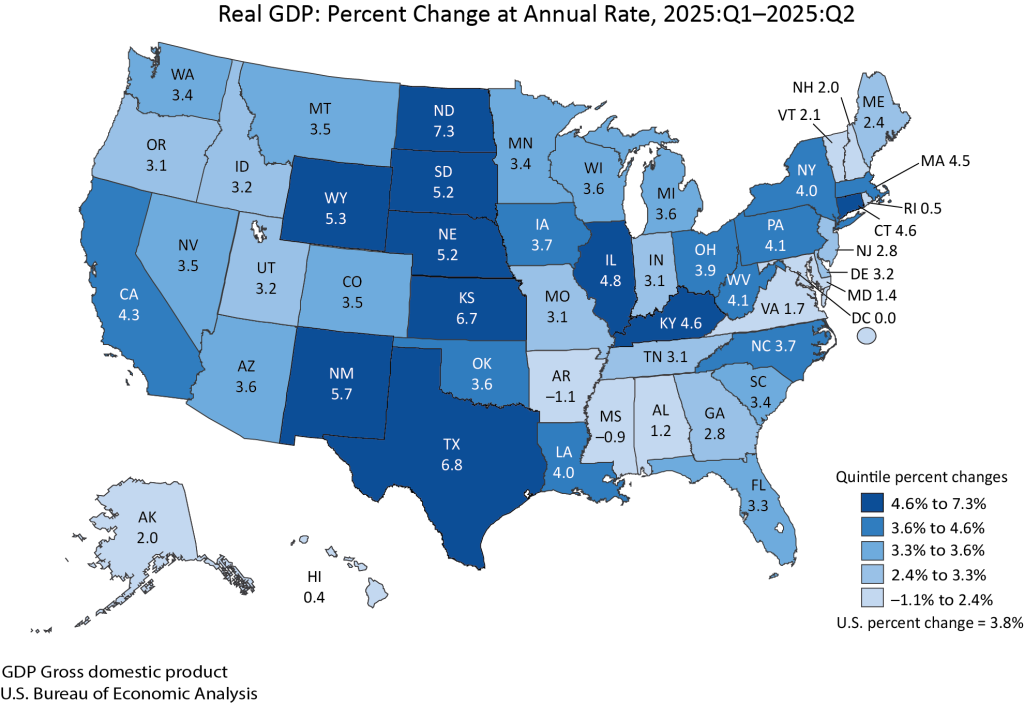
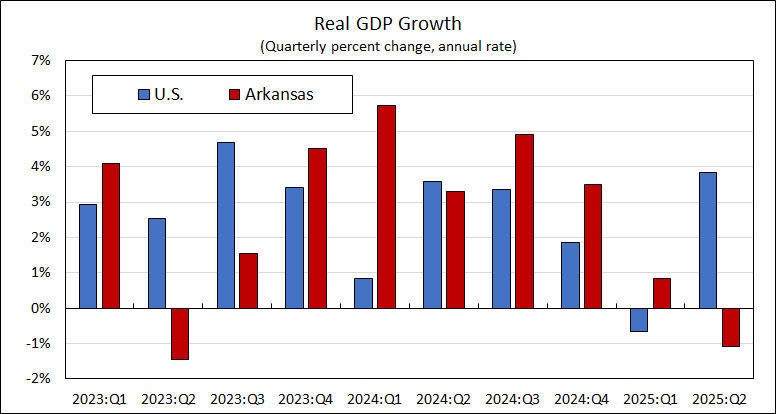
After a string of strong GDP reports since the second half of 2024, the latest report on Arkansas GDP was disappointing. In the second quarter of 2025, Arkansas GDP declined at an annualized rate of 1.1%. Arkansas was one of two states (along with Mississippi) that showed negative growth for the quarter. The U.S. GDP growth rate in the second quarter was 3.8%.

Source: Bureau of Economic Analysis

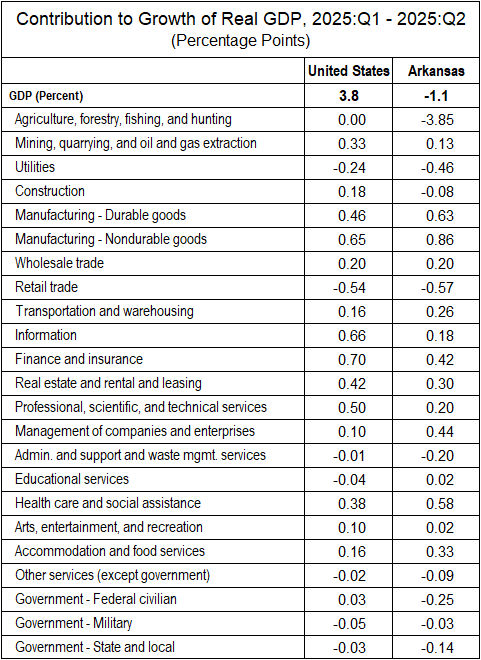
Not surprisingly, the second-quarter weakness was almost entirely attributable to the volatile agricultural sector. In fact, varying conditions in farm output were responsible for both extremes of state GDP growth across the nation. According to the news release from the Bureau of Economic Analysis, the agriculture sector “was the leading contributor to growth in six states including Kansas, the state with the third-largest increase in real GDP. In contrast, this industry was the leading offset to growth in six states including Arkansas and Mississippi, the two states where real GDP declined.”

The table of contributions to GDP growth by sector, below, illustrates the dramatic impact of the agricultural sector decline in the second quarter. Were it not for agriculture, Arkansas GDP would have risen by over 2.7%.

Source: Bureau of Economic Analysis

Annual Revisions
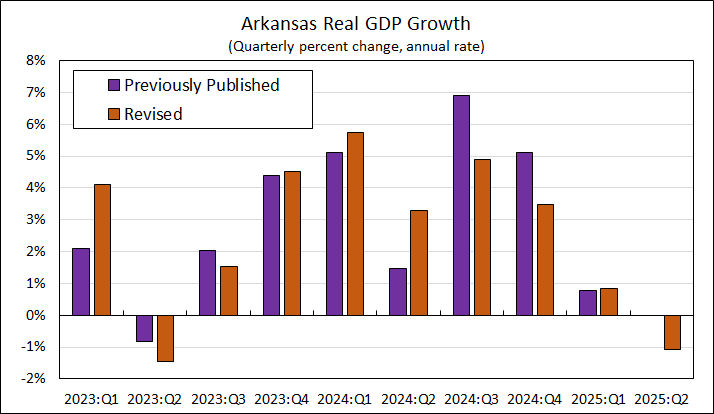
Today’s report also included annual updates and revisions to GDP and Personal Income data. As shown in the figure below, data for Arkansas were subject to notable revisions in both directions in the quarterly data. Notably, the quarterly growth rates for the third and fourth quarters of 2024 were revised down. In the original data releases, Arkansas was the fastest growth state in both quarters. After revision, the lower growth estimates knocked the state’s ranking down, although it remained on the top ten list in both quarters.

Source: Bureau of Economic Analysis

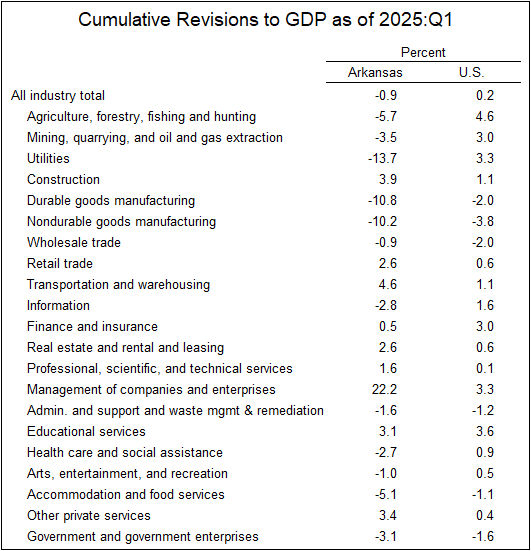
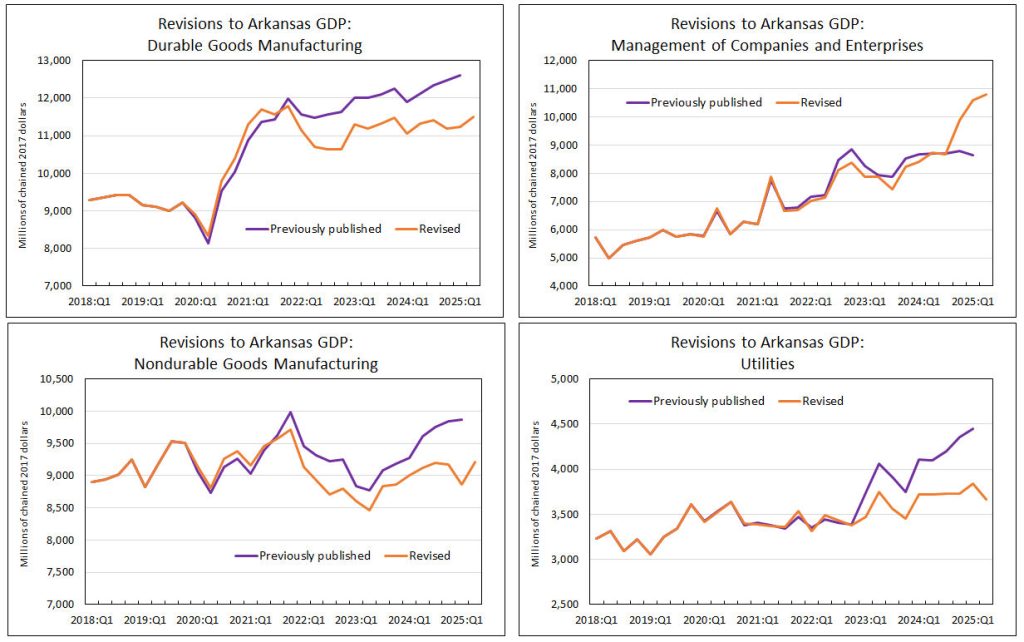
The magnitude of revisions was, for some sectors, substantial. Overall, the cumulative revisions marked down Arkansas’ first quarter GDP by 0.9%. Utilities and manufacturing were particularly hard hit. On the other hand, Management of companies and enterprises was revised significantly higher.

Source: Bureau of Economic Analysis

Arkansas Employment and Unemployment – August 2025

Despite an increase in the state’s unemployment rate, the employment report for August did not indicate weak labor market conditions. Taken as a whole, the data for August suggest ongoing growth in employment and jobs.

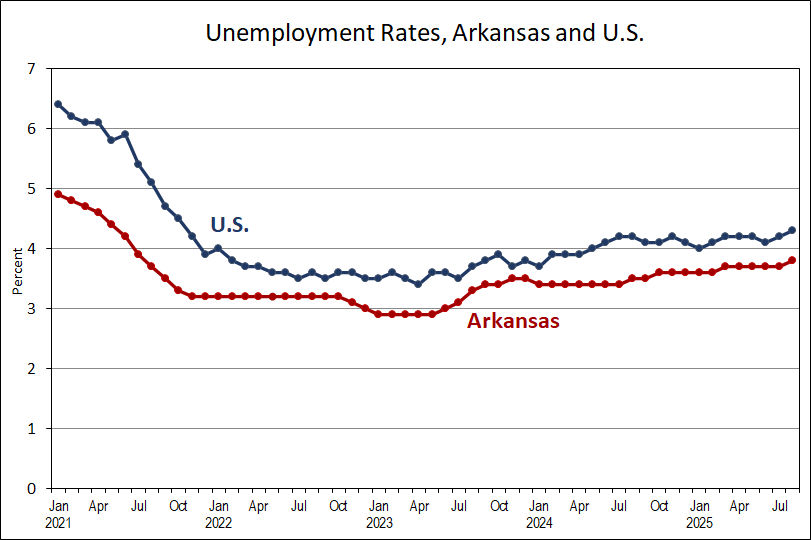
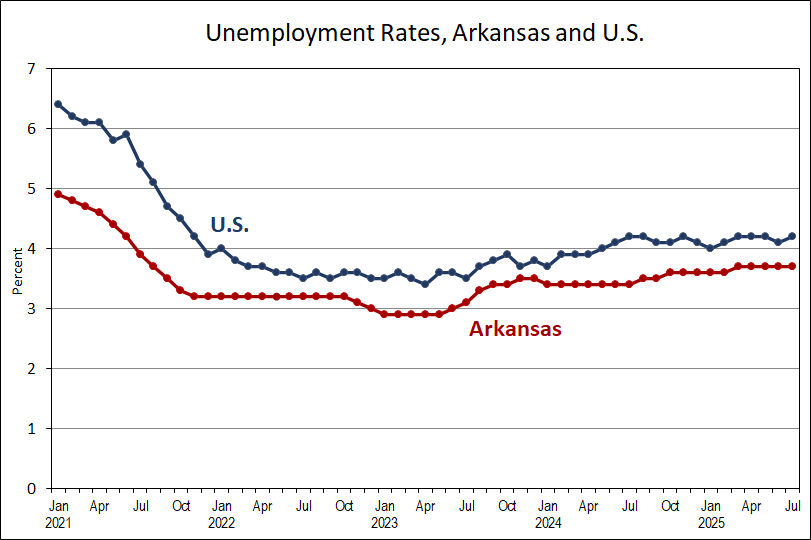
Mirroring a 0.1 percentage point increase in the national data (from 4.2% to 4.3%), Arkansas’ unemployment rate rose from 3.7% to 3.8% in August.

Source: Bureau of Labor Statistics

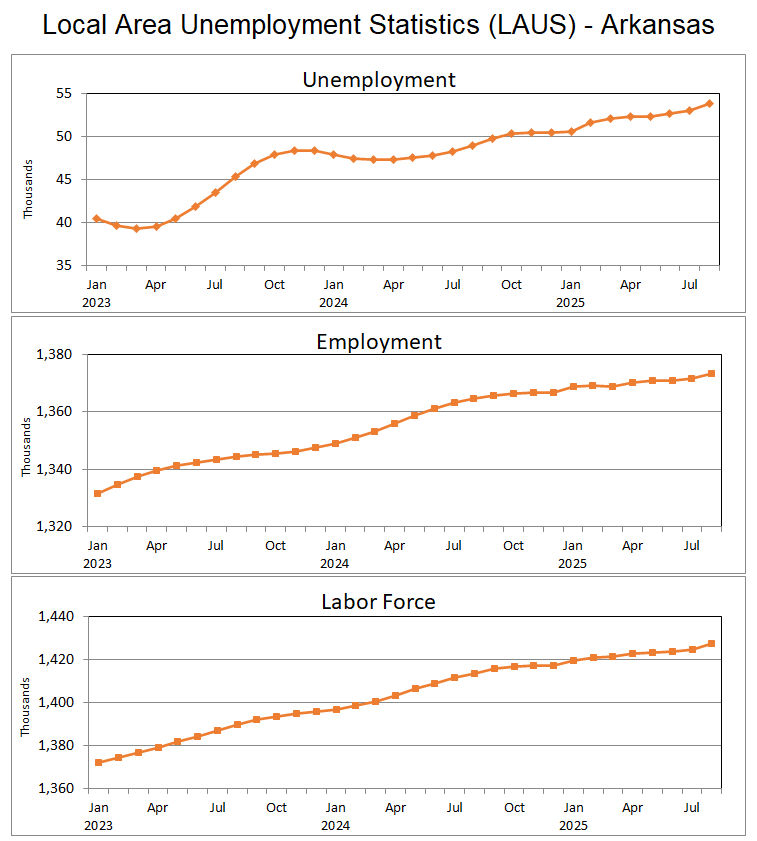
After five months of holding steady at 3.7%, the increase might be interpreted as significant. In reality, unemployment has been slowly and steadily rising over the course of 2025. In August the unemployment rate went from being rounded down to 3.7% to being rounded up to 3.8%. Moreover, the fact that unemployment remains below 4.0% is a sign that Arkansas labor markets continue to be generally healthy. That perspective is reinforced by the continuing growth trends that we see in household employment and the labor force. The number of employed increased by 1,683 in August and is up 8,665 over the past 12 months. The labor force expanded by 2,480 in August, with cumulative growth over the past 12 months of 13,554.

Source: Bureau of Labor Statistics, Local Area Unemployment Statistics (LAUS)

Payroll Employment
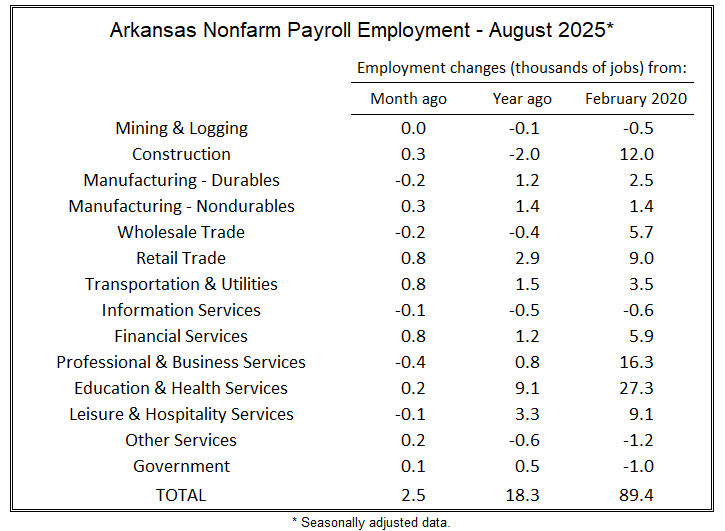
Nonfarm payroll employment increased by 2,500 jobs in August (seasonally adjusted). Seasonal effects are important for interpreting statistics for August because we see employment in both private and public education return to school-year norms. After accounting for this type of recurring pattern, we still see fairly strong growth in the data for August. Sectors that shown notable increases include Retail Trade, Transportation & Utilities, and Financial Services. The only weakness in the sectoral breakdown of employment were small declines in Durable Goods Manufacturing, Wholesale trade and Professional & Business Services. The decline in Professional & Business services was entirely attributable to the subcategory of Administrative & Support Services, which includes temporary workers and is often quite variable from month to month.

Source: Bureau of Labor Statistics, Current Employment Statistics (CES)

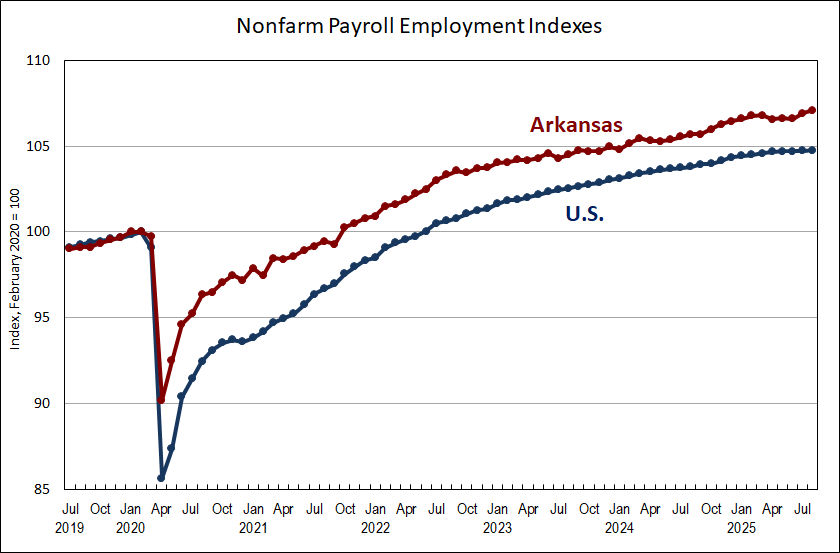
Compared to a year ago, payroll employment is up by 18,300 jobs—about 1.0%. For the U.S., job growth over the past 12 months has also totaled 1.0%. [Note: the data do not reflect the preliminary benchmark revisions that were released last week. Final benchmark data will not be incorporated into the current series until January 2026.]

Source: Bureau of Labor Statistics, Current Employment Statistics (CES)

# # #

Seasonally adjusted data for Arkansas nonfarm payroll employment, reported in a format consistent with the monthly news release from the Arkansas Division of Workforce Services, can be found here: Table-Seasonally Adjusted NFPE.
Preliminary Benchmark Revisions to Payroll Data

Revisions to employment data have recently been the focus of an inordinate amount of attention. The latest story on this topic is the preliminary benchmark revisions to Nonfarm Payroll Employment that were announced this morning by the Bureau of Labor Statistics.

Annual benchmark revisions are primarily the result of incorporating data from the Quarterly Census of Employment and Wages (QCEW). As suggested by the word “census” in the title, this data set is a comprehensive summary of national employment, based on data from state unemployment insurance programs. Benchmarking the payroll data introduces significant new, more accurate information to the series on current employment.

To complicate the story further, the actual benchmark revisions will not take place until early 2026. The data released this morning represent preliminary estimates of the revisions. The actual benchmark revision will be based on revised data from the QCEW which will be available at the end of this year. Accordingly, month-to-month reports on nonfarm payroll employment will not be affected by today’s estimates, and there is often a considerable difference between the preliminary and actual benchmark revisions.

With those provisos in mind, we can evaluate the potential impact of the preliminary benchmarked data on recent trends, assuming that the QCEW data revisions between now and the end of the year will be minimal.

The preliminary benchmark revisions announced this morning affect estimates for March 2025. For the entire U.S., the preliminary benchmark suggests a downward revision of 911,000 jobs—amounting to 0.6% of total March employment. The preliminary benchmark revision for Arkansas is a downward revision of 11,300 jobs, or 0.8% of total state employment.

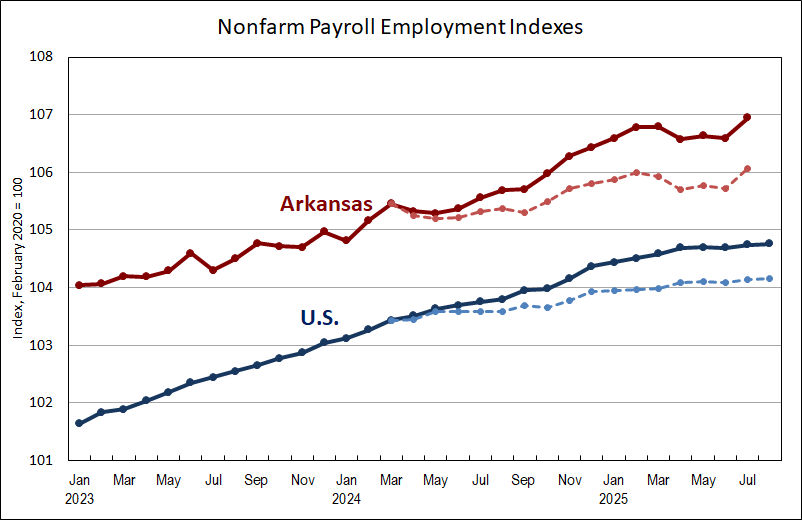
The figure below illustrates the magnitude of the potential revisions, assuming that the cumulative revisions reported for March 2025 were spread across the previous 12 months, with data for March 2024 unaffected. Data for April 2025 and beyond is simply extrapolated from the hypothesized revision to March data.

Dashed lines indicate hypothetical benchmark revisions to data for March 2024 through March 2025.

These hypothetical revised series are intended to be suggestive only. The actual benchmark revisions will not be released or incorporated into current data until the numbers for January 2026 are reported next year. But if the preliminary numbers hold, these hypothetical calculations indicate that employment growth over the past 15 months has been considerably lower than has been previously reported. For July 2024 through July 2025, Arkansas nonfarm payrolls have been reported to expand by 18,000 jobs or 1.3%. With the hypothesized revisions, that growth slows to only 9,800 jobs, amounting to 0.7%. For the same period, U.S. employment growth might be revised down by as much as half—from current estimates of 1.0% to a revised 0.5%.

For more information, see:

Metro Area Employment and Unemployment – July 2025

The latest employment report showed mixed results for Arkansas’ metro areas. Unemployment rates were mostly unchanged, ticking up 0.1 percentage points in Little Rock and Memphis. Over the past 12 months, unemployment rates have generally drifted higher, with the exception of Texarkana, where the rate is down by 0.2 percentage points since July 2024.

Source: Bureau of Labor Statistics, Smoothed Seasonally Adjusted Metropolitan Area Estimates

Payroll Employment
Nonfarm payroll employment increased in most metro areas across the state. Memphis payrolls declined slightly and Fort Smith showed zero net gain for the month. However, increases were recorded in Arkansas’ other metros, with particularly notable gains in Hot Springs and Little Rock. Over the past 12 months, employment in Memphis, Hot Springs, and Fort Smith has held fairly steady, while payrolls in Jonesboro, Little Rock and Texarkana have increased by magnitudes greater than one percent. In Northwest Arkansas, the increase in employment since July 2024 has been 2.7%.

Source: Bureau of Labor Statistics, Current Employment Statistics (CES)

Arkansas Employment and Unemployment – July 2025

The report on state-level employment for July 2025 indicated that Arkansas continues along a relatively steady growth path. The Arkansas unemployment rate was unchanged at 3.7% and the labor force participation rate was unchanged at 58.4%. Those key indicators of labor market activity have shown no significant change over the course of 2025. Meanwhile, Arkansas payroll employment continued to expand in July—albeit with a notable downward revision to the data for June.

The national employment report released on August 1 showed the U.S. unemployment rate ticking up to 4.2% from 4.1% in June. Other than the brief dip in June, the national unemployment rate has been stable for five months. Meanwhile the Arkansas unemployment rate has remained steady at 3.4%.

Source: Bureau of Labor Statistics

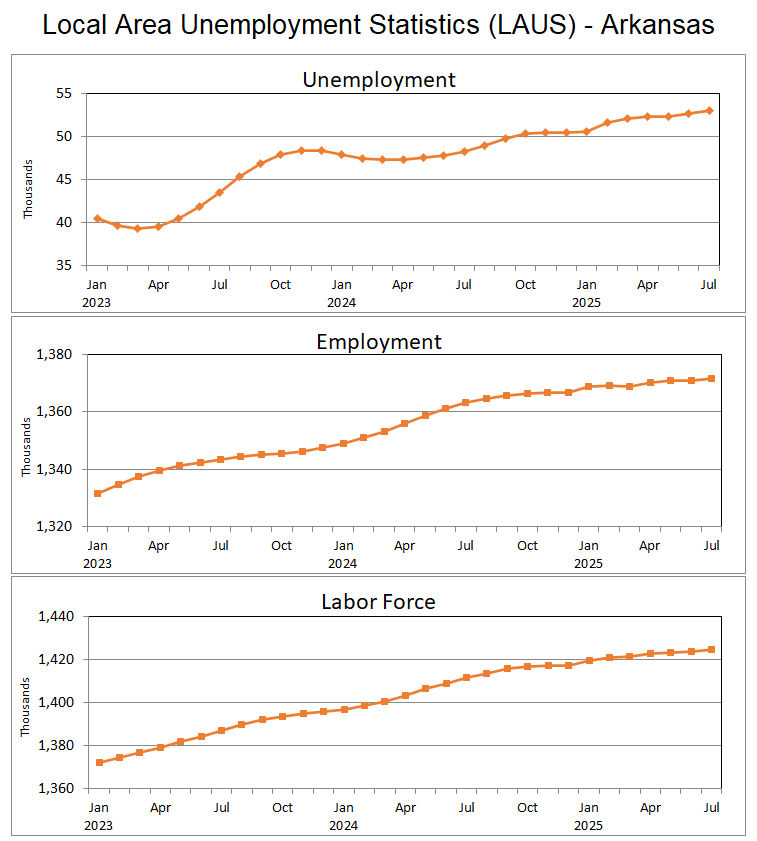
While the unemployment rate has been unchanged since March, the number of unemployed has been trending higher, rising from 50,588 in March to 53,049 in July. Meanwhile, employment and the labor force have been expanding in tandem, resulting in no change in the ratio of the unemployment to the labor force (the unemployment rate). In July, the number of unemployed increased by 347 and the number of employed was up 556, resulting in a labor force increase of 903.

Source: Bureau of Labor Statistics, Local Area Unemployment Statistics (LAUS)

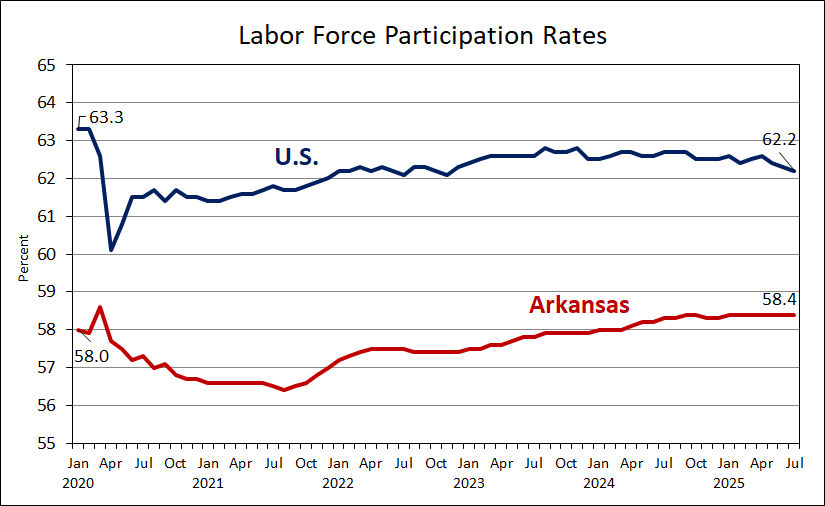
Similarly, the Arkansas labor force has expanded in tandem with population in recent months, resulting in a labor force participation rate that has been steady at 58.4% since January. Arkansas’ labor force participation rate has increased from 57.8% to 58.4% since July 2024. Over the same period, the U.S. participation rate has trended modestly lower, dropping from 62.6% in July 2024 to 62.2% in July 2025.

Source: Bureau of Labor Statistics

Payroll Employment
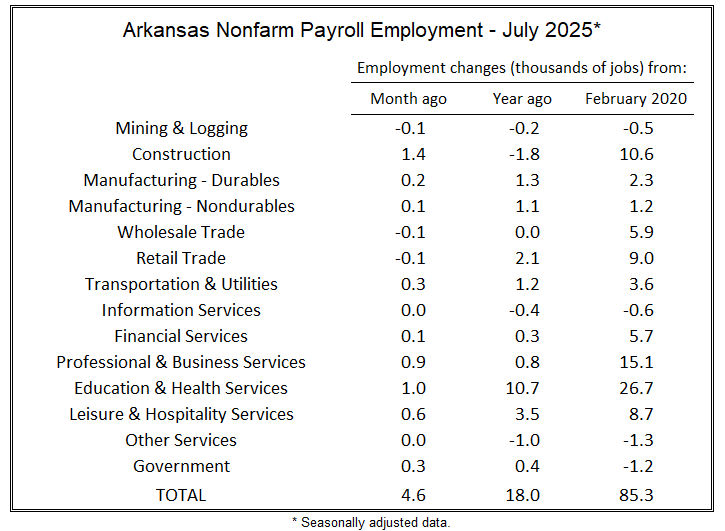
Arkansas nonfarm payroll employment increased by 4,600 in July (seasonally adjusted). When the national employment statistics were released on August 1, the slow job growth and substantial downward revisions to readings from May and June were the cause of consternation—so much so that the President took the unprecedented step of firing the Commissioner of the Bureau of Labor Statistics. Data revisions are not uncommon, but given the controversy about the revisions to U.S. data, it is interesting to note that Arkansas employment was also revised downward for June. What was originally reported as an increase of 1,200 is now reporting a decline of 600 jobs.

For July, the seasonally adjusted increase reflected growth across nearly every sector. Particularly large gains were reported for Construction, Professional & Business Services (primarily in Administrative & Support), Education and Health Services (all related to Health Care), and Leisure & Hospitality Services (Accommodation and Food Services).

Source: Bureau of Labor Statistics, Current Employment Statistics (CES)

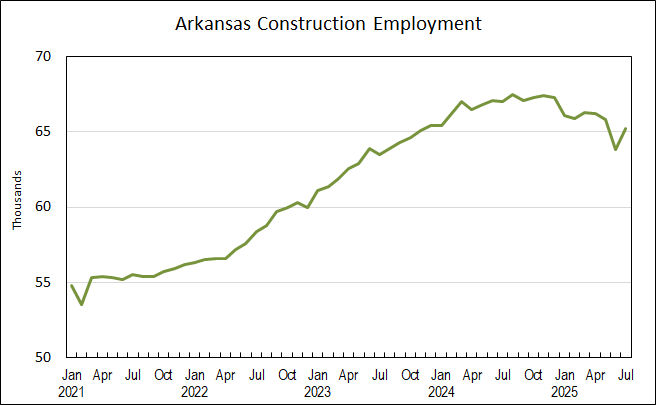
The increase in Construction employment was notable for the fact that it followed a sharp decline reported in June. As shown in the figure below, Construction employment has been trending downward for a year or more, but the sharp drop in June (which was exacerbated by the June data revision) appears to have been largely transitory.

Source: Bureau of Labor Statistics, Current Employment Statistics (CES)

Over the past 12 months, seasonally-adjusted nonfarm payroll employment in Arkansas has increased by 18,000 jobs—about 1.3%. Over the same period, U.S. payroll employment increased by 1.0%. Relative to the previous cyclical peak in February 2020, Arkansas employment has increased by 6.9%, while U.S. employment has increased by 4.8%/

Source: Bureau of Labor Statistics, Current Employment Statistics (CES)

# # #

Seasonally adjusted data for Arkansas nonfarm payroll employment, reported in a format consistent with the monthly news release from the Arkansas Division of Workforce Services, can be found here: Table-Seasonally Adjusted NFPE.
Metro Area Employment and Unemployment – June 2025

Labor market indicators for Arkansas’ metropolitan areas in June were mixed. Unemployment rates ranged from 2.9% in Northwest Arkansas to 4.3% in the Memphis metro area. Unemployment rates in Fort Smith and Jonesboro edged slightly higher from the May estimates, while Memphis and Texarkana declined by 0.1 percentage points.

Source: Bureau of Labor Statistics, Smoothed seasonally adjusted metropolitan area estimates.

Compared to six months ago, unemployment rates are generally up slightly, but with small declines in Memphis and Texarkana. Rates are higher than a year ago in all metro areas except Texarkana.

Payroll Employment
Nonfarm payroll employment changes were also mixed. Employment was lower in the four metro areas that have been showing the strongest growth in recent months: Northwest Arkansas, Central Arkansas, Jonesboro, and Texarkana. Employment was up slightly in Fort Smith, and unchanged in Hot Springs and Memphis.

Source: Bureau of Labor Statistics, Current Employment Statistics (CES)

Compared to a year ago, employment has increased in all metro areas except Memphis, albeit to varying degrees. Over the longer term, Fayetteville, Little Rock and Jonesboro have had the highest growth trends, but employment in all of the metro areas is higher than the pre-covid peak in February 2020.