Skip to content

Arkansas Employment and Unemployment – June 2025

The report on state-level employment and unemployment for June suggests a fairly stable labor market in Arkansas. The unemployment rate was unchanged at 3.7% while measures of household and payroll employment both continued to show modest rates of expansion. The national unemployment rate had previously been reported to have declined 0.1% to 4.1% in June.

Source: Bureau of Labor Statistics

The gradual uptrend in Arkansas unemployment rate over the past year (+0.3%) has reflected a steady increase in the number of unemployed, with enough growth in employment and the labor force to maintain a constant unemployment rate since March. In June, the number of unemployed was up by 419 and the number of employed rose by 121. Over the past 12 months, the number of unemployed has risen by nearly 5,000 (4,886) and the number of employed is up by over 10,000 (10,049).

Source: Bureau of Labor Statistics, Local Area Unemployment Statistics (LAUS)

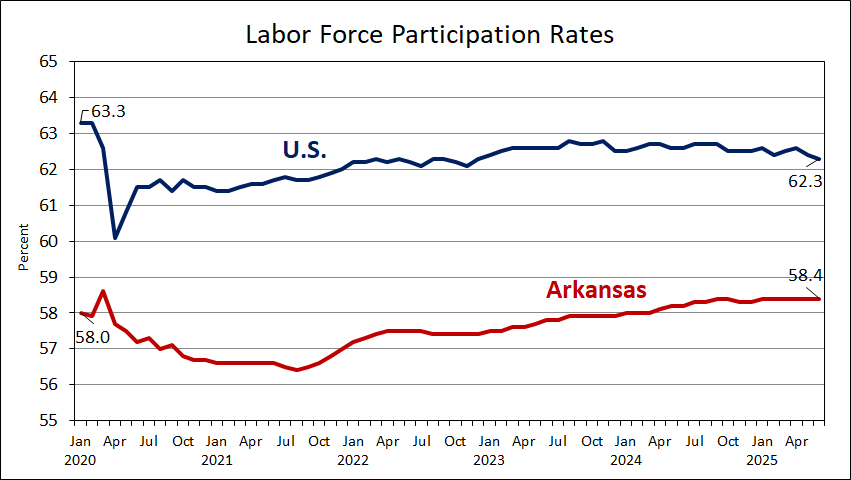
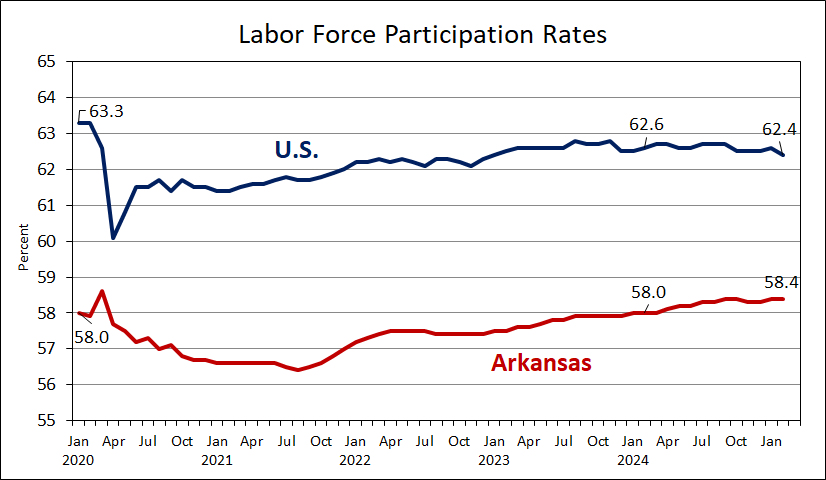
The stability of the unemployment rate this year is mirrored by Arkansas’ labor force participation rate, which has been steady at 58.4% since February. Nevertheless, over the past two years, Arkansas participation rate has been trending higher, while the U.S. participation rate has declined slightly.
Source: Bureau of Labor Statistics

Payroll Employment
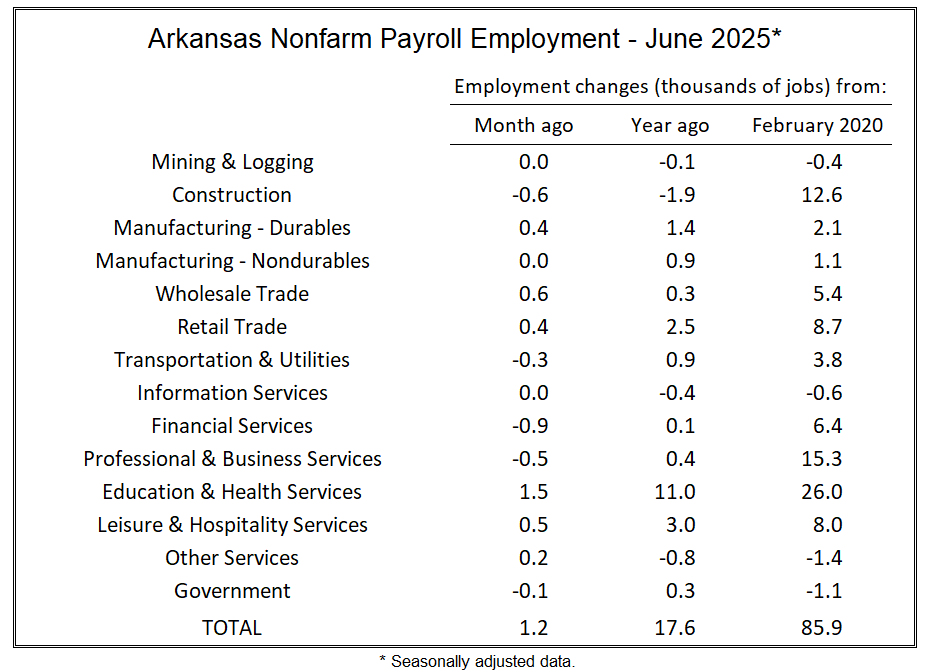
Arkansas Nonfarm payroll employment expanded by 1,200 in June (seasonally adjusted). Not-seasonally adjusted figures showed a decline for the month, but that was largely due to the seasonal shedding of education-related jobs. After seasonal adjustment, changes in state and local government employment, as well as private-sector education employment, were nearly unchanged for the month, suggesting that the seasonal effect was typical.

Health Services employment was the largest contributor to the June increase, adding 1,300 jobs. Other sectors showed mixed changes. Expanding sectors included Durables Manufacturing, Wholesale and Retail Trade, and Leisure and Hospitality Services. Declines showed up for Construction, Financial Services, and Professional & Business Services (mostly in the Administrative and Support category).
Source: Bureau of Labor Statistics, Current Employment Statistics (CES)

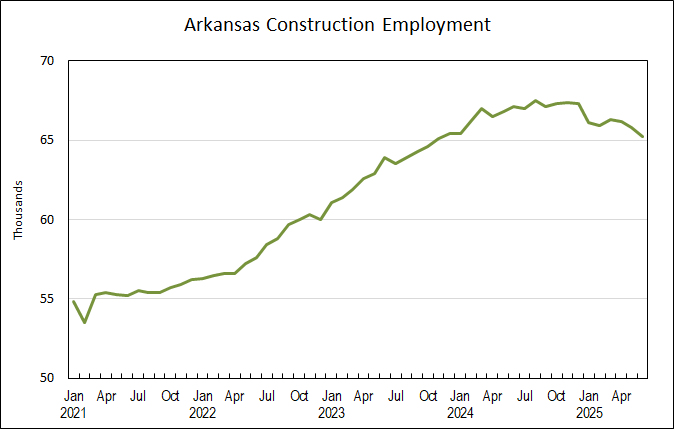
The decline in Construction employment continues a trend that began last summer after employment in that sector reached a record-high level in August 2024.
Source: Bureau of Labor Statistics, Current Employment Statistics (CES)

Other sectors have been fairly steady or increasing over the past 12 months. Employment Education and Health Services (mostly Health) continues to be the largest driver of job growth.

The 12-month growth rate for Arkansas payroll employment was approximately 1.3%, compared to 1.1% for the U.S. Compared to pre-Covid employment in February 2020, Arkansas employment has expanded by 6.7%, while that of the U.S. has increased by 4.9%.
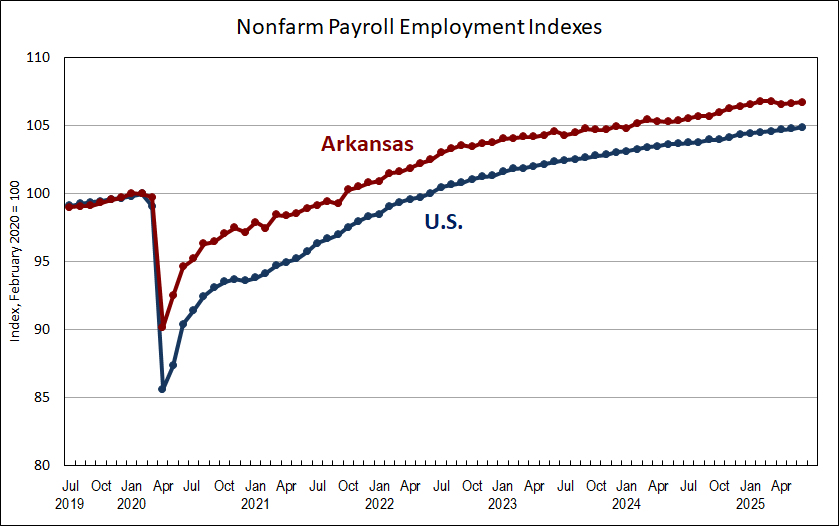
Source: Bureau of Labor Statistics, Current Employment Statistics (CES)

# # #

Seasonally adjusted data for Arkansas nonfarm payroll employment, reported in a format consistent with the monthly news release from the Arkansas Division of Workforce Services, can be found here: Table-Seasonally Adjusted NFPE.

Metro Area Employment and Unemployment – May 2025

Revisions to the metro area unemployment data—including the revised seasonally adjusted figures—are finally complete. The most significant revisions involve redefinitions of the metropolitan areas themselves, as well as updated population controls for labor force numbers. Pine Bluff is no longer considered a metropolitan area so new data will not be available for that urban center. Changes to the unemployment rate readings across the other metro areas were subject to only minor revisions.

Source: Bureau of Labor Statistics, Smoothed Metropolitan Area Estimates

Generally, the state’s metro areas have seen unemployment rates trending higher over the second half of 2024 and the first half of 2025 (with the exception of Fort Smith, which has seen no change since the beginning of 2024).

In the most recent monthly data for May, unemployment rates in all seven metro areas were unchanged from April. Northwest Arkansas continues to show the lowest unemployment rate in the state at 2.9%. Memphis and Texarkana have rates above 4%, while all other metro areas remain near 3.5% (slightly higher in Hot Springs).

Source: Bureau of Labor Statistics, Smoothed Metropolitan Area Estimates

Payroll Employment
Data for nonfarm payroll employment was revised in March. As with the unemployment rate data, the revisions were primarily associated with changes in population controls and the metro area definitions. The pattern of employment growth rates around the state was largely unaffected.

Recent trends are summarized in the table and figure below. From April to May, employment increased in all metro areas except Jonesboro. Over the past 12 months, growth rates have ranged from near zero in Hot Springs and Memphis to 3.2% in Northwest Arkansas.

Source: Bureau of Labor Statistics, Current Employment Estimates (CES)

All metro areas have shown net employment growth over the past five years. Employment growth in NWA has been nearly double that of Central Arkansas, with Jonesboro showing only slightly slower growth than Little Rock. Fort Smith, Hot Springs and Texarkana have all expanded by approximately 2% over the course of 5 years, while employment growth in Memphis has been near zero.

Source: Bureau of Labor Statistics, Current Employment Estimates (CES)

Arkansas Personal Income – 2025:Q1

The latest report on state level GDP was accompanied by new data for state personal income for the first quarter of 2025. Arkansas personal income grew at an annual rate of 8.7%, significantly higher than the U.S. growth rate of 6.7%. Arkansas was in in the top ten of state income growth, ranking #6.

All major components of income growth in Arkansas outpaced the U.S. totals, with substantial contributions from capital income (Dividends, interest and rent) and from Transfer receipts. Proprietors’ income comprised the bulk of earnings growth in Arkansas, expanding at a 33.9% rate and contributing 1.8 percentage points to the personal income growth rate.

Source: Bureau of Economic Analysis

Not surprisingly, the growth in Proprietors’ income was concentrated in the farm component. Farm proprietors’ income increased at a 237% annual rate, while Nonfarm proprietors’ income was up at at 1.3% rate.

Source: Bureau of Economic Analysis

The recent data release included revisions to figures for 2024. The revisions included a slight upward revision to second quarter growth and a slight downward revision to third quarter growth (without altering Arkansas’ ranking as #1 for personal income growth in the Q3). The fourth quarter number was revised upward considerably, from 3.6% to 6.1% (annual rates).

Source: Bureau of Economic Analysis

Longer term trends continue to show that Arkansas is outpacing the nation for income growth. Over the past 5 years (from 2020:Q1-2025Q1), Arkansas income growth has cumulatively totaled 42.4% while total U.S. growth has been 35.6%.

Source: Bureau of Economic Analysis

After adjusting for inflation (using the Personal Consumption Expenditures Price Index), real income growth over the five year period totaled 18.4% for Arkansas and 12.7% for the U.S.

Source: Bureau of Economic Analysis

Arkansas GDP – 2025:Q1

After showing the highest growth rate in the U.S. in the third and fourth quarters of 2024, Arkansas GDP growth in 2025:Q1 again exceeded the pace of most of the nation. As previously reported, U.S. GDP contracted at an annual rate of 0.5% in the first quarter of the year. The state-level date show that Arkansas was one of only 10 states showing positive GDP growth for the quarter, having increased at an annual rate of 0.8%. Arkansas ranked 5th-highest in growth, with other positive-growth states clustered in the southeast.

The volatile agriculture component was once again a driving factor for Arkansas GDP growth in the first quarter. After declining in 2022 and 2023, the trajectory for the Agriculture sector (which also includes forestry, fishing and hunting) has sharply recovered, expanding by 77% since the second quarter of 2024.

Source: Bureau of Economic Analysis

As shown in the table below, the agriculture sector contributed 1.6 percentage points to Arkansas GDP growth. Without that sector included, Arkansas GDP growth would have been negative at -0.8%. Nevertheless, there were other factors contributing to positive growth, including Utilities, Manufacturing, and some service-providing sectors. Sectors that contributed negative growth to the total included Construction, Wholesale and Retail Trade, along with small negative contributions from some service-providing sectors.

Source: Bureau of Economic Analysis

Including the first quarter growth, the cumulative gap between the GDP growth paths Arkansas and the U.S. continued to widen. Since the fourth quarter of 2019, Arkansas GDP has grown by 17.5% while U.S. GDP has expended by 12.0%.

Source: Bureau of Economic Analysis

Arkansas Employment and Unemployment – May 2025

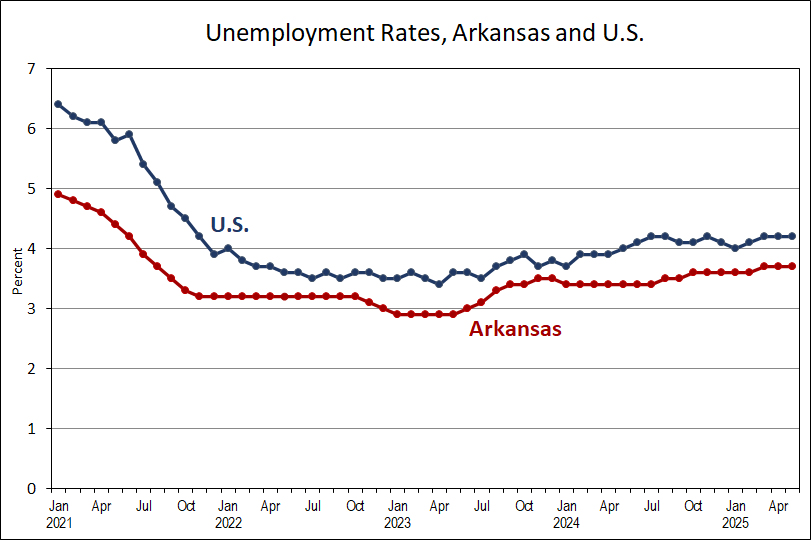
The latest report on state employment suggests that Arkansas labor markets . The unemployment rate remained at 4.7% and employment increased only slightly.

Source: Bureau of Labor Statistics

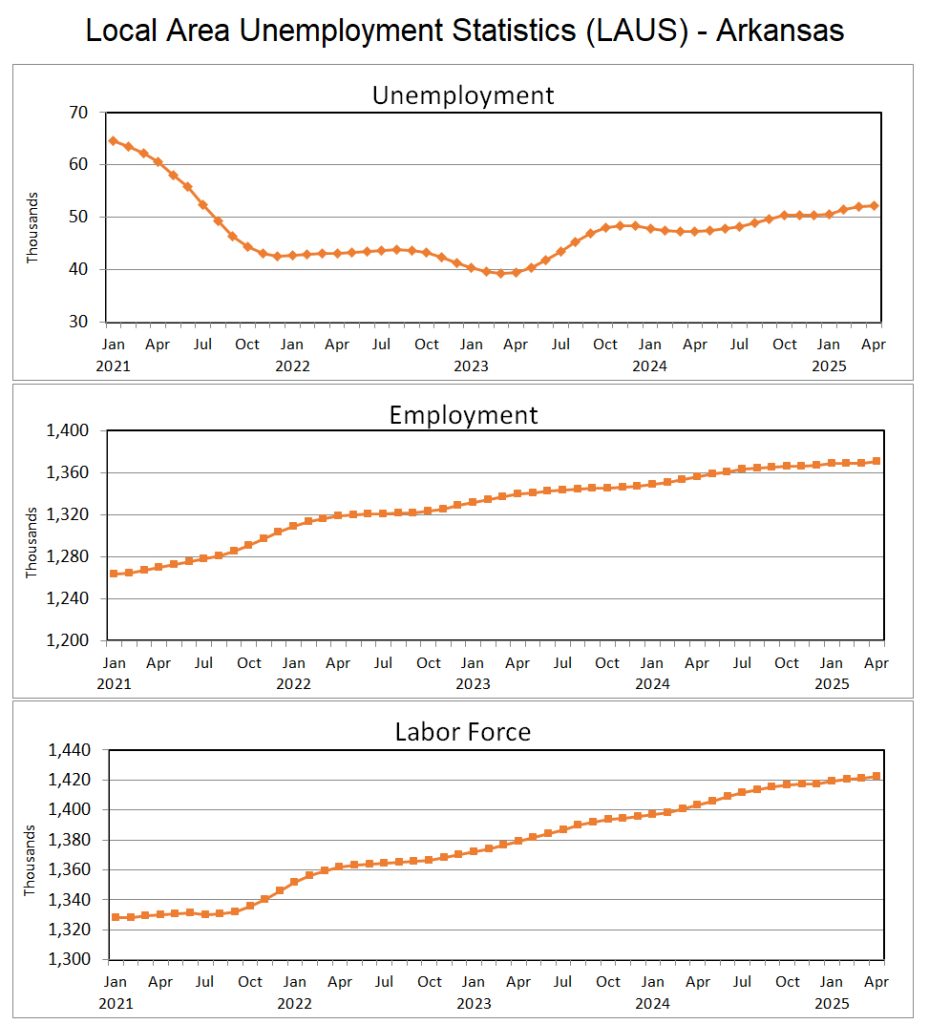
The components of the unemployment rate changed little from April to May. The number of unemployed was essentially unchanged (-43) and the number of employed was up by 658—about half of the average monthly increase over the previous 12 months. The labor force increased by 615. None of these changes were sufficient to change the unemployment or labor force participation rates.

Source: Bureau of Labor Statistics, Local Area Unemployment Statistics (LAUS)

Payroll Employment
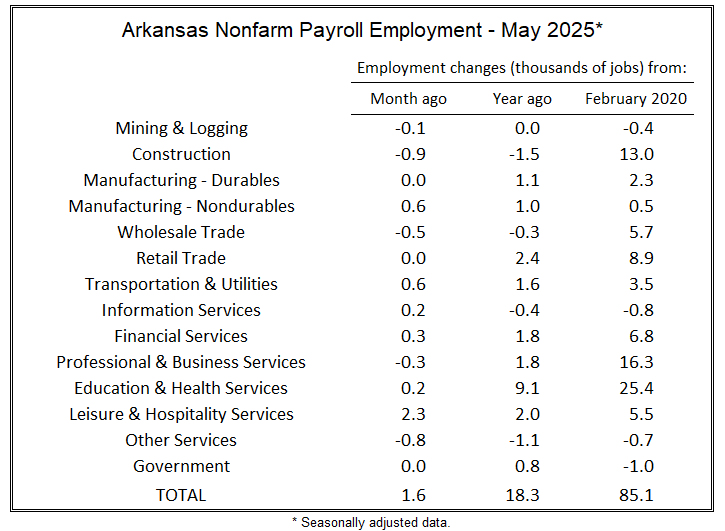
Nonfarm payroll employment increased by 1,600 from April to May, partly offsetting the (revised) 2,800 decline in the previous month (seasonally adjusted data). Employment declines in Construction, Wholesale Trade, and Other Services were offset by gains in other sectors, particularly Leisure & Hospitality Services. The surge in Leisure & Hospitality employment (+2,300) reversed a sharp decline in April (-2,000), revealing that the April contraction was likely a seasonal anomaly. Other sectors showing notable gains were Nondurables Manufacturing and Transportation & Utilities.

Source: Bureau of Labor Statistics, Current Employment Statistics (CES)

Employment in four sectors—Construction, Wholesale Trade, Information Services, and Other Services—have shown year-over year declines, while all other sectors show increases from May 2024. Education & Health Services has displayed the largest gains, with notable increases in Retail Trade, Leisure and Hospitality Services, Financial Services, and Professional & Business Services. In the latter category, gains in Management of Companies & Enterprises were offset by declining employment in Administration & Support services, with the net gain coming from Professional, Scientific & Technical subsector.

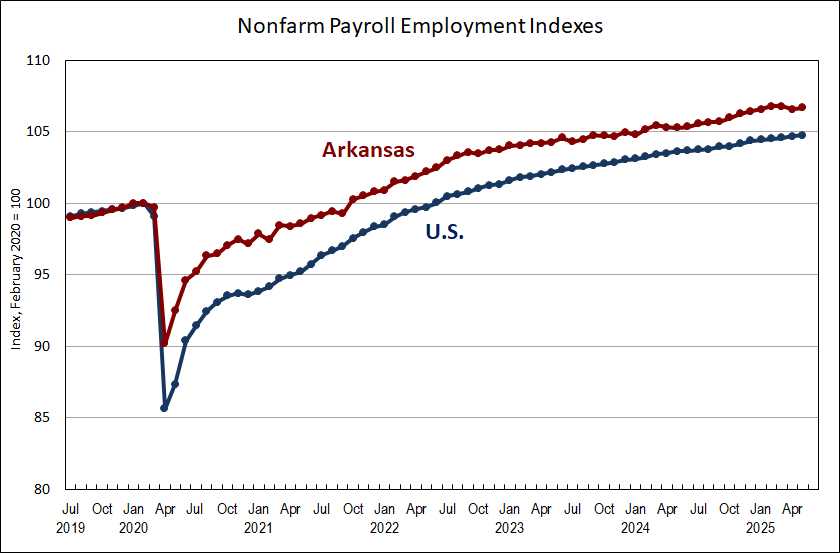
From May 2024 through May 2025, we’ve seen a total increase of 18,300 jobs—a gain of approximately 1.3%. Over the same period, U.S. nonfarm payrolls expanded by 1.1%.

Source: Bureau of Labor Statistics, Current Employment Statistics (CES)

# # #

Seasonally adjusted data for Arkansas nonfarm payroll employment, reported in a format consistent with the monthly news release from the Arkansas Division of Workforce Services, can be found here: Table-Seasonally Adjusted NFPE.

Arkansas Employment and Unemployment – April 2025

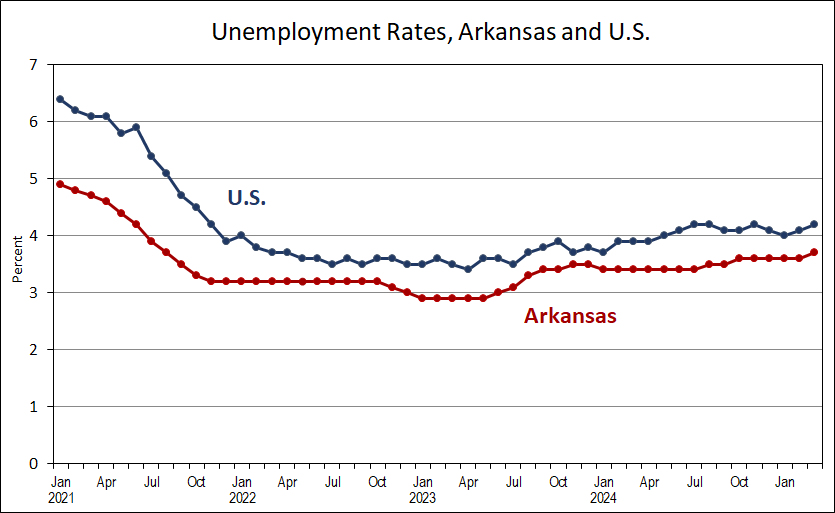
The latest state-level report on employment and unemployment was unremarkable in most respects, but did hint at ongoing weakness in the state’s labor markets. The unemployment rate was unchanged from March, but at 3.7% it was 0.3 percentage points higher than a year ago. The unemployment rate for the U.S. was also unchanged at 4.2% for the month—and also up 0.3 percentage points from April 2024.

Source: Bureau of Labor Statistics

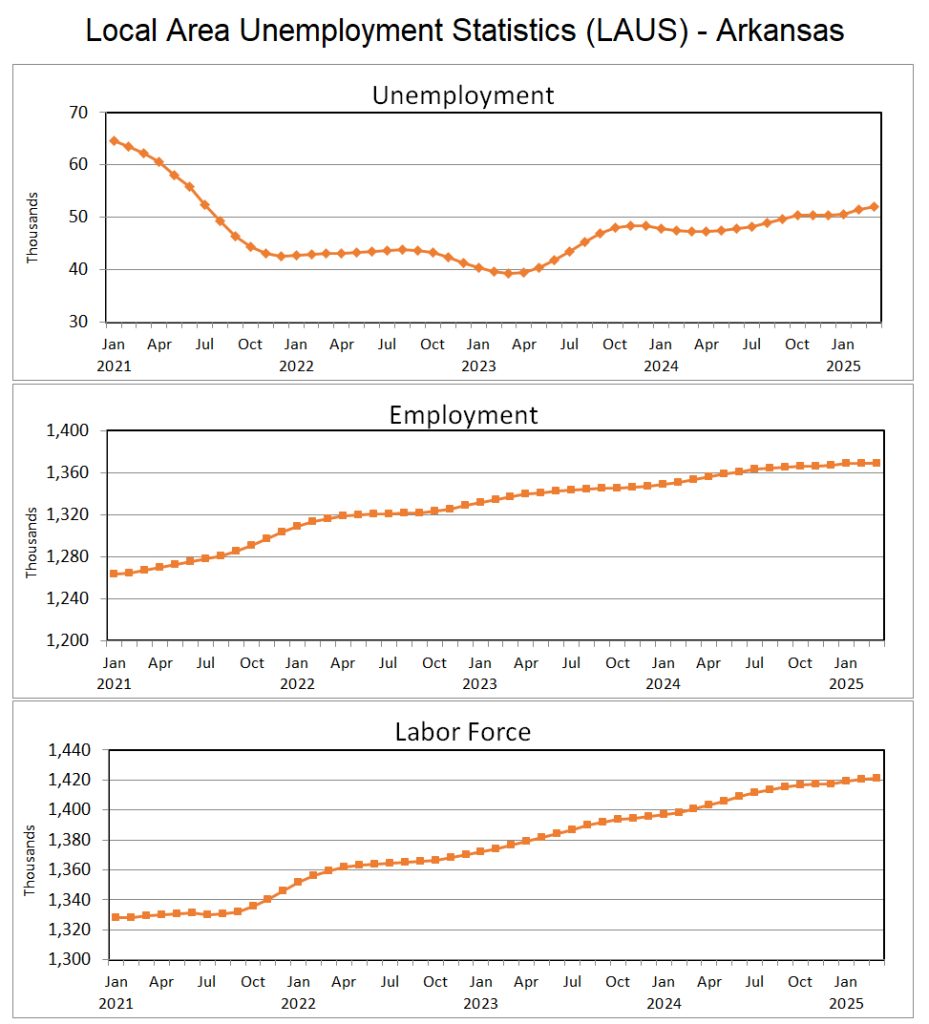
The gradual increase in Arkansas’ unemployment rate has been driven by persistent increases in the number of unemployed. Interrupted by only a slight decline in December, the number of unemployed has risen by 4,855 over the past 12 months. The number of employed increased by 1,406 in April, suggesting that the slight decline recorded for March was anomalous. As a result of the increases in both employed and unemployed, the labor force expanded by 1,519 for the month.

Source: Bureau of Labor Statistics, Local Area Unemployment Statistics (LAUS)

Payroll Employment
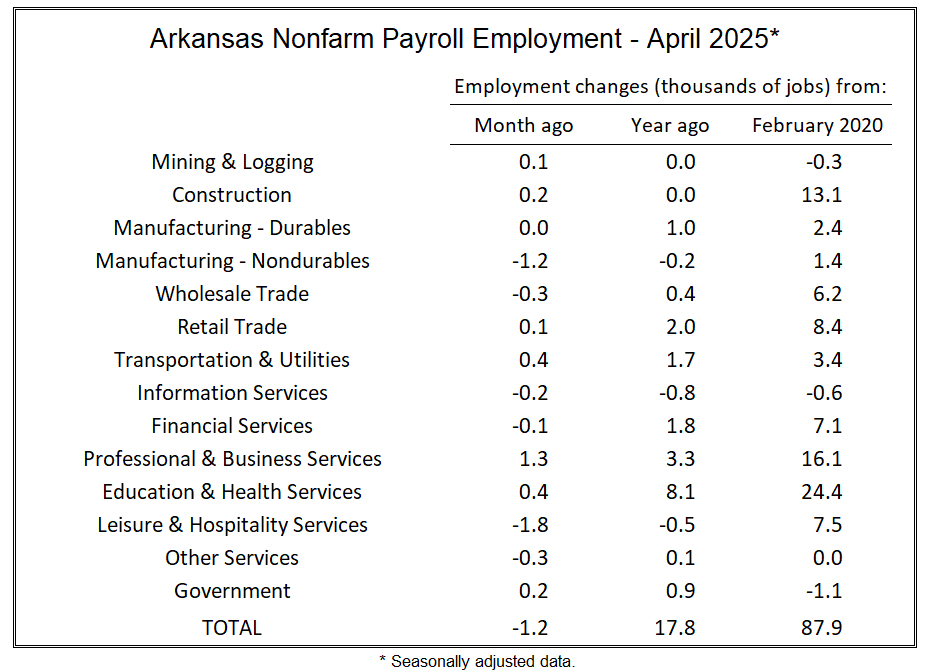
Nonfarm payroll employment declined by 1,200 from March to April (seasonally adjusted). Before seasonal adjustment, employment increased for the month, but in several categories the gains were smaller than typically expected for April. For example, not-seasonally adjusted employment in Leisure and Hospitality Services increased by 2,100 jobs. After adjusting for seasonality the change was a decline of 1,800.

More generally, the seasonally adjusted changes in payroll employment were mixed. In addition to Leisure & Hospitality Services, there was also a substantial decline in Nondurables Manufacturing. Other goods-producing sectors saw increases for the month, as did Professional & Business Services (exclusively in the category of Administrative and Support Services) and Education & Health Services.

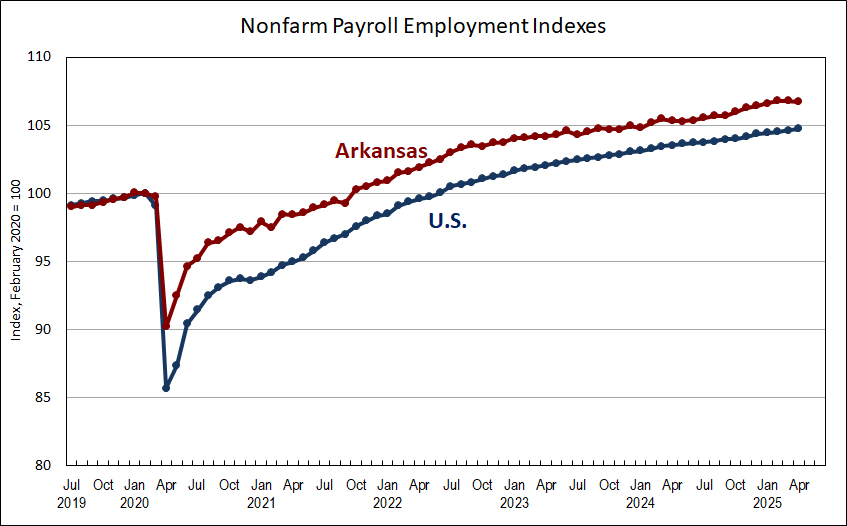
Over the past 12 months, payroll employment has increased by 17,800—about 1.3%. Over the same period, U.S. payroll employment increased by 1.2%.

Source: Bureau of Labor Statistics, Current Employment Statistics (CES)

# # #

Seasonally adjusted data for Arkansas nonfarm payroll employment, reported in a format consistent with the monthly news release from the Arkansas Division of Workforce Services, can be found here: Table-Seasonally Adjusted NFPE.

Arkansas Employment and Unemployment – March 2025

The state-level report on employment and unemployment shows some unwelcome weakness in Arkansas labor markets last month. The unemployment rate ticked up from 3.6% to 3.7%, while household employment showed a slight decline. The report on nonfarm payroll employment also showed a slight decline (seasonally-adjusted), although the data for February were revised higher, implying a net increase from the level reported a month ago.

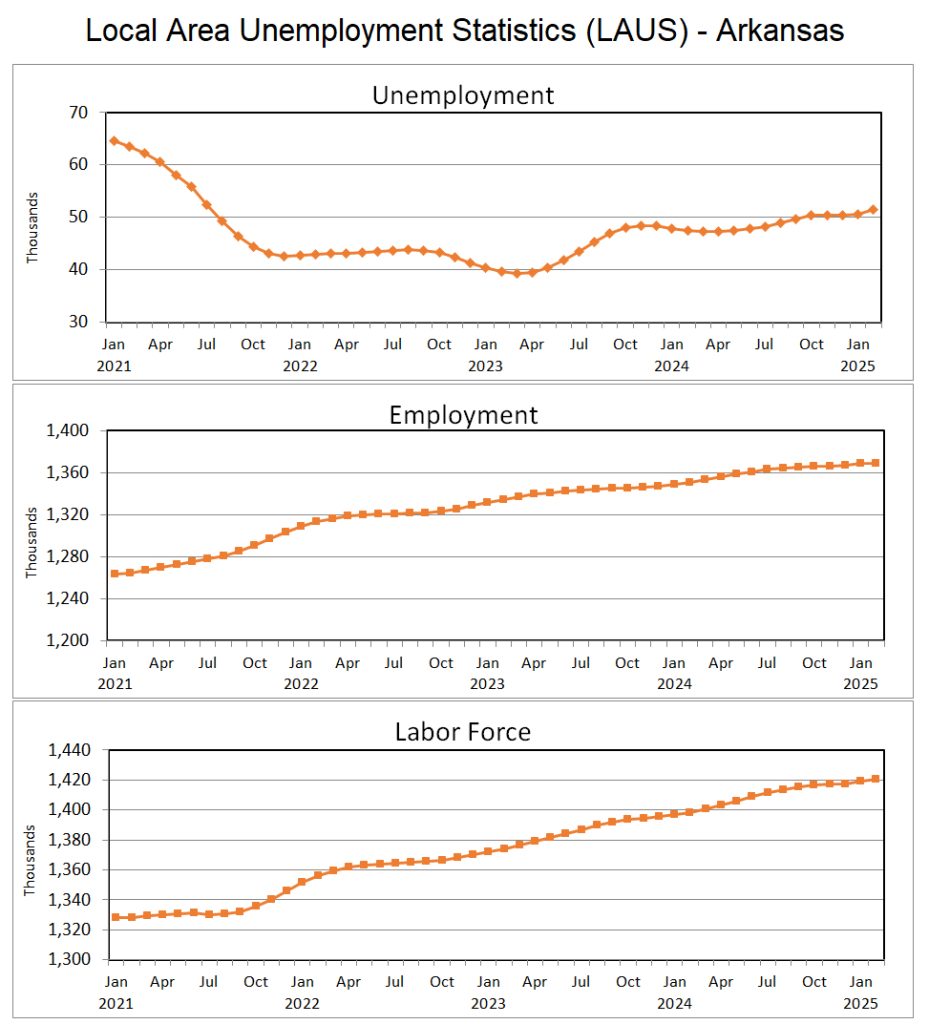
The increase in the unemployment rate was driven by small changes in the underlying data. Household employment was practically unchanged, declining by only 242 (less than 0.02%). Although the downturn was small, it represented the first negative month since April of 2020 (recently revised data). The number of unemployed increased by 502 in March—the third consecutive monthly increase, with the total for the first three months of the year increasing by 1,627. As a result of the tiny decline in employment an the increase in unemployment, the labor force expanded by 260. The labor force participation rate remained stable at 58.4%

Source: Bureau of Labor Statistics, Local Area Unemployment Statistics (LAUS)

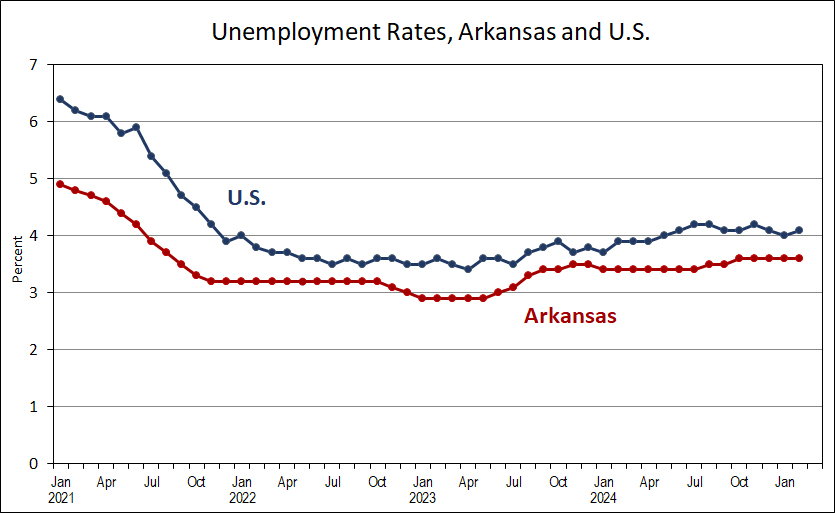
The national unemployment rate had previously been reported as rising 0.1 percentage points to 4.2 in March. Arkansas’ rate remains lower than the U.S., but the difference has narrowed to the point that it is not statistically significant.

Source: Bureau of Labor Statistics

Payroll Employment
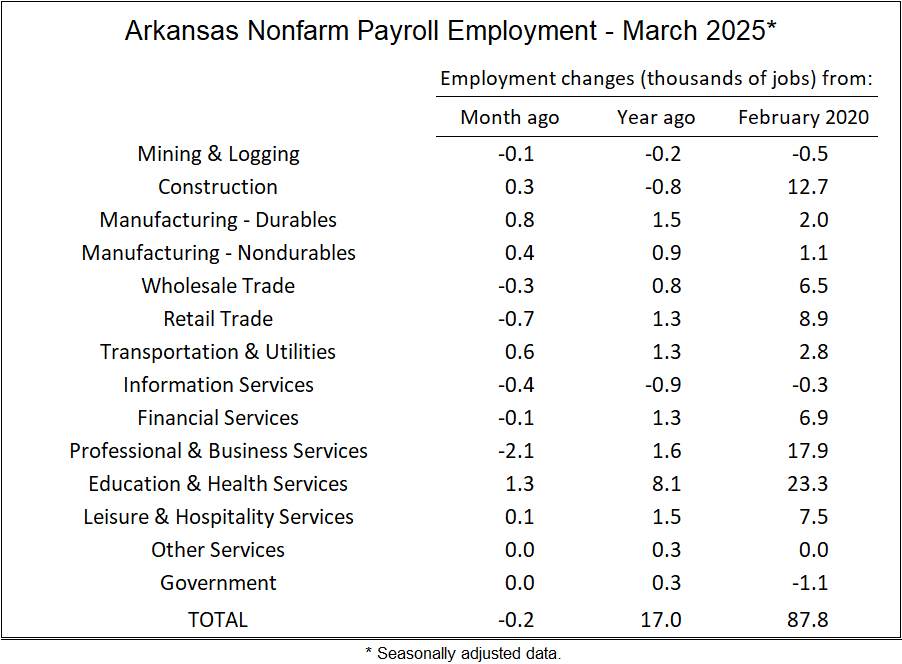
Nonfarm payroll employment also experienced a small decline, -200 (seasonally adjusted). The data for February were revised higher by 2,500 for a net gain since our report last month. The not-seasonally adjusted data showed an increase for the month, but that was largely attributable to gains in Construction Employment and Leisure & Hospitality Services, both of which tend to experience seasonally increases in the springtime. After seasonal adjustment, the changes in both sectors were positive, but of much smaller in magnitude. Retail Trade also tends to pick up in the spring months, but was up by 600 jobs in the not-seasonally adjusted data and was down by 700 jobs after seasonal adjustment.

Although the total showed a small net decline, we saw strong increases in Manufacturing, Transportation & Utilities, and Education & Health Services. Professional & Business Services declined from March, offsetting relatively large increases of from the previous three months.

Source: Bureau of Labor Statistics, Current Employment Statistics (CES)

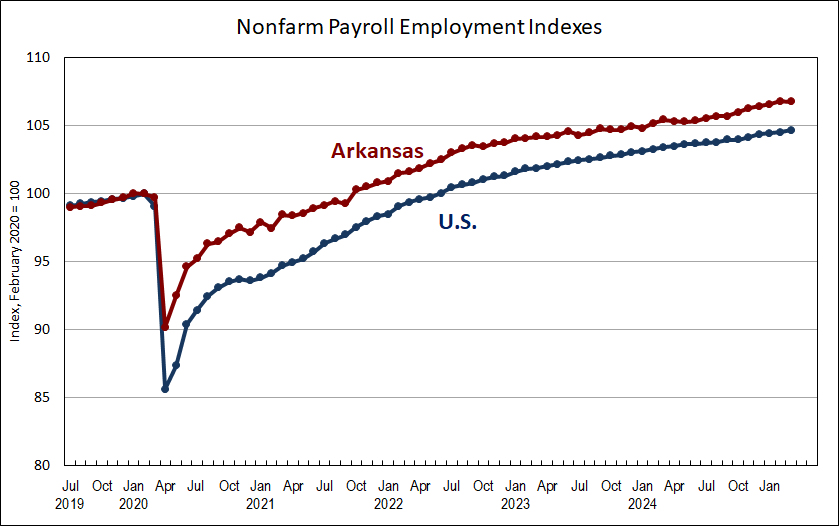
Since February of 2020, total Nonfarm Payroll Employment has expanded by 87,800, a gain of 6.8%. Over the same period, U.S. payroll employment has increased by 4.7%.

# # #

Seasonally adjusted data for Arkansas nonfarm payroll employment, reported in a format consistent with the monthly news release from the Arkansas Division of Workforce Services, can be found here: Table-Seasonally Adjusted NFPE.

Arkansas GDP – 2024:Q4

Along with the fourth quarter personal income estimates, the Bureau of Economic Analysis has also released data for state-level GDP [LINK]. For the second consecutive quarter, Arkansas had the fastest growing real GDP in the nation, expanding at an annualized rate of 5.1%. Nationally, GDP grew at a 2.5% rate in the fourth quarter. Compared to the fourth quarter of 2023, Arkansas GDP was up 4.6%, compared to 2.5% for the U.S.
As was the case in the third quarter, Arkansas GDP was boosted by strong growth in the sector including agriculture (Agriculture, forestry, fishing and hunting). Indeed, in three of the four quarters of 2024 agricultural output boosted total growth significantly. Nevertheless, non-Agricultural output has grown at rates of 2.4% to 4% over the course of the year.

As detailed in the table below, the agriculture sector accounted for 40% of the state’s growth rate in the fourth quarter, with other significant growth contributions from other goods-producing sectors, as well as several service-providing sectors

Over the past five years, real GDP in Arkansas has shown cumulative growth well above the national average. Compared to 2019:Q4, Arkansas GDP has expanded 17.2%, with a comparable figure of 12.2% for the U.S. The most recent two quarters contribute to a widening of that gap.

Arkansas Personal Income – 2024:Q4

State-level personal income statistics for the fourth quarter came out today [LINK]. Arkansas’ annualized growth rate for the quarter was reported at 3.6%, one percentage point lower than the U.S. growth rate of 4.6%. Arkansas ranked in the lowest quintile of growth rates among states. However, the state’s growth rate for the third quarter was revised upward from 5.4% to 7.1%, retaining the status of being the highest-growth state in the third quarter (and making Arkansas the highest growth state for the third and fourth quarters combined).

The slower growth in Arkansas than the U.S. was attributable to net earnings. Transfer receipts generated approximately the same growth for personal income at the national and state level, while property income (Dividends, Interest, & Rent) contributed somewhat more to Arkansas’ growth rate than for the nation.

Source: Bureau of Economic Analysis

The slower growth rate of earnings in Arkansas was, in turn, driven by lower growth in wage & salary components. In contrast, Proprietors’ Income surged higher, growing at an annualized rate of over 30% and contributing 1.5 percentage points to the personal income growth rate for the quarter.

Source: Bureau of Economic Analysis

If you’ve been following the personal income statistics for a few quarters, the source of the surge in Proprietors’ Income should not be surprising: farm proprietors’ income accounted for the bulk of the increase. This component has been the source of volatility in Arkansas income growth statistics since 2020.

Source: Bureau of Economic Analysis

The contribution of the agriculture sector is also prominent in the breakdown of earnings by sector, with Arkansas Farm earnings accounting for nearly three-quarters of growth in total earnings.

Source: Bureau of Economic Analysis

Note that Management of Companies and Enterprises had a significant negative contribution to overall earnings growth in the fourth quarter; however, that decline merely offset a sharp positive spike in the third quarter (and therefore contributing to the strong third-quarter growth).

Source: Bureau of Economic Analysis

With the preliminary estimates for fourth-quarter income in hand, the preliminary annual figures for 2024 are now also available. Compared to the previous year, Arkansas growth was 4.2%, compared to 5.4% for the U.S.

Source: Bureau of Economic Analysis

One notable feature of the annual growth contributions is the relatively small contribution of Personal Current Transfer Receipts to earnings growth in 2024. The press release from the BEA noted that Arkansas had the lowest growth rate in the nation for transfer payments (only 1.7%).

Arkansas Employment and Unemployment – February 2025

The monthly report on employment and unemployment by state for February showed stable conditions in Arkansas’ labor markets. For example, the unemployment rate was unchanged at 3.6%. By comparison, the U.S. unemployment rate ticked up from 4.0% in January to 4.1% in February.

Source: Bureau of Labor Statistics

The Arkansas labor force expanded in February by 1,345, with an increases of 385 employed and 960 unemployed. Monthly labor force growth has been positive every month since July 2021. Employment growth has been consistently positive since the economy was emerging from the pandemic in 2020.

Source: Bureau of Labor Statistics, Local Area Unemployment Statistics (LAUS)

Over the past 12 months, the labor force has expanded by 22,264, with increases of 18,205 employed and 4,059 unemployed. The unemployment rate reflects the increase in the number of unemployed, having risen from 3.4% to 3.6% over the past year.

The labor force participation rate was unchanged for the month at 58.4—which was 0.4 percentage points higher than in February 2024. The U.S. participation rate has declined by 0.2 percentage points over the same 12-month period.

Source: Bureau of Labor Statistics

Payroll Employment
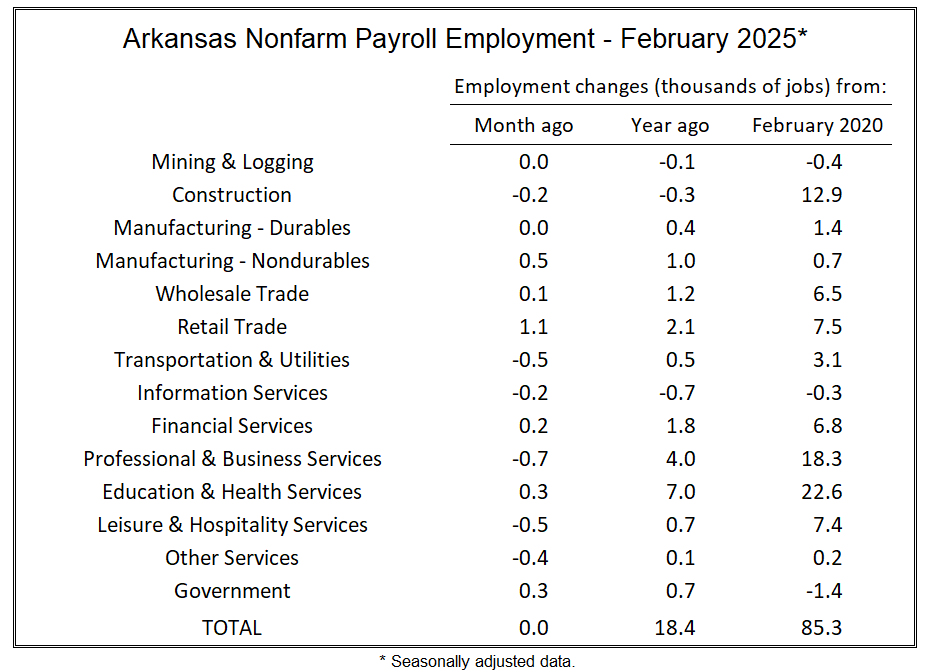
Nonfarm payroll employment was unchanged from January to February, although the January increase was revised down from +3,000 to +2,000 (seasonally adjusted data). Employment in Retail Trade and Nondurables Manufacturing showed increases, but the other service-providing sectors showed a preponderance of monthly declines, including Professional & Business Services, Leisure & Hospitality Services, and Other Services. Employment in Transportation and Utilities was also down.

Source: Bureau of Labor Statistics, Current Employment Statistics (CES)

Over the past year, payroll employment is up by 18,400 jobs—approximately 1.4%. The year-over-year figures show that February’s weakness in service-sector growth is not indicative of the trend. Over the past 12 months, service-providing sectors have accounted for 17,400 net new jobs, with the remaining 1,000 job-increase found in the goods-producing sectors.

# # #

Seasonally adjusted data for Arkansas nonfarm payroll employment, reported in a format consistent with the monthly news release from the Arkansas Division of Workforce Services, can be found here: Table-Seasonally Adjusted NFPE.