One of the unique characteristics of the post-COVID economy has been an exceptionally high number of unfilled job vacancies. Data documenting this phenomenon is available from the Bureau of Labor Statistic’s Job Openings and Labor Turnover Survey (JOLTS). Along with the employment and unemployment data for July, the BLS this morning released the latest JOLTS numbers for June.
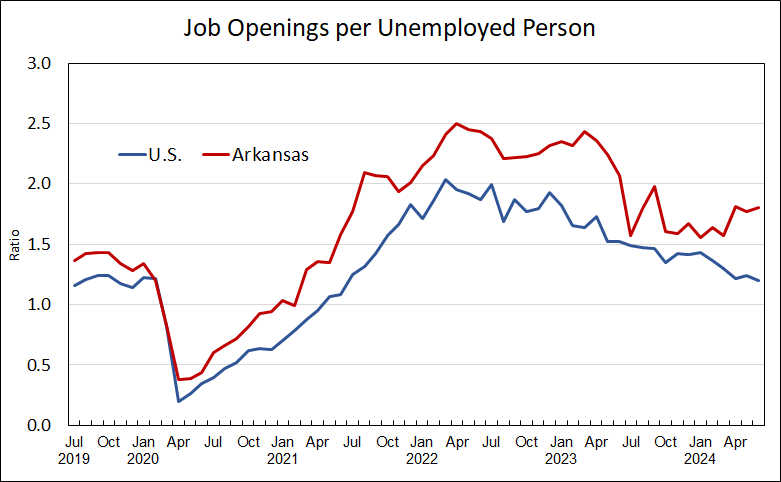
As national labor market conditions have softened in recent months, some of the slack has come from a decline in job openings. One popular measure is the ratio of Job Openings to Unemployed Persons. As shown below, this ratio has been in decline over the past two years, both nationwide and here in Arkansas. Nevertheless, the Arkansas ratio remains elevated, and has increased since the beginning of the year. As of June, there were 84,000 job openings and 46,530 unemployed in Arkansas, implying that there are 1.8 job openings for each unemployed person. In the U.S. data, the ratio has fallen to 1.2.
Another way to measure the importance of unfilled vacancies is to consider the Job Openings Rate, defined as the number of job openings as a percent of the total potential employed labor force (employment + job openings). By this measure, Arkansas has also remained higher than the U.S. average.
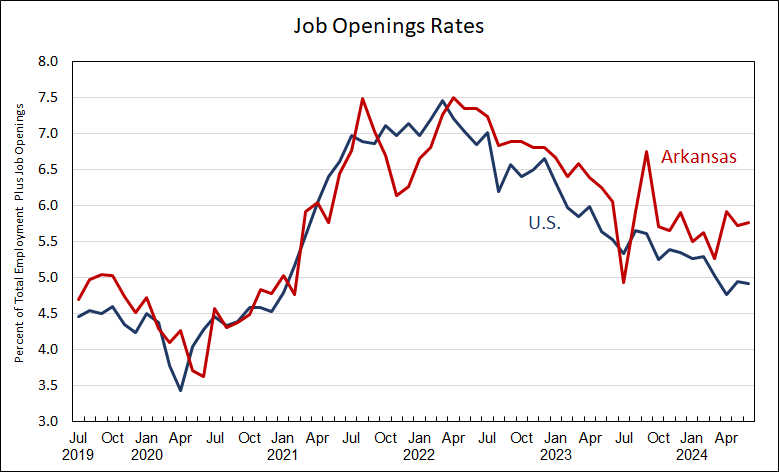
The elevated job openings rate for Arkansas helps explain how the state’s unemployment has remained low while the unemployment rate has been rising nationally. Job openings rates are returning to a more normal level for the U.S., meaning that some of the labor market softening is showing up in higher unemployment instead of fewer vacancies. The relatively high rates of vacancies in Arkansas has helped keep unemployment in the state from rising.
Another feature of the labor turnover data that has been of interest in recent years is the Quit Rate, the number of voluntary separations as a fraction of total employment. As shown below, the quit rates for both the U.S. and Arkansas have been trending down from their unusually high levels in 2021. Quit rates, like the Job Openings rates, have been steadily declining since interest rates started rising in 2022, and have returned closer to pre-pandemic levels.
