Along with the fourth quarter personal income estimates, the Bureau of Economic Analysis has also released data for state-level GDP [LINK]. For the second consecutive quarter, Arkansas had the fastest growing real GDP in the nation, expanding at an annualized rate of 5.1%. Nationally, GDP grew at a 2.5% rate in the fourth quarter. Compared to the fourth quarter of 2023, Arkansas GDP was up 4.6%, compared to 2.5% for the U.S.
As was the case in the third quarter, Arkansas GDP was boosted by strong growth in the sector including agriculture (Agriculture, forestry, fishing and hunting). Indeed, in three of the four quarters of 2024 agricultural output boosted total growth significantly. Nevertheless, non-Agricultural output has grown at rates of 2.4% to 4% over the course of the year.
As detailed in the table below, the agriculture sector accounted for 40% of the state’s growth rate in the fourth quarter, with other significant growth contributions from other goods-producing sectors, as well as several service-providing sectors
Over the past five years, real GDP in Arkansas has shown cumulative growth well above the national average. Compared to 2019:Q4, Arkansas GDP has expanded 17.2%, with a comparable figure of 12.2% for the U.S. The most recent two quarters contribute to a widening of that gap.
State-level personal income statistics for the fourth quarter came out today [LINK]. Arkansas’ annualized growth rate for the quarter was reported at 3.6%, one percentage point lower than the U.S. growth rate of 4.6%. Arkansas ranked in the lowest quintile of growth rates among states. However, the state’s growth rate for the third quarter was revised upward from 5.4% to 7.1%, retaining the status of being the highest-growth state in the third quarter (and making Arkansas the highest growth state for the third and fourth quarters combined).
The slower growth in Arkansas than the U.S. was attributable to net earnings. Transfer receipts generated approximately the same growth for personal income at the national and state level, while property income (Dividends, Interest, & Rent) contributed somewhat more to Arkansas’ growth rate than for the nation.
Source: Bureau of Economic Analysis
The slower growth rate of earnings in Arkansas was, in turn, driven by lower growth in wage & salary components. In contrast, Proprietors’ Income surged higher, growing at an annualized rate of over 30% and contributing 1.5 percentage points to the personal income growth rate for the quarter.
Source: Bureau of Economic Analysis
If you’ve been following the personal income statistics for a few quarters, the source of the surge in Proprietors’ Income should not be surprising: farm proprietors’ income accounted for the bulk of the increase. This component has been the source of volatility in Arkansas income growth statistics since 2020.
Source: Bureau of Economic Analysis
The contribution of the agriculture sector is also prominent in the breakdown of earnings by sector, with Arkansas Farm earnings accounting for nearly three-quarters of growth in total earnings.
Source: Bureau of Economic Analysis
Note that Management of Companies and Enterprises had a significant negative contribution to overall earnings growth in the fourth quarter; however, that decline merely offset a sharp positive spike in the third quarter (and therefore contributing to the strong third-quarter growth).
Source: Bureau of Economic Analysis
With the preliminary estimates for fourth-quarter income in hand, the preliminary annual figures for 2024 are now also available. Compared to the previous year, Arkansas growth was 4.2%, compared to 5.4% for the U.S.
Source: Bureau of Economic Analysis
One notable feature of the annual growth contributions is the relatively small contribution of Personal Current Transfer Receipts to earnings growth in 2024. The press release from the BEA noted that Arkansas had the lowest growth rate in the nation for transfer payments (only 1.7%).
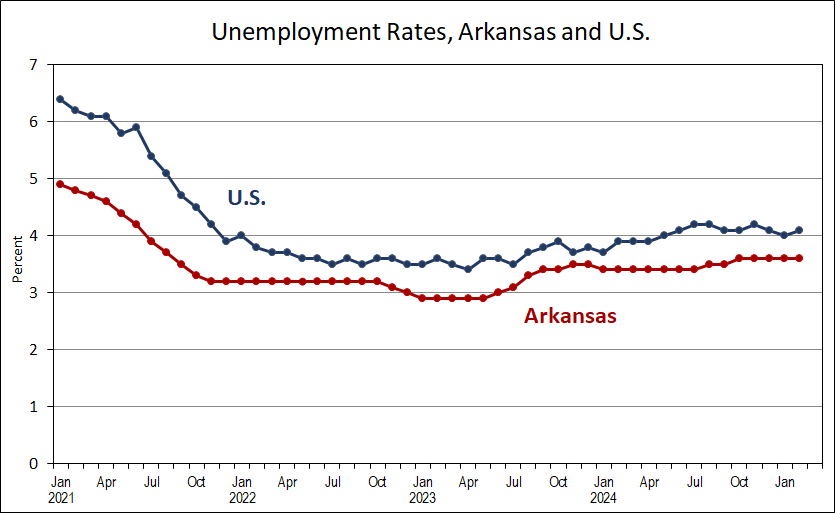
The monthly report on employment and unemployment by state for February showed stable conditions in Arkansas’ labor markets. For example, the unemployment rate was unchanged at 3.6%. By comparison, the U.S. unemployment rate ticked up from 4.0% in January to 4.1% in February.
Source: Bureau of Labor Statistics
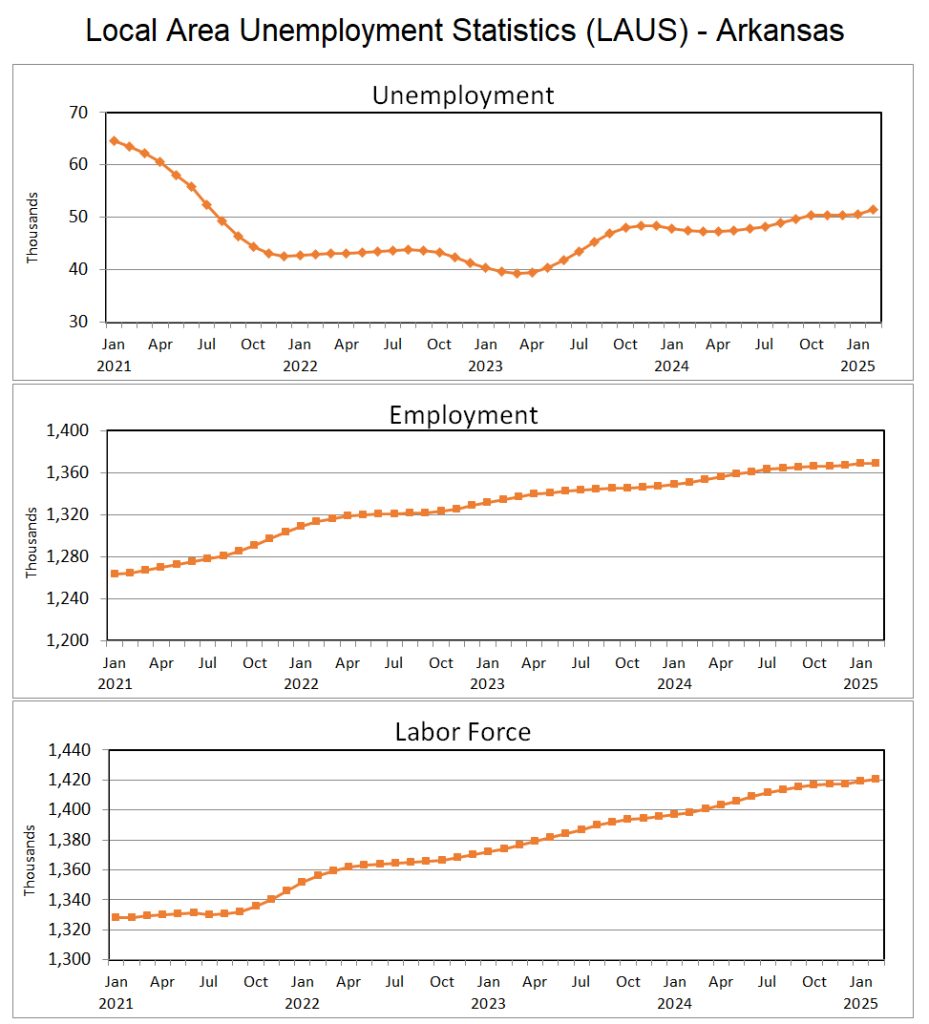
The Arkansas labor force expanded in February by 1,345, with an increases of 385 employed and 960 unemployed. Monthly labor force growth has been positive every month since July 2021. Employment growth has been consistently positive since the economy was emerging from the pandemic in 2020.
Source: Bureau of Labor Statistics, Local Area Unemployment Statistics (LAUS)
Over the past 12 months, the labor force has expanded by 22,264, with increases of 18,205 employed and 4,059 unemployed. The unemployment rate reflects the increase in the number of unemployed, having risen from 3.4% to 3.6% over the past year.
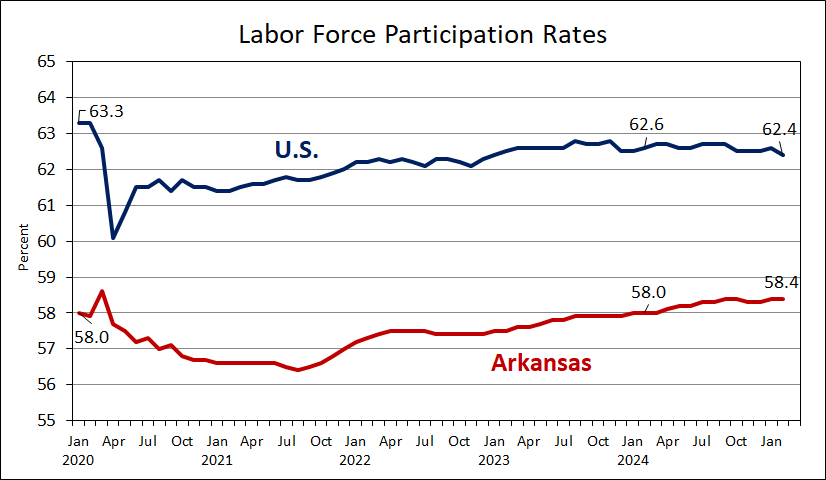
The labor force participation rate was unchanged for the month at 58.4—which was 0.4 percentage points higher than in February 2024. The U.S. participation rate has declined by 0.2 percentage points over the same 12-month period.
Source: Bureau of Labor Statistics
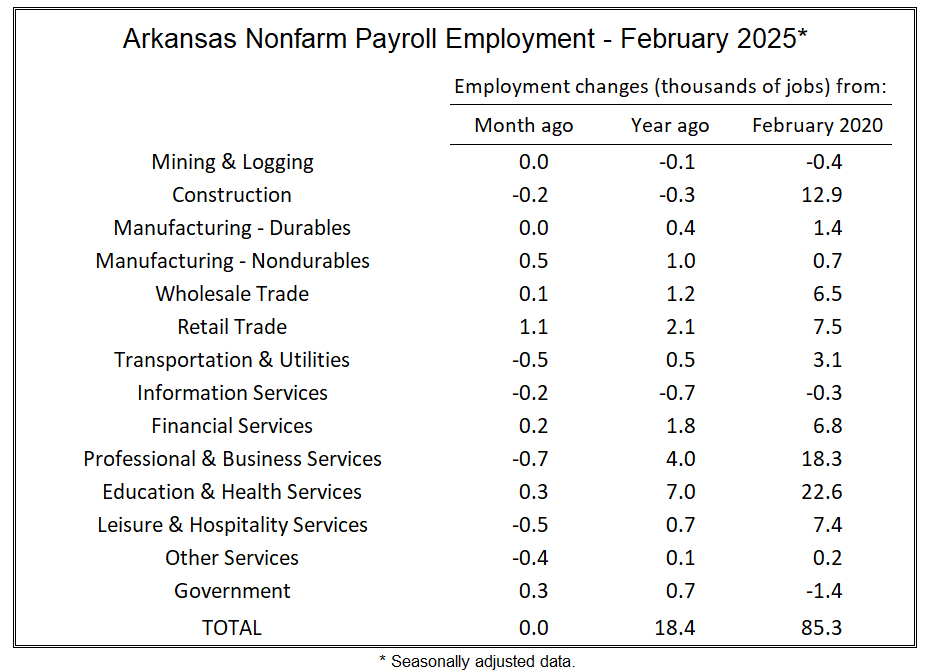
Payroll Employment Nonfarm payroll employment was unchanged from January to February, although the January increase was revised down from +3,000 to +2,000 (seasonally adjusted data). Employment in Retail Trade and Nondurables Manufacturing showed increases, but the other service-providing sectors showed a preponderance of monthly declines, including Professional & Business Services, Leisure & Hospitality Services, and Other Services. Employment in Transportation and Utilities was also down.
Source: Bureau of Labor Statistics, Current Employment Statistics (CES)
Over the past year, payroll employment is up by 18,400 jobs—approximately 1.4%. The year-over-year figures show that February’s weakness in service-sector growth is not indicative of the trend. Over the past 12 months, service-providing sectors have accounted for 17,400 net new jobs, with the remaining 1,000 job-increase found in the goods-producing sectors.
# # #
Seasonally adjusted data for Arkansas nonfarm payroll employment, reported in a format consistent with the monthly news release from the Arkansas Division of Workforce Services, can be found here: Table-Seasonally Adjusted NFPE.
With annual data revisions now nearly complete, state-level data on employment and unemployment is now available with updates for January 2025.
The Arkansas unemployment rate was unchanged at 3.6% in January. The originally published data for December reported an unemployment rate for 3.4%, but recent revisions raised the December estimate to 3.6%. For more information on revisions to the LAUS data, see https://arkansaseconomist.com/laus-data-revisions/
The January figures indicated a fairly strong gain in household employment, +1,956. After the recent revisions, the data now show that household employment has not shown a month-to-month decline since April 2020. The number of unemployed edged slightly higher in January (+112). As a result, the labor force expanded by 2,068 for the month.
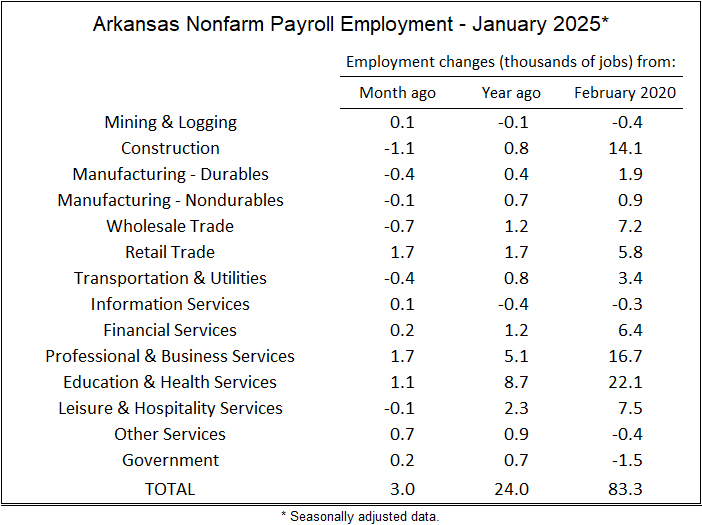
Payroll Employment Without seasonal adjustment, nonfarm payroll employment contracted by 16,500 jobs in January. However, there is always a sharp drop in employment after the holidays and the start of a new year. After taking this predictable seasonal pattern into account, the data for seasonally adjusted payroll employment showed an increase of 3,000 jobs for the month.
The largest gains came from Retail Trade and Professional & Business Services, which were both up by 1,700 jobs. Sectors showing declines included Construction and Manufacturing, as well as Wholesale Trade. Compared to a year earlier, nearly all sectors showed increases, with total employment increasing by 24,000 jobs—approximately 1.8%.
Source: Bureau of Labor Statistics, Local Area Unemployment Statistics (LAUS)
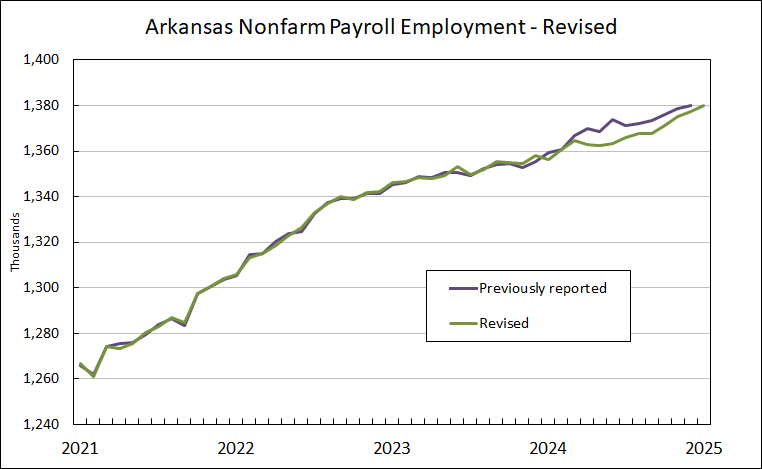
Revisions to Payroll Data The annual benchmark revisions changed some of the month-to-month patterns of employment growth for specific sectors, but had little quantitative impact on the situation at the end of 2024. As shown in the figure below, the data revisions had the effect of lowering measured employment during mid-2024, but higher growth estimates toward the end of the year brought the revised data back to nearly in line with previously-reported information. The largest revision was for the month of June (-10,600 jobs). By December the gap was reduced to 2,600 jobs. Hence, January’s increase of 3,000 jobs means that employment for January was higher than at any other time in history (at least for the seasonally-adjusted data).
# # #
Seasonally adjusted data for Arkansas nonfarm payroll employment, reported in a format consistent with the monthly news release from the Arkansas Division of Workforce Services, can be found here: Table-Seasonally Adjusted NFPE.
The full set of revisions to state employment and unemployment data, along with new information for January 2025, will be released next week. Meanwhile, the Bureau of Labor Statistics has issued revised data for the Local Area Unemployment Statistics (LAUS). This years LAUS revisions were more extensive than normal, with data revised back to the beginning of the series in 1976. In this article, we will focus on the more recent history revealed by the revised data.
The figures below compare the pre-revision time series to the newly revised data for total household employment and unemployment. As is typical, the revisions tend to smooth out some of the fluctuations in the originally published data.
The originally published data for the number of employed showed two brief periods of contraction, in 2022 and 2023. The revised data show positive monthly increases for the entire period from May 2020 through December 2024. The revised series ends up slightly lower than the original estimates, but by only 1,850 individuals (0.14%).
Source: Bureau of Labor Statistics, Local Area Unemployment Statistics (LAUS)
The number of unemployed individuals was revised lower for the second half of 2023, then somewhat higher during the second half of 2024. As a result, the new path of unemployment shows a slow, but relatively steady increase in the number of unemployed over the past two years. As of December 2024, the number of unemployed was revised higher by approximately 2,740 individuals.
Source: Bureau of Labor Statistics, Local Area Unemployment Statistics (LAUS)
The impact on the unemployment rate was a smoother profile path, attenuating some of the extreme changes. The record-low unemployment rate of 2.8% in early 2023 has been revised up to 2.9%; the transitory peak in late 2023 was lowered from 3.7% to 3.5%; and the new end-of year unemployment rate was revised up from 3.4% to 3.6%.
Source: Bureau of Labor Statistics, Local Area Unemployment Statistics (LAUS)
The revisions also affected the calculated estimates for the state’s labor force participation rate. The new data show a more sustained rate of increase over the past two years, culminating in a rate of 58.3% in December 2024—slightly higher than the $58.2% originally reported.
Source: Bureau of Labor Statistics, Local Area Unemployment Statistics (LAUS)
The final, but unrevised, report for 2024 metropolitan area employment and unemployment came out this week.
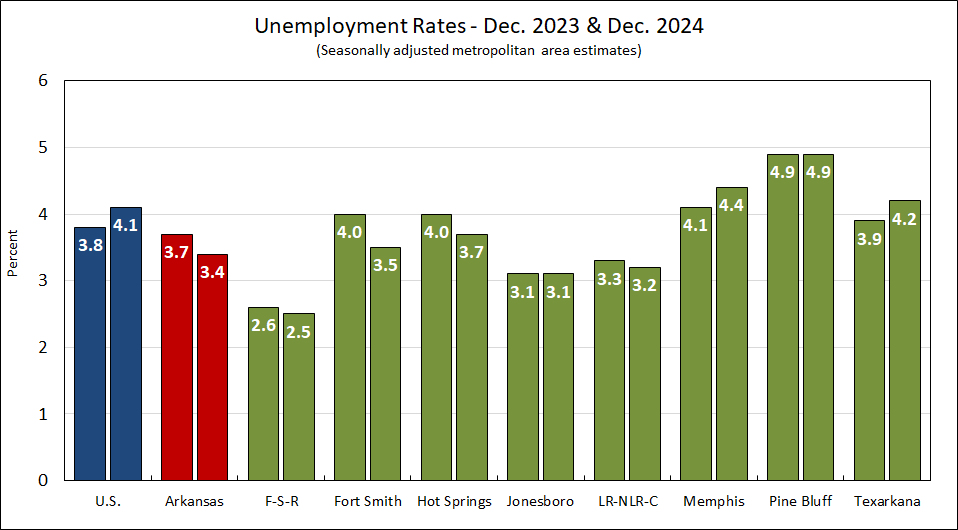
Unemployment rates tended to edge higher from November to December. Mirroring the 0.1 percentage point increase recorded for the state, unemployment rates edged up in Hot Springs, Jonesboro, Little Rock and Pine Bluff. Compared to a year earlier, unemployment rates were unchanged or down slightly, with the exception of Memphis and Texarkana which ended the year with higher rates than in December 2023. Northwest Arkansas had the state’s lowest unemployment rate, which was down to 2.5% by December. Pine Bluff remained the metro area with the highest unemployment rate, unchanged at 4.9%.
Source: Bureau of Labor Statistics
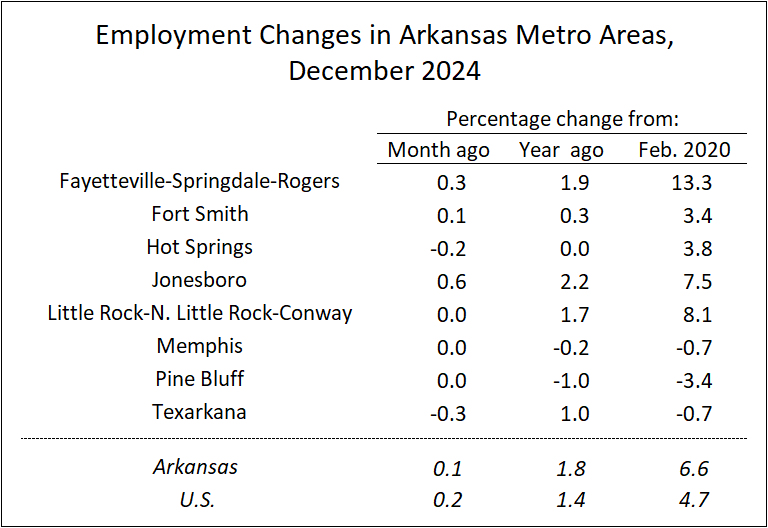
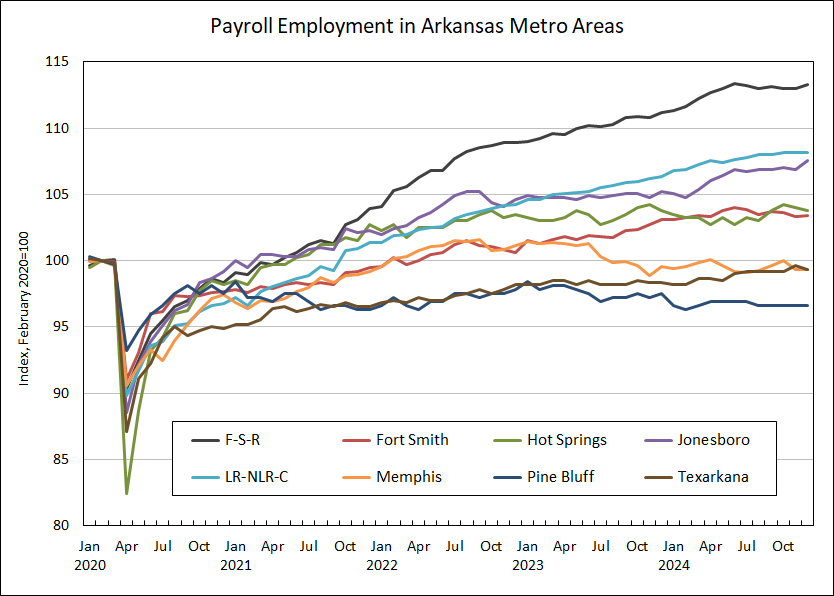
Payroll Employment Nonfarm payroll employment rose sharply for Jonesboro in December, with mixed changes among other metro areas. The end-of-year surge in Jonesboro boosted year-over-year growth to 2.2%—the highest growth rate in the state for 2024. Northwest Arkansas and Central Arkansas both saw strong growth over the year as well. Memphis and Pine Bluff were the only metro areas to experience employment declines for the year.
Over the longer-run, Northwest Arkansas continues to lead the state in employment growth, followed by Central Arkansas and Jonesboro. Fort Smith and Hot Springs have shown positive growth over the last five years, while employment Memphis, Texarkana and Pine Bluff remain lower than pre-pandemic levels.
The next report on metro area employment and unemployment will incorporate annual revisions for nonfarm payroll employment and will partly include annual revisions to the unemployment data as well. We will report on the revisions when they are released in March and April.
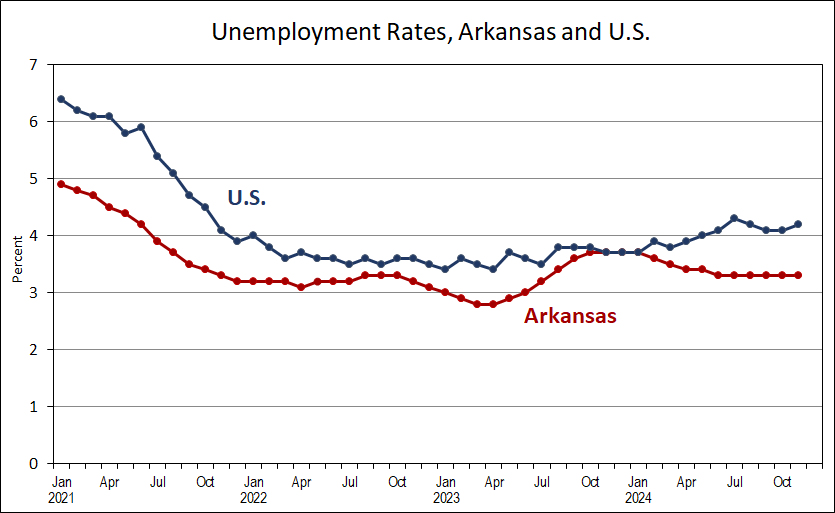
In the final month of 2024 the Arkansas unemployment rate crept slightly higher, from 3.3% to 3.4%, while both household and payroll employment continued to expand. The national unemployment rate edged lower in December to 4.1%, contributing to closing the gap between rates for Arkansas and the U.S. Nevertheless, Arkansas’ unemployment rate remains significantly lower than the national average.
Source: Bureau of Labor Statistics
The number of unemployed increased by 1,057. This was the third monthly increase, with the cumulative increase totaling nearly 2,000 (+1,897). Although the monthly pace of employment gains has slowed somewhat in the past two months, total household employment was up by 1,487 with a three-month increase of 5.663. With increases in both employed and unemployed, the Arkansas labor force expanded by 2,554 in December and by 7,560 over the past three months. Compared to a year earlier, employment was up by 31,598 (2.6%) and the number unemployed down by 3,028.
Source: Bureau of Labor Statistics, Local Area Unemployment Statistics (LAUS)
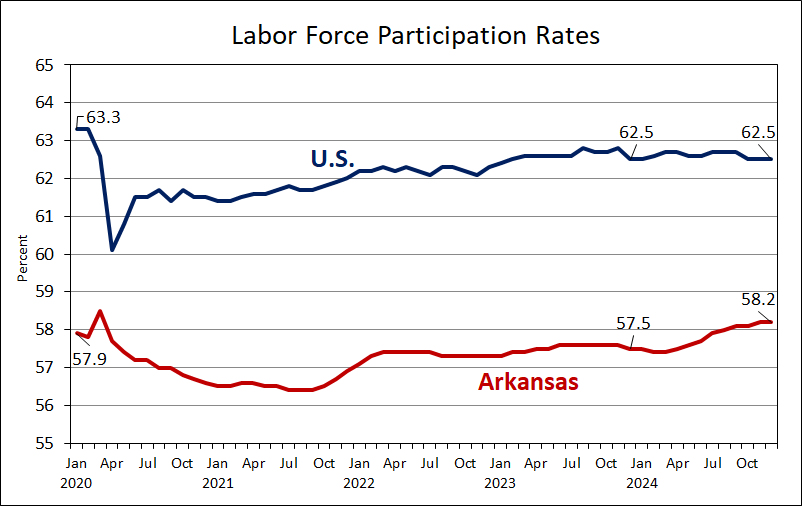
The expanding labor force pushed the labor force participation rate higher over the course of 2024. From December 2023 to December 2024, Arkansas’ participation rate increased from 57.5% to 58.2%—exceeding the pre-pandemic rate. Over the same period, the U.S. participation rate was unchanged at 62.5%.
Source: Bureau of Labor Statistics
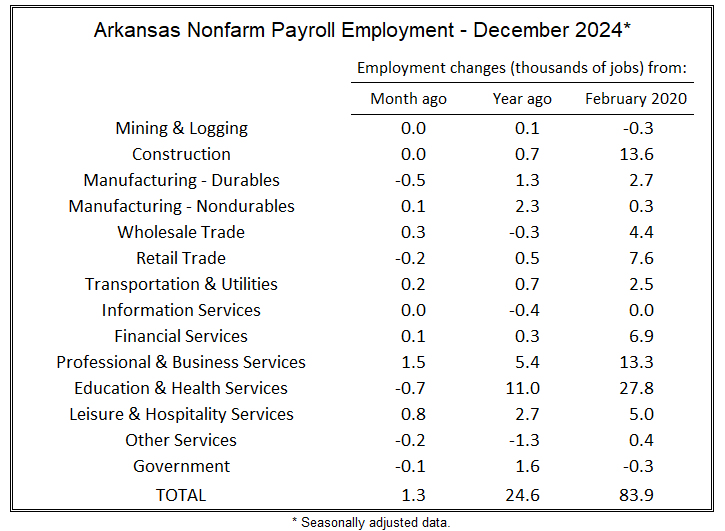
Payroll Employment Nonfarm payroll employment expanded by 1.300 jobs in December and was up 24,600 from the previous year (seasonally adjusted data). The monthly increase was dominated by surge in employment in Professional & Business services. Most of that increase was in the category of Administrative & Support Services. Leisure & Hospitality Services also showed a strong gain, continuing to recover from a sharp decline over the summer months. Education and Health Services showed an unusual monthly decline, with both the private education and health care categories contracting.
Source: Bureau of Labor Statistics, Current Employment Statistics (CES)
Over the past 12 months, payrolls have expanded by 24,600—an increase of 1.8%. The most significant growth sector has been Education & Health Services, with strong gains in Professional & Business Services as well.
With the first-published data for 2024 now complete, the next state-level employment report will incorporate annual revisions. The annual averages for unemployment rate data will be released on March 5, 2025, and the fully revised household and payroll data will be released on March 17, 2025. Stay tuned!
# # #
Seasonally adjusted data for Arkansas nonfarm payroll employment, reported in a format consistent with the monthly news release from the Arkansas Division of Workforce Services, can be found here: Table-Seasonally Adjusted NFPE.
Yesterday, the U.S. Bureau of Economic Analysis released third-quarter data for state-level personal income and GDP. For both series, Arkansas had the distinction of having the highest growth rates in the nation. Arkansas Personal Income increased at an annual rate of 5.4% and real GDP expanded at a 6.9% pace.
Arkansas’ rapid growth rate in the third quarter was attributable to the same factor that was responsible for relatively slow growth in the second quarter: the volatile Farm Income component. Excluding the sector of Agriculture, forestry, fishing and hunting, GDP growth in the third quarter was 4.0%. Excluding that component from second-quarter growth yields a growth rate of 3.4%, compared to total GDP growth of only 1.5%. Over the four quarters from 2023:Q3 – 2024:Q3, Arkansas GDP growth was 4.4%, compared to a growth rate of 2.7% for the United States. Excluding the farm income component, Arkansas’ four-quarter growth rate would be 3.5%.
Source: Bureau of Economic Analysis
A more detailed breakdown of contributions to GDP growth by sector highlights the contribution of agriculture, but also reveals positive contributions from a number of industries. Manufacturing added nearly a full percentage point to growth and retail trade added nearly 1.5 percentage points. The only sectors showing negative growth for the quarter were Construction and Accommodation and food services.
Source: Bureau of Economic Analysis
Personal Income Arkansas personal income expanded at a 5.4% rate, compared to 3.2% for the U.S. As broken down in the table below, the growth rate of earnings (by place of work) was 9.7%, led by a huge increase in Proprietors’ Incomes. Capital income (Dividends, interest, and rent) contracted both nationally and here in Arkansas.
Source: Bureau of Economic Analysis
The contribution of proprietors’ income to income growth was, not surprisingly, dominated by farm income. Nonfarm proprietors’ income increased at an annual rate of 1.3%, while farm proprietors’ income increased more than three-fold in a single quarter.
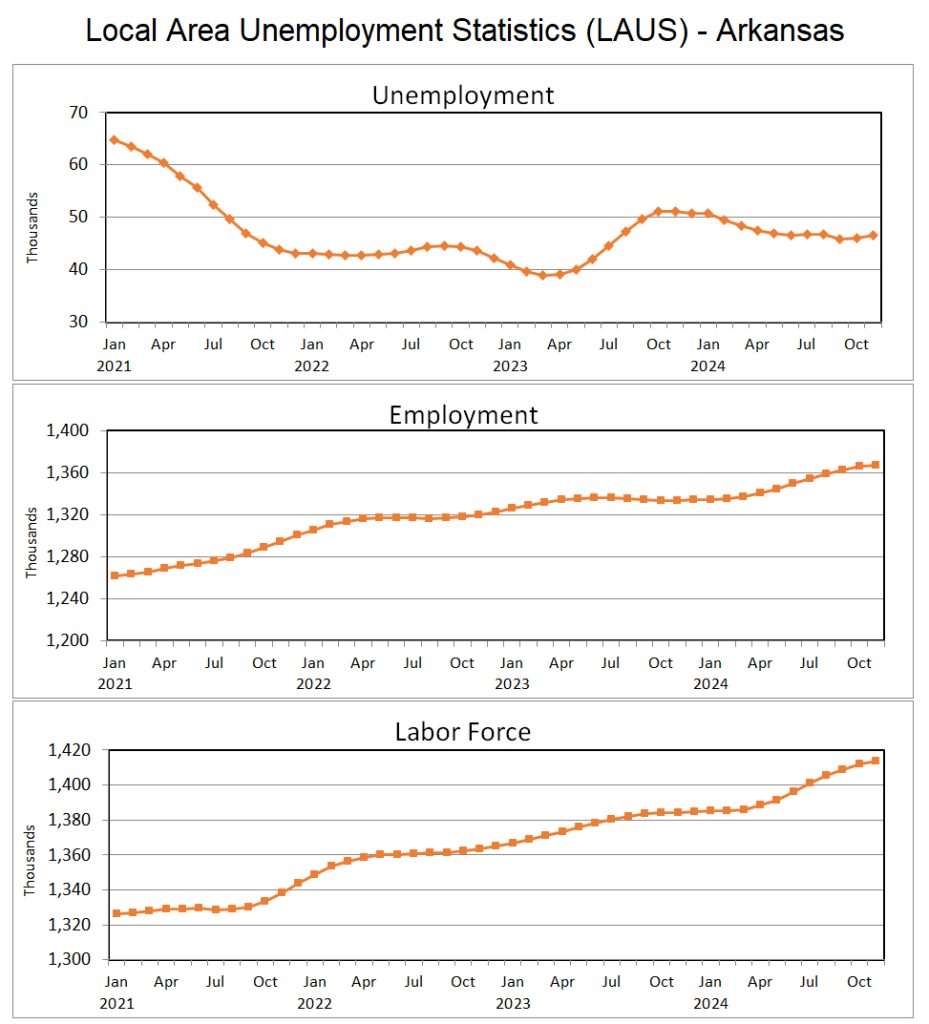
The November employment report showed continued strength in Arkansas labor markets. Although the number unemployed edged higher (+669), the unemployment rate remained steady at 3.3%. The U.S. unemployment rate ticked up from 4.1% to 4.2% for the month.
Source: Bureau of Labor Statistics
The number of unemployed rose for the second consecutive month in November, but the two-month increase amounts to only 817 and the number of unemployed remains lower than it was in July and August. The number of employed increased by 1,073 in November–a slightly slower pace than in recent months, but it continues a series of uninterrupted increases for over a year. The labor force expanded by 1,742.
Source: Bureau of Labor Statistics, Local Area Unemployment Statistics (LAUS)
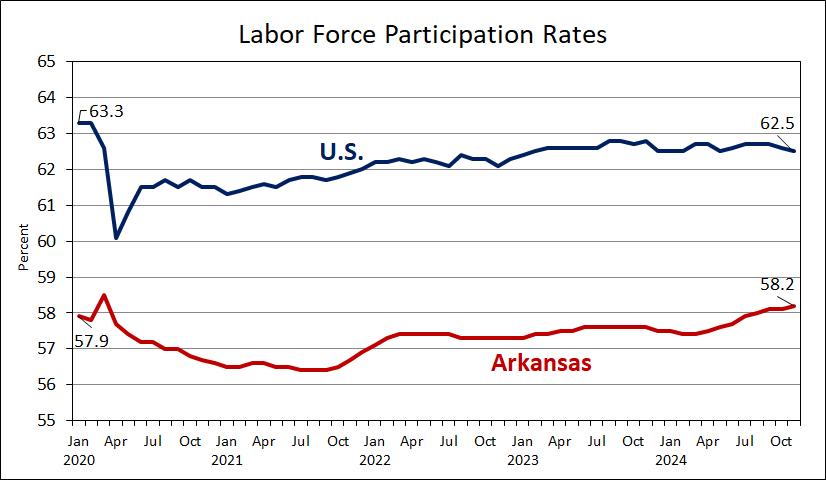
Recent labor force growth has driven an increase in Arkansas’ labor force participation rate, which ticked up to 58.2% in November. Since March, the participation rate has risen by 0.8 percentage points.
Source: Bureau of Labor Statistics
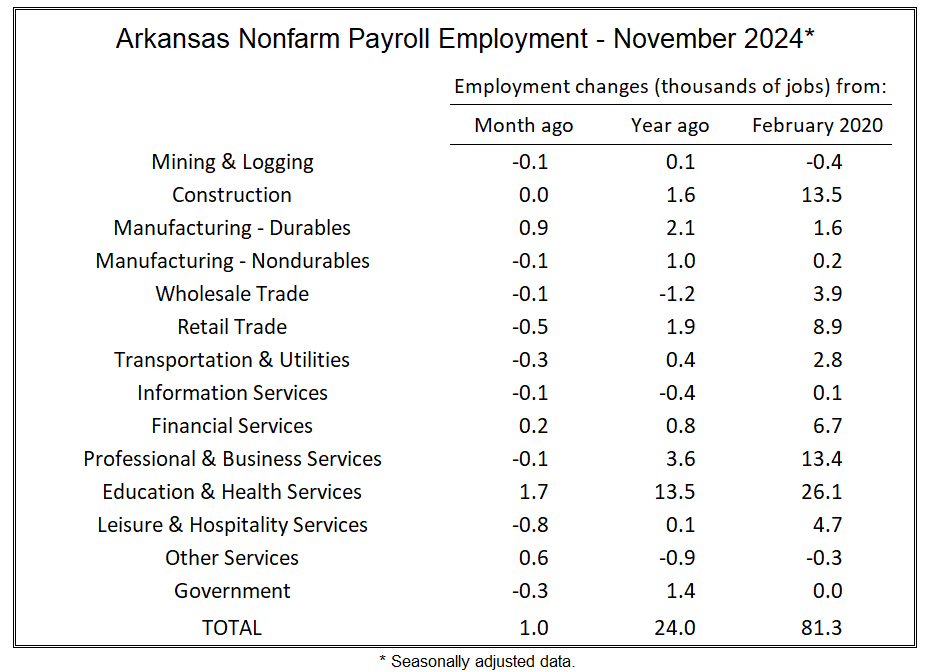
Payroll Employment Nonfarm payroll employment expanded by 1,000 jobs in November (seasonally adjusted). The gains were entirely attributable to growth in Durable Goods Manufacturing and Health Services. Most other sectors, including Leisure & Hospitality and the Trade, Transportation and Utilities sectors saw employment declines for the month.
Source: Bureau of Labor Statistics, Current Employment Statistics (CES)
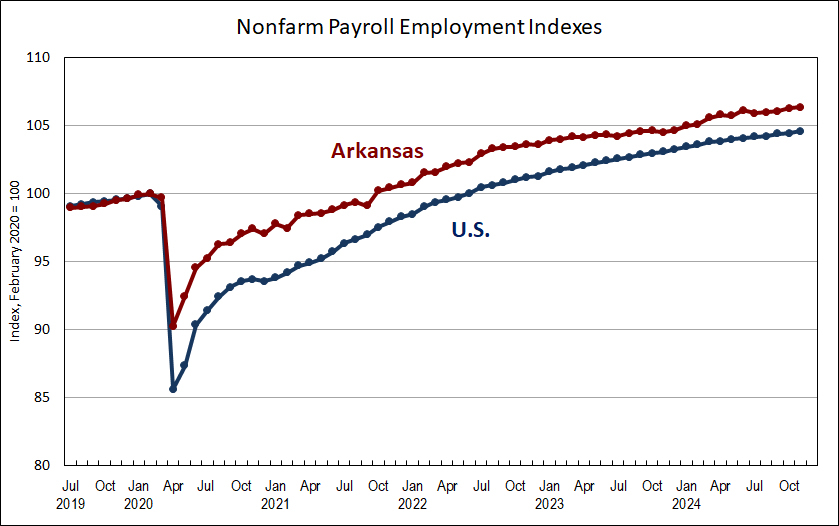
From November 2023, payroll employment has grown by 24,000 jobs—representing growth of 1.8%. Over the same period, U.S. employment growth has been 1.4%.
Source: Bureau of Labor Statistics, Current Employment Statistics (CES)
# # #
Seasonally adjusted data for Arkansas nonfarm payroll employment, reported in a format consistent with the monthly news release from the Arkansas Division of Workforce Services, can be found here: Table-Seasonally Adjusted NFPE.
This week, the U.S. Bureau of Economic Analysis released new figures for real (inflation-adjusted) income and consumer spending by state for 2023. The data show how changes in prices over time and across geographic areas affect relative income and purchasing power.
At the heart of the real income and consumption data is the calculation of Regional Price Parities, which compare the cost of living across states. In 2023, for the second year in a row, the state with the lowest cost of living in the nation was Arkansas, with a RPP of 86.5. This figure implies that the overall cost of living in Arkansas is 13.5% lower than the U.S. average.
Arkansas moved from being a low cost-of-living state to the lowest cost-of-living state in 2022, with a decline in the state’s RPP coefficient that continued into 2023. This means that the relative cost of living in Arkansas was declining relative to the U.S., or more concretely, that consumer prices were rising more slowly in Arkansas than the rest of the nation.
As a matter of fact, we can use the RPP figures to derive distinctive patterns of inflation for the state compared to the nation. As shown in the figure below, Arkansas prices were rising faster than the U.S. average during the consumer-spending boom of 2020 and 2021, but the rate of price increase has been lower than the U.S. since then—particularly during the peak inflation year of 2022. From 2019 through 2023, the cumulative increase in Arkansas prices has been 14.8%, compared to 16.4% nationwide.
Source: Bureau of Economic Analysis
The differences in purchasing power that are identified in the RPP data also have implications for assessing the relative welfare of households. Without price adjustment, per capita income in Arkansas is only 82.6% of the national average and spending per capita is only 78.7% of the national average. After accounting for the relatively low cost of living, however, real incomes in Arkansas amount to 95.5 of the national average, while consumer spending is 91%. The price-adjusted standard of living in Arkansas is clearly higher than the nominal (dollar denominated) figures suggest.