Skip to content

Arkansas Personal Income – 2024:Q1

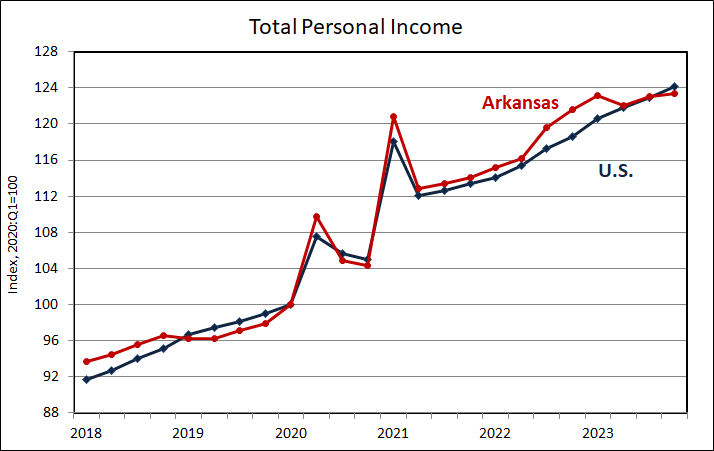
As is their relatively new practice, the U.S. Bureau of Economic Analysis issued a combined combined report on state-level GDP and Personal Income. [Link: Analysis of Arkansas GDP] The report showed that Arkansas Personal Income increased at a rate of 6.1% in the first quarter of 2024–somewhat slower than the 7.0% growth rate for the U.S. Arkansas’ quarterly growth rates have been erratic over the past two years, but this first observation for 2024 suggests a resumption of a trend paralleling the national average.

Source: Bureau of Economic Analysis

The contributions to overall growth from Net earnings and Dividends, interest & rent were nearly identical for the state and the nation. Arkansas growth rate lagged in the Transfer receipts component.

Source: Bureau of Economic Analysis

Nationwide, and for some of the higher-growth states, transfer payments accounted for a particularly large component of growth. The BEA report noted that “The increase in transfer receipts in the first quarter of 2024 reflected a 3.2 percent cost-of-living adjustment for social security recipients, along with increases in refundable tax credits and Medicaid benefits.” These adjustments had significant impacts on some states, but were proportionately smaller for Arkansas.

Source: Bureau of Economic Analysis

A breakdown of the major components of total earnings shows the key change in the turn-around in Arkansas’ growth in the first quarter: Proprietors’ income. After declining by 22.8% over the four quarters of 2023, Proprietors’ income rose by 4.4% in 2024:Q1 (an annualized growth rate of 18.8%). Dividends, interest & rent increased at an annualized rate of 5.3%, while Wages and salaries increased at a 4.7% pace.

Source: Bureau of Economic Analysis

As reported for the fourth quarter, Farm Proprietors’ Income has been the driving factor in the unusual swings in Arkansas’ growth patterns for Total Proprietors’ Income (and Total Personal Income) over the course of 2022 and 2023. In 2024:Q1, both farm and non-farm components increased.

Source: Bureau of Economic Analysis

A breaking down the components of earnings by industry highlights the importance of the Farm sector. Other important contributors to personal income growth were Construction, Health Care, and Administrative services.

Source: Bureau of Economic Analysis

The erratic nature of Farm income clearly complicates the analysis of underlying trends in personal income growth. The volatility in the time-series is likely related to changes in inventory valuations that accompany variability in commodity prices. In measuring farm income, the BEA factors in changes in agricultural commodity prices to revalue inventories, even though those changes may not actually impact farmers’ cash flows. To the extent that is true, the quarter-to-quarter fluctuations likely overstate the true volatility of farm income.

One final note: The personal income data are not adjusted for inflation. If we adjust the first quarter growth rates for a 3.4% rate of inflation (using the PCE price index) the rate of real personal income growth was 2.6% for Arkansas and 3.5% for U.S.
Arkansas Personal Income – 2023:Q4

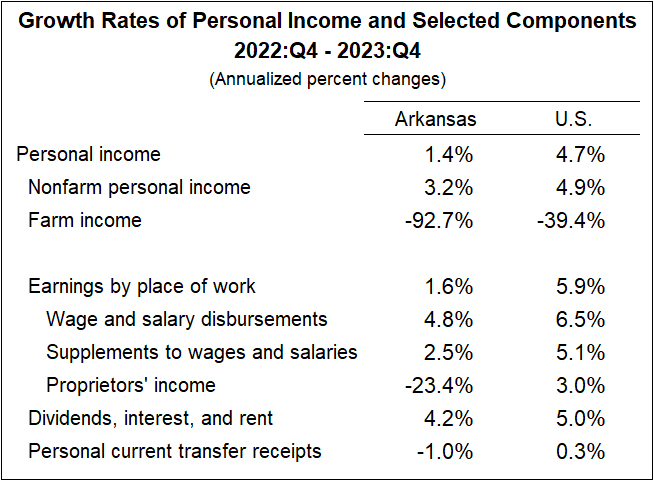
The latest figures on state-level personal income show that Arkansas incomes expanded at an annual rate of 1.0% in the fourth quarter, compared to a 4.0% growth rate nationwide. Arkansas’ growth rate ranked 48th among the 50 states, with only North Dakota and Iowa showing slower growth. On a more positive note, data for the third quarter were revised upward to show a growth rate of 0.8%—previously reported to have been 0.0%. Over the past four quarter, Arkansas personal incomes have increased by only 1.4%, compared to 4.7% for the U.S.

Source: Bureau of Economic Analysis

The table below shows the year-over-year growth rates of some key components of personal income. Significant factors lowering Arkansas overall growth are Farm income and Proprietors income, as well as Transfer receipts.

Source: Bureau of Economic Analysis

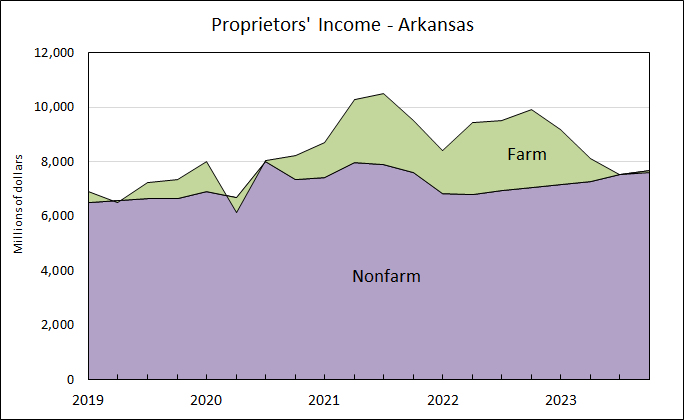
The declines in Farm income and Proprietors’ income are reflections of the same phenomenon, since most farm income is received by proprietors. As shown below, large swings in farm income boosted total proprietors’ income in 2021 and 2022, but that collapsed in effect collapsed in 2023. Meanwhile, nonfarm proprietors incomes have continued to expand in 2023.

The swings in farm income are likely an artifact of the way that agricultural inventories are valued in the personal income and GDP accounts. The post-pandemic rise in commodity prices caused a positive revaluation of inventories, while more recent declines in commodity values have reversed that effect. This is likely an inaccurate measure of true agricultural income: extreme fluctuations in inventory valuations represent paper profits and losses, not necessarily income flows.

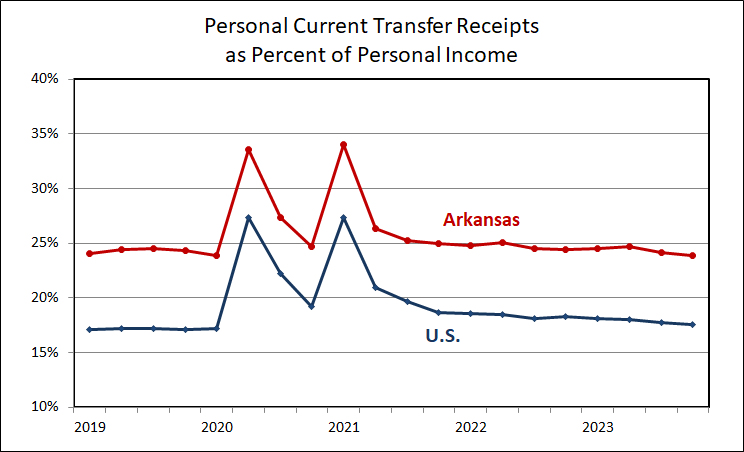
The other factor suppressing personal income growth in 2023 was the decline in transfer receipts, which is associated with the winding-down of pandemic-related spending programs. As shown below, transfers declined during 2023 to pre-pandemic levels in Arkansas.

Source: Bureau of Economic Analysis

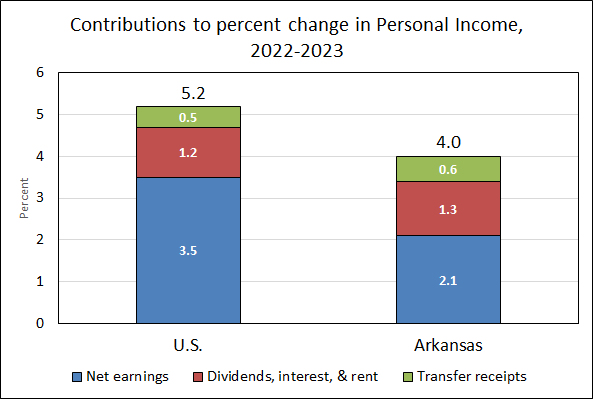
Annual data for total for total personal income shows growth of 4.0 percent for Arkansas, compared to 5.2 percent nationwide. Contributions of Dividends, interest & rent and Transfer receipts are comparable, but Arkansas is lagging in net earnings growth.

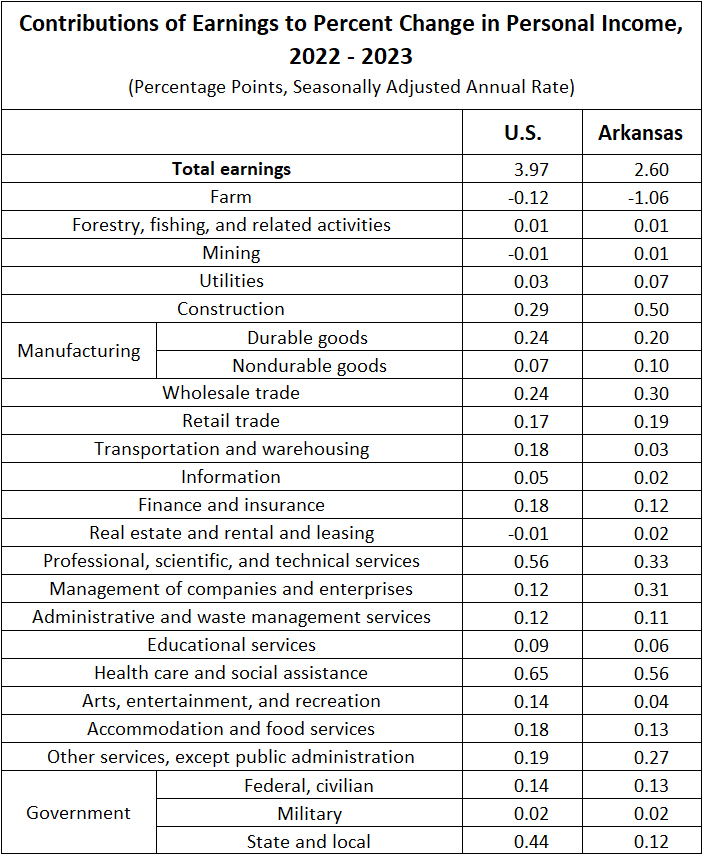
Breaking down the growth in net earnings by sector we see that the major factor restraining Arkansas’ growth is farm earnings. Positive contributors include Construction, Wholesale trade, and Health care.

Arkansas Personal Income – 2023:Q2

The most recent personal income report showed a sharp slowing of Arkansas income growth in the second quarter. However, thorough revisions to the data had the effect of raising estimates of the state’s growth in the recent past, particularly in 2020 and 2021.

For the second quarter, Arkansas Personal Income growth rate was only 0.4% at a seasonally-adjusted annual rate, compared to a 4.3% growth rate for the U.S.  Arkansas growth rate was the slowest positive growth rate in the nation, with Maine showing a decline of 2.7%.

Arkansas slow growth in the second quarter was primarily attributable to Farm Income, which dropped by 7.4% for the quarter, a decline of 97.8% at an annualized rate. This followed a (revised) sharp decline in the first quarter as well. The impact on total proprietors’ income is illustrated in the figure below.

Source: Bureau of Economic Analysis

Note that the decline in Farm income had the effect of lowering total proprietors’ income, even though Non-farm proprietors’ income increased at a 4.3% annual rate. This followed a (revised) sharp decline in farm income in the first quarter as well.

As shown in the table below, Proprietors’ income was the sole factor for slow earnings growth.  Wages & Salaries, and Dividends, Interest & Rent were positive contributing factors to personal income growth.

Source: Bureau of Economic Analysis

A breakdown of industry contributions to earnings and personal income growth again highlights the prominence of farm income in this quarter’s report. Nearly all other sectors showed positive growth or only small declines. Were it not for the -3.3 percentage point contribution of Farm earnings, personal income would have increased at the same rate as the U.S. total.

Source: Bureau of Economic Analysis

Data Revisions
Comprehensive revisions to the Personal Income data had significant implications for income growth over the past several years. The revised statistics show slower growth in 2019, but higher growth rates during 2021 and 2022.

Source: Bureau of Economic Analysis

The slower growth in 2019 is reflected in downward revisions to Dividends, Interest and Rent, as well as Proprietors Income. As shown in the two figures below, however,  Revisions of more recent data for these two categories diverge, however. The new data show more rapid post-2020 growth for Dividends, Interest, & Rent, while Proprietors Income was revised sharply lower (both Farm and Nonfarm were revised lower).

Source: Bureau of Economic Analysis

The upward revisions to personal income growth during the pandemic were primarily attributable to higher estimates of Current Personal Transfer Receipts:

Source: Bureau of Economic Analysis

The revisions had little impact on the main source of earnings: Wages and Salaries.

Overall, the revisions leave Arkansas in a position with larger cumulative income gains since 2019 than the rest of the nation. The most recent quarter added little to total growth, but compared to 2019:Q4 Arkansas income has increased by 25.8%. Over the same period, U.S. cumulative income growth has been 23.1%.

Source: Bureau of Economic Analysis


Arkansas Personal Income and GDP

New reports on personal income and GDP for the first quarter show signs of relative weakening of the Arkansas economy.

Personal income increased at a 3.2% annual rate in the first quarter, well below the national growth rate of 5.1%. (Personal income figures are not adjusted for inflation.) Arkansas growth rate ranked among the lowest in the nation, ranking 45th among the 50 states.  The report from the Bureau of Economic Analysis showed reported that “Nationally, Nationally, earnings, property income (dividends, interest, and rent), and transfer receipts all contributed to the increase in personal income.”  However, the growth rate of net earnings was only 0.1% in Arkansas, the lowest growth rate in the nation.

Source: Bureau of Economic Analysis

Among the components of earnings, wages and salaries increased at a 4.6% rate, outpacing the nationwide growth rate of 2.4%. However, proprietors’ income declined at an annualized rate of 21.8%.

Source: Bureau of Economic Analysis

The decline in proprietors’ income was, in turn, entirely attributable to farm proprietors’ income. In fact, total farm income declined at a rate of 54.1%. Rising farm income had been a contributing factor to higher growth rates in 2022, so although the decline in the first quarter is disappointing, farm income remains a positive contribution to total earnings.

Source: Bureau of Economic Analysis

Quarterly growth rates of personal income can vary significantly without necessarily indicating a change in trend. If we consider the longer-term performance of income growth in Arkansas, the first-quarter results are disappointing but they do not suggest an imminent downturn. In fact, the growth rate of total personal income over the past four quarters has been 6.2% in Arkansas and 5.1% for the U.S.

Source: Bureau of Economic Analysis

State GDP
Figures for Arkansas GDP showed similar relative weakness. Real GDP growth in the first quarter came in at an annualized growth rate of only 0.2%, compared to a nationwide growth rate of 2.0% (inflation-adjusted).  Arkansas’ growth rate was among the lowest in the nation, with only Rhode Island showing slower growth (0.1%).

Source: Bureau of Economic Analysis

As we saw in the case of personal income, much of the first quarter slowdown in GDP was attributable to farm sector. In contrast to a positive contribution to the national growth rate, the contribution of Agriculture, forestry, fishing, and hunting was to subtract 0.6% from GDP growth in Arkansas. Other factors subtracting from growth included Manufacturing, Finance and insurance, and Real estate.  In contrast, significant positive contributions were recorded for Construction, Wholesale and Retail trade, as well as Accommodation and food services.

Source: Bureau of Economic Analysis

As is the case for personal income, the first quarter performance of Arkansas GDP is disappointing, but does not necessarily indicate a significant change in trend. Over the longer term, Arkansas growth has been relatively strong. Since the fourth quarter of 2019, cumulative growth has totaled 7.8% in Arkansas, compared to 5.6% for the U.S.

Source: Bureau of Economic Analysis

The next release of GDP and Personal Income data will be in September, which will include annual revisions to the data.

Arkansas Personal Income – 2022:Q4

In the final quarter of 2022, personal income increased at an annualized rate of 7.3%—keeping pace with the national growth rate of 7.4%. Compared to a year earlier, incomes were up 7.7% in Arkansas and 5.7% for the U.S.

Source: Bureau of Economic Analysis

A breakdown by major components shows that Net Earnings provided a larger share of income growth in Arkansas than in the rest of the nation, with Transfer Receipts accounting for a smaller share of growth.

Source: Bureau of Economic Analysis

Netting out Transfer receipts, the major components of earnings all showed increases in the fourth quarter:  The largest component, Wages and Salaries, increased at a rate of 6.9% in the fourth quarter and was up 9.0% from a year earlier. Dividends, Interest, & Rent increased at a 6.6% rate for the quarter and was up 4.6% from the fourth quarter of 2021. Proprietors’ Income surged at a 19.9% rate for the quarter and was up 35.0% over the year.

Source: Bureau of Economic Analysis

As shown in the figure below, most of the recent growth in proprietors income has been from the Farm component. In fact, total Farm Income accounted for over one-quarter of Arkansas personal income growth over the four quarters of 2022.

Source: Bureau of Economic Analysis

The importance of farm income is also highlighted in the breakdown of total earnings by industry for the fourth quarter. Growth in farm income contributed contributed 1.43 percentage points to the total earnings growth of 5.2% in Arkansas. In the U.S. data, Farm income comprised a much smaller share of growth. In other respects, the patterns of earnings contributions by industry were similar for Arkansas and the U.S.

Source: Bureau of Economic Analysis

Note: The Bureau of Economic Analysis released data on both Personal Income and Gross Domestic Product by State on Friday, March 31: Gross Domestic Product by State and Personal Income by State, 4th Quarter 2022 and Year 2022.  The GDP data are discussed in a separate post.


Arkansas Personal Income – 2022:Q2

Last week’s release of new GDP data coincided with a new report on state-level personal income. The Bureau of Economic Analysis indicated that the two reports would be released simultaneously from now on.  There is some logic in that plan: GDP and personal income statistics share many of the same original data sources and so the information is overlapping. One distinction between the two reports is that the highlighted GDP statistic is “real,” or inflation-adjusted, whereas the personal income statistics are in nominal terms.  Regarding the GDP report, we noted that the implicit price index has been increasing faster in Arkansas than nationwide, boosting nominal measures of economic activity.  This shows up in the personal income statistics as strong nominal growth.

The second quarter growth rate of personal income in Arkansas was 6.9% (annualized), compared to 5.8% for the U.S. The second quarter figure for Arkansas was revised significantly higher, with a growth rate that is now reported to have been 9.4%, up from the originally-reported rate of 5.5%.  For the first two quarters of the year, the growth rate of Arkansas personal income was 8.1% (annualized), well-above the 4.4% national average.  Among the 50 states, Arkansas’ growth rate ranked 5th highest in the nation.

Source: Bureau of Economic Analysis

Among the major components of personal income growth, Proprietors’ income increased dramatically, rising at a 53% rate. This increase contributed 3.3 percentage points to the state’s total personal income growth of 6.9%.  The increase in proprietors income was entirely in farming. Nonfarm proprietors’ income declined slightly in the second quarter, while farm income rose at a 288% rate.  Nationwide, the growth of personal current transfer receipts has slowed considerably with the winding down of covid-related transfer payments.  In Arkansas, transfers continued to contribute to income growth.

Source: Bureau of Economic Analysis

Data Revisions
As was the case for GDP, the second-quarter data included revisions dating back to 2017.  The cumulative effects of the revisions were relatively small, with the exception of proprietors’ income (revised upward) and Dividends, interest and rent (revised downward.)  The revision to proprietors’ income affected only post-covid data. The revision to Dividends, interest and rent was large and persistent, with the revised data showing a smaller contribution from this component from 2017 onward.

Source: Bureau of Economic Analysis

Source: Bureau of Economic Analysis

Source: Bureau of Economic Analysis

Earnings by Industry
A breakdown of earnings by industry shows many of the same patterns that we saw for GDP.  Total earnings contributed approximately 4.0 percentage points to total personal income growth, with 3.4 percentage points coming from the Farm sector.  Industries with negative contributions to growth included retail trade and real estate.  As was the case with GDP, a large negative contribution came from Management of companies and enterprises (following an unusual upward spike in the first quarter).

Source: Bureau of Economic Analysis


Arkansas Personal Income – 2021:Q3

The latest report on state-level personal income, released yesterday by the Bureau of Economic Analysis, shows that personal incomes in Arkansas increased at a 2.9% annual rate in the third quarter, following a revised second quarter decline of 26.9%.  [The second quarter decline was originally reported as 29.8%.]

Source: Bureau of Economic Analysis

Arkansas growth rate was slightly higher than the national growth rate of 2.6%, and ranked 17th among the 50 states.  Second quarter growth rates ranged from -4.3% in North Dakota to 6.7% in Kentucky.

The report from the BEA noted that, in general “increases in earnings and property income (dividends, interest, and rent) more than offset a decrease in transfer receipts.”  The report also notes that states with the highest growth rates had the highest growth rates in earnings, while those with the slowest growth rates were slowed most by the nationwide decline in transfer payments.

For Arkansas, annualized earnings growth was 8.8%, accounting for 5.2 percentage points of total personal income growth.  The most significant component of earnings growth came from Wages and Salaries, which grew at a 10.8% annual rate.  Transfer Receipts declined, but that component had a smaller negative impact on personal income growth than it did in nationwide.

Source: Bureau of Economic Analysis

Cumulatively, the annualized growth of total Personal Income less Transfer Receipts over the past two years has been at 4.4% for Arkansas and 4.3% for the U.S.

Source: Bureau of Economic Analysis

A breakdown the components of earnings by sector shows that gains were widespread.  The only sectors showing declines were Construction and Military.  Farm income contributed positively to income growth in Arkansas, despite a nationwide decline.

Source: Bureau of Economic Analysis


Arkansas Personal Income – 2021:Q2

New data from the U.S. Bureau of Economic Analysis reports that Arkansas Personal Income declined by 8.5% in the second quarter (an annualized rate of -29.8%). Nationwide, the second-quarter decrease in income was 6.0% (-21.8% annual rate). Income declines in the second quarter were the result of a sharp drop in Transfer Payments, as pandemic-related assistance programs wound down. Consequently, the states experiencing the largest declines in the second quarter income were the same as those that saw the largest increases in the first quarter. For example, Arkansas’ second-quarter decline was the 6th largest decline among the 50 states, while the 14.9% increase in the first quarter (74.5% annualized rate) was the nation’s 5th highest.  More generally, the correlation of first quarter with second-quarter growth rates across the states was -0.88.

Source: Bureau of Economic Analysis

Removing the effect of government transfer payments, personal incomes continued their robust recovery from the pandemic-related downturn a year ago.  Arkansas Personal Income less Transfer Receipts rose at a 9.6% annual rate in the second quarter, compared with a 9.2% rate in the U.S. data.  Since the trough of 2020:Q2, this measure of income has increased 10.6% in Arkansas an 10.4% in the nationwide data.

Source: Bureau of Economic Analysis

All major components of personal income except transfer receipts increased in the second quarter.  Proprietors Income surged by 16.1% and was 53.5% higher than its dismal reading of one year earlier.  Wages and Salaries rose 1.3%, for a cumulative 4-quarter change of 12.0%.  Dividends, Interest, and Rent was up 1.2% for the quarter, which represented a 1.4% increase from a year earlier.

Source: Bureau of Economic Analysis

With most government support and stimulus programs winding down, personal income is expected to return to a more normal growth pattern over the remainder of the year.

Arkansas Personal Income – 2020:Q3

New data from the Bureau of Economic Analysis released today shows that Arkansas personal income declined by 5.5% in the third quarter — corresponding to a -20.3% annual rate.  Nationwide, personal income was down 2.6% (a 10.0% annual rate).  The BEA reported that income was lower in all 50 states, with annualized percent declines ranging from -0.6% in Georgia to -29.9% in West Virginia.

The third quarter declines were driven primarily by decreases in personal current transfer receipts as the impact of CARES Act relief payments declined from their second-quarter surge.  Revised data showed that transfer receipts in Arkansas rose 57.0% in the second quarter and declined by 24.6% in the third.  The national averages showed a second-quarter increase of 75.4% and a third-quarter decline of 23.0%.

After the second-quarter increases and third quarter declines, Arkansas personal income was up 4.1% relative to Q1, with the corresponding U.S. total up 5.1%.

Source: Bureau of Economic Analysis

Net of transfer payments, Arkansas personal income categories generally showed encouraging increases in the third quarter. All major components of earnings increased in Q3, with Proprietors’ Income rebounding sharply from its decline in the second quarter.  Dividends, Interest, and Rent was down slightly.

Source: Bureau of Economic Analysis

Source: Bureau of Economic Analysis

In addition to the increases in third-quarter earnings, today’s report contained some relatively large revisions to data from the second quarter.  Most encouraging, wage and salary disbursements were revised 4.0% higher than originally reported.  The surge in transfer receipts in the second quarter was also revised higher for Arkansas.

Source: Bureau of Economic Analysis

Net of transfers, the third quarter data show significant recovery from the sharp declines in the second-quarter. Compared to the first quarter of the year, Arkansas Personal Income Less Transfer Payments was down by only 0.3% in Q3.  Nationwide, Income less transfers was down 1.0%.

Source: Bureau of Economic Analysis

Arkansas Personal Income – 2020:Q2

Today’s report from the Bureau of Economic Analysis showed that total personal income increased by 7.0% in Arkansas in the second quarter of 2020 – an annualized growth rate of 31.3%. Arkansas’ growth rate was slightly slower than the 34.2% pace recorded for the United States and ranked #31 among the 50 states.  Growth rates ranged from a low of 15.8% in Tennessee to 76.3% in Massachusetts.

Source: Bureau of Economic Analysis

The increases in personal income were driven entirely by Personal Current Transfer Receipts, with non-transfer income declining in all 50 states.  In Arkansas, non-transfer income declined by 6.5% (an annualized rate of 23.4%), while transfer receipts increased by 51% (a 419% annual rate).  Arkansas declines in wages and salaries (and supplements) were smaller than the U.S. average, while Proprietors’ Income and Dividends, Interest & Rent contracted more sharply than in the national statistics.

Source: Bureau of Economic Analysis

The increase in total personal income was somewhat less than projected in recent forecasts, due to a larger decline in non-transfer income and a smaller increase in transfer payments than had been expected.

Looking at a breakdown of earnings declines by industry, we see that Arkansas endured smaller declines than the U.S. in several industries that were directly affected by COVID-19 shutdowns, including Retail Trade, Health Care, Accommodation and Food Service, as well as Art, Entertainment & Recreation.  The most significant sector of weakness for Arkansas was Farm Income, which fell to below zero for the quarter.

Source: Bureau of Economic Analysis

Revisions to Earlier Data
The statistics released this morning also included revised statistics for 2013:Q1 through 2020:Q1.  The revisions were generally small, shifting Arkansas income levels slightly higher for 2015 through 2017, and slightly lower during 2019.

Source: Bureau of Economic Analysis

The effect of revisions on income growth rates was generally positive for 2015 and 2016, but resulted in slower reported growth for more recent periods.  Through the first quarter of 2020, four-quarter growth was previously reported to be 3.4%.  After revisions it is estimated to have been 3.2%.

Source: Bureau of Economic Analysis